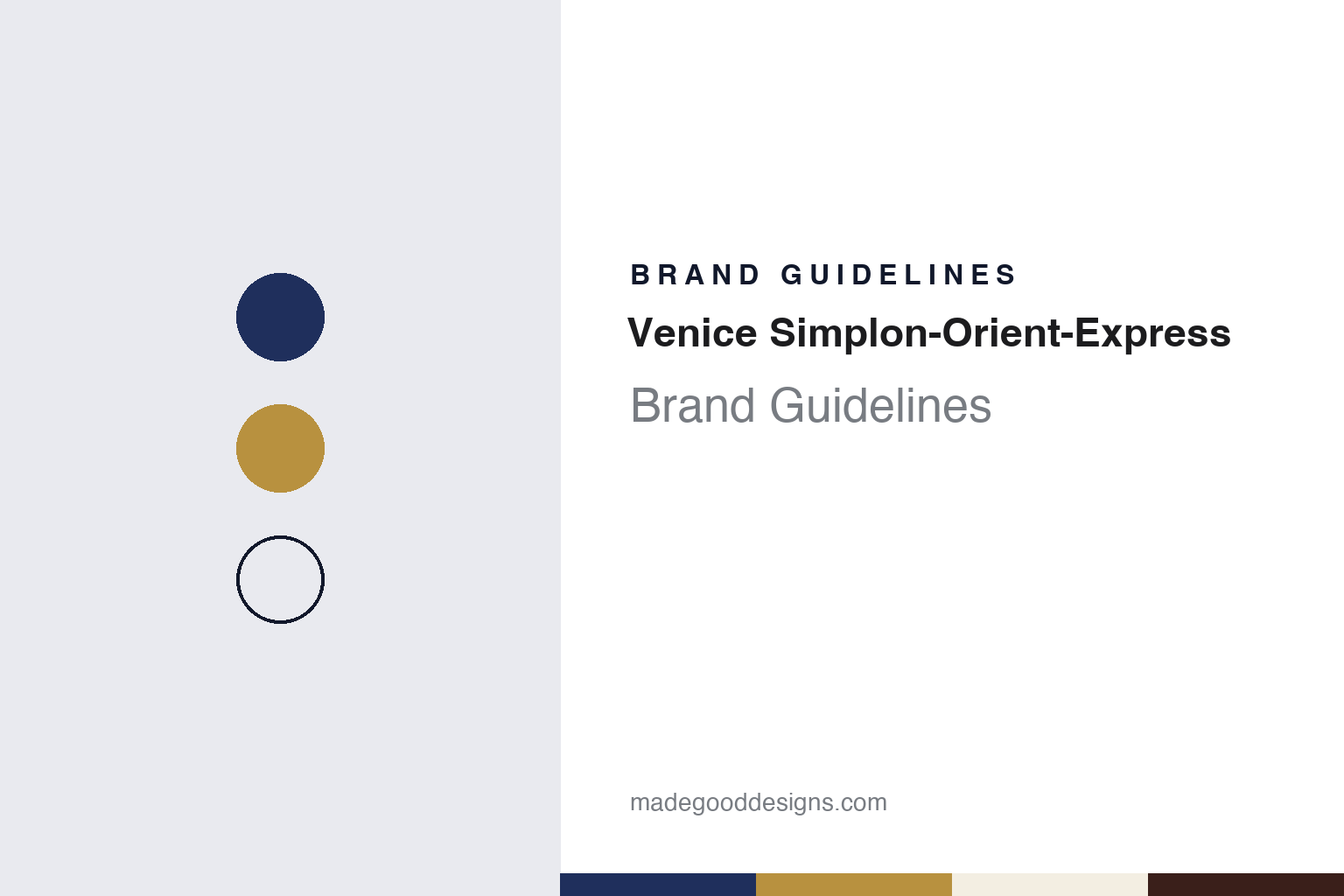
Venice Simplon-Orient-Express Brand Guidelines
The 1982 revival of 1920s carriages, in blue and gold.
Aa
Two constants: a blue, gold and ivory palette and an art deco serif register. Abstract homage — not a Venice Simplon-Orient-Express or Belmond asset; no crest, carriage, logo or livery is reproduced.
The revival
Two carriages bought at auction, and a train rebuilt around them.
The name reaches back to the nineteenth century. National Geographic Traveller (UK) explained in its March 2018 issue that the Orient Express was created in 1883 by the Compagnie Internationale des Wagons-Lits, originally running between Paris and Istanbul via Vienna and Budapest. Between the wars the Simplon Orient Express took a more southerly line from Calais and Paris through the Simplon Tunnel under the Swiss Alps and on to Venice. It ran until 1962, when the slower Direct Orient Express replaced it, and that service was withdrawn in 1977. Those historic Wagons-Lits trains are a separate subject from the train in this guide.
The modern train was the project of the American entrepreneur James Sherwood. The same magazine reports that he had bought the Hotel Cipriani in Venice in 1976, and that five months after the Direct Orient Express was withdrawn he bought two original first-class carriages at a Sotheby’s auction in Monaco. He went on to acquire a further 23 and had the 1920s and 1930s cars restored. Because the train could not cross the Channel on a ferry, a second restoration produced the British Pullman, a set of Pullman cars from the 1920s to the 1950s for the run from London to Folkestone.
On 25 May 1982, the magazine says, the Venice Simplon-Orient-Express began service, with London as its new starting point. Within a year the Arlberg Tunnel had replaced the Simplon on the route, but the Simplon name stayed. The Fashion Law, writing in January 2025, describes the launch the same way: restored carriages carrying guests from Paris and London to Venice.
Colour
Marquetry, Lalique glass and white-jacket service.
The look of the train comes from its restored rolling stock. Belmond says the carriages in service today were built between 1926 and 1949, and its notes on individual cars give builders and dates: several were built in Birmingham between 1926 and 1929, one sleeping car in Belgium in 1926, and another at Aytré, near La Rochelle, in 1929. One Pullman of 1929 was decorated by René Lalique, whose glass panels remain in Dining Car 4141, the company says.
For the revival, Sherwood hired the French designer Gérard Gallet to oversee the decoration of both trains. In a passage from Sherwood’s book quoted by National Geographic Traveller, Gallet copied the original Wagons-Lits cutlery, adapted an 1820s china design with the train’s own logo and had the towels and linen made as replicas of the originals. Belmond says craftspeople on the restoration included a marquetry specialist whose grandfather had worked on the original cars, and glassmakers from the Lalique house.
The magazine’s 2018 account sets out the visual system plainly. The continental train wears a blue-and-gold livery; the British Pullman’s carriages are cream and umber, each with a name, a style and a history. On the continent its writer counted 11 sleeping cars, three restaurant cars, two service cars and a bar car, number 3674, decked out in blue and gold with a resident pianist. The restaurant cars include the Côte d’Azur and L’Oriental, each with its own decor, and the writer noted original designs and logos, restored brasswork and repeatedly varnished wood panels on almost every surface.
Belmond says that each year, while the train is not running, the carriages go to French or Italian workshops to be examined and restored, from the Chinese lacquerwork to the mechanical parts.
Typography
How these trains present themselves.
Luxury, sleeper and scenic trains sell a journey rather than a seat, and their identities are built to match. A train’s name is often its strongest asset: some revive the names of older services, others are named after a route, a region or a landscape. Operators publish these names with crests, monograms and lettering that echo railway signwriting, and many give a train its own livery, so that the colour of the carriages becomes part of the brand. The Venice Simplon-Orient-Express, for example, runs in a blue-and-gold livery, National Geographic Traveller reported in 2018.
Inside, the identity moves into materials. Carriage interiors carry marquetry, glass, upholstery and fittings, and on trains that use restored rolling stock the pages on history and individual carriages, with their build years and builders, become a large part of what the operator publishes. Newer interiors are often credited to named designers, studios and craft workshops.
The printed and digital pieces around a journey do much of the remaining work. Menus, cabin cards, tickets, luggage labels and welcome letters repeat the same names and lettering; route maps and timetables show where a train runs, how many nights a journey takes and which stations it stops at; and dress codes, music and dining arrangements are described as part of the experience.
Behind the names sit owners and operators that change over time: state railways, regional railway companies, private operators and international hotel groups. This guide states those owners and operators plainly, with dates, and attributes descriptions of carriages, suites and routes to the operator or to a named, dated source. It does not cover fares, and it makes no record claims.
Aa
An art deco serif for crests, menus and labels. (Specimen set in Cormorant Garamond, a serif STAND-IN; NOT the Venice Simplon-Orient-Express logo or lettering.)
Belmond and LVMH
A hotel company renamed, then a luxury group as owner.
The train sits inside a larger hotel and travel company. National Geographic Traveller notes that the Orient Express name was licensed from the French railway SNCF and that Sherwood’s company extended it with Orient-Express Hotels, renamed Belmond in 2014; the licence for the Venice Simplon-Orient-Express stayed with Belmond. The magazine adds that SNCF later agreed a deal with the French hotel group Accor to develop hotels under the Orient Express name, a brand that has no link to the Belmond train. The Fashion Law gives the same 2014 renaming.
In December 2018 the French luxury group LVMH agreed to buy Belmond, and the purchase was completed in April 2019, The Fashion Law reports. LVMH’s own release of 17 April 2019 says Belmond’s shareholders had approved the deal on 14 February that year and that Belmond’s shares would no longer be listed in New York. The train’s pages now carry the name “Venice Simplon-Orient-Express, A Belmond Train,” and its copyright line names Belmond Management Limited.
The train has added new accommodation inside its old carriages. National Geographic Traveller reported in 2018 that three Grand Suites with double beds, a private shower room and a living area were joining the train that March; Belmond now lists six Grand Suites named after cities on its routes, including Paris, Venice and Istanbul, and four further suites themed on lakes, mountains, forests and countryside, restored in France. During the 2024 Venice Biennale the train showed L’Observatoire, a sleeper carriage by the French artist JR, The Fashion Law reports; LVMH says its marquetry was reworked with Atelier Philippe Allemand, which has worked with the train since 1997.
The journeys listed on Belmond’s site in November 2026 start mostly in Paris, with routes to Venice, Vienna via Budapest and Monaco, a Brussels to Venice departure and an Istanbul to Paris journey listed for 2027.
For a design guide, the Venice Simplon-Orient-Express shows how a brand can be built from restored objects: livery, marquetry, glass, china and menus all carry the identity before any logo does. Compare Royal Scotsman, a Belmond train in Scotland, and Eastern & Oriental Express, its Southeast Asian counterpart. For this guide we use a carriage blue, gilt and ivory with a serif, an unofficial interpretation; no product or logo is reproduced.
Explore & save
Keep Venice Simplon-Orient-Express’s identity on hand — save it to a board in the Made Good inspiration library.
Venice Simplon-Orient-Express identity set
Pin the blue, gold and ivory palette and the art deco serif register to your own board.
Source & notes
Frequently Asked Questions
What font can I use to match the Venice Simplon-Orient-Express look?
This guide describes Venice Simplon-Orient-Express’s type as “An art deco serif for crests, menus and labels”. Its type specimen is set in Cormorant Garamond from Google Fonts as a stand-in; Cormorant Garamond is not Venice Simplon-Orient-Express’s own lettering.
What colours are in the Venice Simplon-Orient-Express palette?
This guide’s Venice Simplon-Orient-Express palette is Carriage blue #1F2F5C, Night #11182B, Gilt #B8913F, Lacquer brown #3A1F1A and Ivory #F3EEE2. The tones are the guide’s own unofficial interpretation, not official Venice Simplon-Orient-Express hex codes.
Who owns Venice Simplon-Orient-Express?
Venice Simplon-Orient-Express is owned by LVMH (since April 2019).