Davis Cup Brand Guidelines
The men’s team competition named after a silver bowl.
Aa
Two constants: a navy, silver and clay palette and a classic serif register. Abstract homage — not a Davis Cup asset; no trophy, logo or mark is reproduced.
The International Lawn Tennis Challenge
A silver bowl, two nations and a club in Boston.
The Davis Cup began in 1900 as a match between the United States and Great Britain. The organisers’ own history page says the first tie was played at the Longwood Cricket Club in Boston, and that the idea had come a year earlier from four members of the Harvard University tennis team. The competition was first called the International Lawn Tennis Challenge. English Wikipedia says it soon became known by the name of the trophy given by Dwight F. Davis, one of those Harvard players, and that the name was later made official.
The trophy sits at the centre of the identity. English Wikipedia says Davis ordered a sterling silver punchbowl from the Boston firm Shreve, Crump & Low, paying for it himself, and that the firm commissioned a classically styled design from William B. Durgin’s company of Concord, New Hampshire, which was crafted by the English silversmith Rowland Rhodes. The organisers’ page names the same designer and craftsman. Wikipedia describes the bowl as about 13 inches tall and 18 inches across, sitting on top of three plinths, and gives its nickname, the “Salad Bowl.” It is restored and repaired today by the goldsmiths and silversmiths Thomas Lyte, Wikipedia says.
For its first seven decades the event ran as a challenge cup. Wikipedia explains that every other team played for the right to meet the previous year’s champion in a final round, known as the Challenge Round. From 1923 the draw was split into an America Zone and a Europe Zone; a third, the Eastern Zone, was added in 1955, and in 1966 the Europe Zone was divided in two, so that four zone winners played for the right to challenge the holder. The zone names described where matches were played rather than where teams came from, Wikipedia notes. The organisers say that by the 1920s more than 20 nations were taking part regularly.
Colour
From a challenge cup to a World Group and a Finals week.
The format changed in 1972, when the Challenge Round was abolished. The organisers’ page says the reigning champion from then on had to play in every round rather than going straight to the final. In 1981 a tiered structure arrived: Wikipedia says the 16 strongest nations formed the World Group, with every other team placed in groups within three regional zones and promotion and relegation between them. The organisers date the first title sponsor, the Japanese electronics company NEC, to the start of the World Group era. BNP Paribas took over as title sponsor in 2002, and that agreement ended in April 2019, they say. In 1989 the tiebreak was introduced, Wikipedia says, and in 1993 the competition reached 100 entered nations for the first time, according to the organisers.
A further change came with the 2019 season. Wikipedia says the member federations of the governing body voted in 2018, with 71% in favour, to replace the year-long knockout with an 18-team event at the end of the season. The Irish broadcaster RTÉ reported in January 2023 that the revamp followed a partnership with the investment group Kosmos: the usual home-and-away ties spread over several weekends were replaced by one home-and-away round, followed by 18 teams playing in one city for a week. The first of these Davis Cup Finals was held at the Caja Mágica in Madrid in 2019, the organisers say. RTÉ reported that the 2021 finale was spread across Madrid, Turin and Innsbruck over 11 days, and that in 2022 teams played a group stage in September, with the top eight going on to the finals.
On 12 January 2023 the governing body announced that the Kosmos partnership was ending in its fifth year, RTÉ reported, and that as custodian of the competition it would run the 2023 Qualifiers and Finals itself, with the Final 8 in Málaga, Spain, that November. The organisers say the Final 8 began in Málaga in 2022, that a two-stage qualifying process started in 2025, and that 2025 was also the first year the Finals moved to Italy.
Typography
How tennis tournaments and team competitions present themselves.
Professional tennis events present themselves through a small set of repeated elements: an event name, a logo, a trophy and a venue. Organisers publish these on their own websites, alongside pages on the event’s history, its past champions and the cities it has called home. Many tournaments have moved more than once, and their published histories often read as a list of venues and dates as much as a list of results.
Names change more often than places. A title sponsor’s name usually leads the event name, and when a partner changes, the name changes with it: the Miami tournament has carried the names of a tea company, a telecoms firm, a stock index and a bank since 1985, and the Indian Wells event has been named for an airline, a magazine, an insurer and a bank. Some events add a presenting partner after the main title rather than before it. Sanctioning bodies, such as the ATP, the WTA and the ITF, and the companies or federations that own each event are part of the record and are named here plainly.
Much of the visual identity sits on the site itself. Court colours are chosen for the event and sometimes explained by the surface supplier; signage around the court, scoreboards, branded balls and towels, and the uniforms of officials and ball kids carry the event and sponsor marks into broadcast pictures. Merchandise extends the same colours and logos to visitors.
This guide looks at those elements as organisers and independent sources describe them: names, owners, venues, sponsors and documented design choices. It leaves out results, scores and money, and treats each sponsor’s own identity as a separate subject.
Aa
A classic serif, chosen to echo an engraved trophy plate. (Specimen set in Libre Baskerville, a serif STAND-IN; NOT the Davis Cup logo.)
Davis Cup
A competition run by World Tennis.
The competition belongs to the sport’s global governing body. Founded in Paris in 1913 as the International Lawn Tennis Federation, it became the International Tennis Federation in 1977, Tennis Now reported. Its member associations voted at the annual general meeting in October 2025 to trade as World Tennis from the start of 2026, Sportcal reported, and the full new brand was launched on 25 June 2026, according to Tennis Now and Australasian Leisure Management. The Davis Cup kept its own name through that change, and its website now carries a World Tennis copyright line. Bologna, in Italy, is the host city of the 2026 Final 8, Tennis Now reported in June 2026.
Entry is wide. English Wikipedia gives 155 nations for 2025, while the organisers give 157 for the same year; both put the field well above 150 national teams, spread across regional groups that feed the Qualifiers and the Finals. The organisers’ honour roll lists the United States with 32 titles, the most of any nation. Italy won the 2025 edition, its fourth title, Wikipedia says.
For a design guide, the Davis Cup shows how a competition can take its name, and much of its look, from a single object: a silver bowl ordered for a match between two nations in 1900 that now stands for a contest between more than 150. Its formats have changed several times, from the Challenge Round to the World Group to a Finals week, but the trophy and the name have stayed. Compare the Billie Jean King Cup, the women’s team competition run by the same body, and the Laver Cup, a newer team event. For this guide we use a deep navy, a soft silver grey, a clay orange and a grass green with a serif, an unofficial interpretation; no product or logo is reproduced.
Explore & save
Keep Davis Cup’s identity on hand — save it to a board in the Made Good inspiration library.
Davis Cup identity set
Pin the Davis Cup navy, silver and clay palette and the classic serif register to your own board.
Source & notes
Frequently Asked Questions
What font can I use to match the Davis Cup look?
This guide describes Davis Cup’s type as “A classic serif, chosen to echo an engraved trophy plate”. Its type specimen is set in Libre Baskerville from Google Fonts as a stand-in; Libre Baskerville is not Davis Cup’s own lettering.
What colours are in the Davis Cup palette?
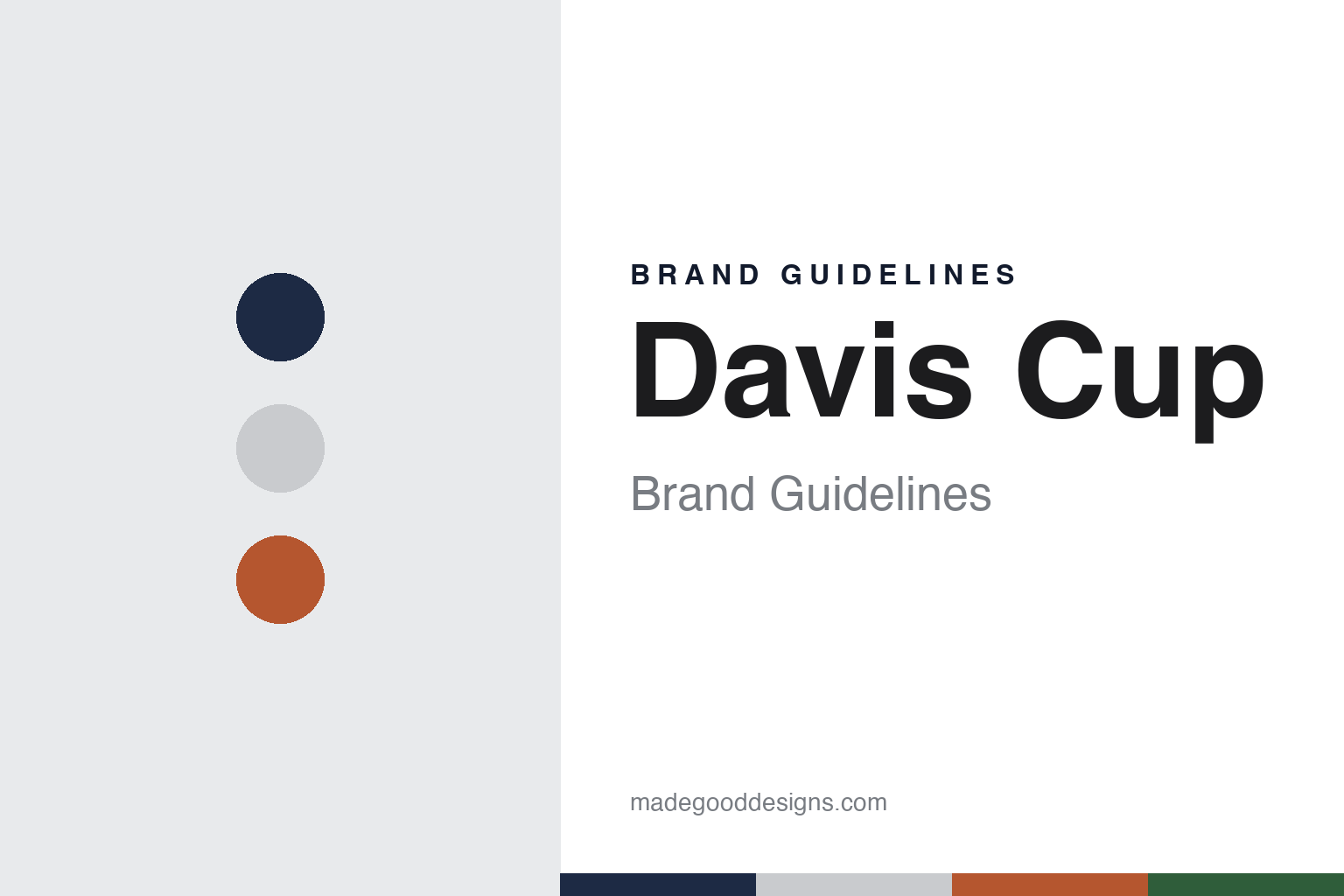
This guide’s Davis Cup palette is Club navy #1D2A44, Bowl silver #C9CBCE, Clay court #B5562F, Grass line #2F5D3A and Paper #F6F5F1. The tones are the guide’s own unofficial interpretation, not official Davis Cup hex codes.