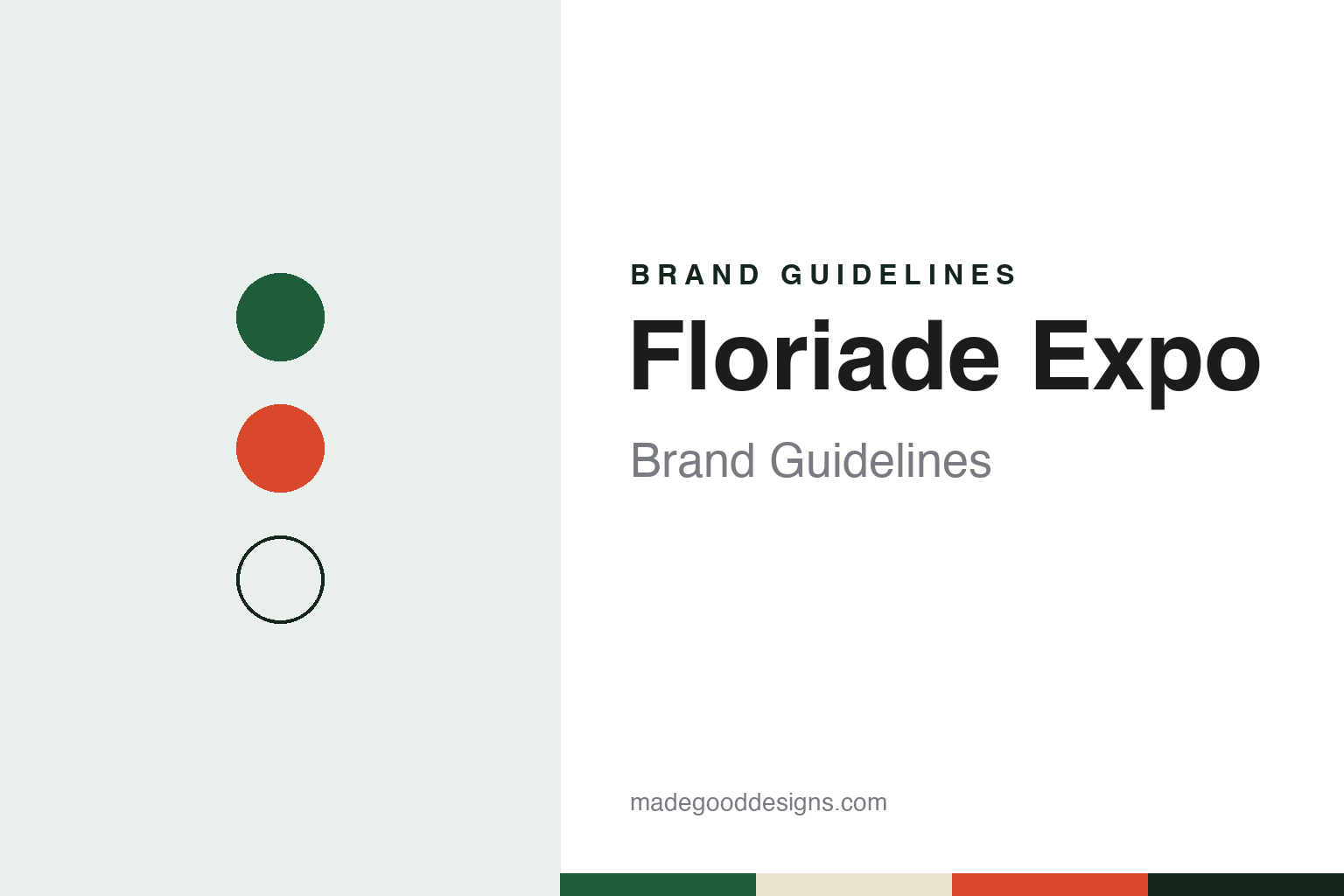
Floriade Expo Brand Guidelines
The Dutch horticultural expo held once a decade, from Rotterdam in 1960 to Almere in 2022.
Aa
Two constants: a polder green, tulip vermilion and sand palette and an expo sans register. Abstract homage — not a Floriade Expo mark or poster; no logo, map or pavilion is reproduced.
From Flora to Floriade
A horticultural show that moved from city to city.
Floriade was the name of the Netherlands’ world horticultural exhibition, an event that ran for a full spring-to-autumn season in a different Dutch municipality each time. Dutch Wikipedia describes it as held in 1960 and then once every ten years from 1972 to 2022, and says the name was used for Dutch horticultural exhibitions that met the A1 category of the International Association of Horticultural Producers (AIPH), which made them eligible for recognition by the Bureau International des Expositions (BIE) as world horticultural exhibitions. English Wikipedia lists every Floriade as a BIE-recognised horticultural exposition.
The idea had older roots. Before Floriade, Dutch Wikipedia says, international flower exhibitions under the name Flora were staged in the Groenendaal woods near Heemstede in 1925, 1935 and 1953, and earlier, in 1910, in the Haarlemmerhout in Haarlem; a pavilion and naturalised daffodils and hyacinths remain at Groenendaal from those shows.
The 1960 edition opened the series in Rotterdam, in Het Park, from 25 March to 25 September 1960. The Euromast observation tower was built for it, according to both the English and Dutch Wikipedia articles, which cite the tower’s own history page. That set a pattern: each Floriade left something behind in the host city’s landscape, and those leftovers became part of the event’s identity.
The event was coordinated by the Nederlandse Tuinbouwraad (NTR), the Dutch Horticultural Council, founded in 1908 to strengthen the image of Dutch horticulture and to promote its exports. Dutch Wikipedia calls Floriade the council’s main instrument for that purpose. Municipalities could put themselves forward for each edition with a bid book, and the council then chose the host.
Colour
Seven editions, seven host sites.
After Rotterdam the expo went to Amsterdam twice: in 1972 to the Amstelpark and Beatrixpark, from 30 March to 1 October, and in 1982 to the Gaasperpark, from 8 April to 10 October. In the Amstelpark, Dutch Wikipedia notes, the Amsteltrein miniature railway and the Rhododendron Valley laid out for 1972 are still there.
In 1992 Floriade moved to Zoetermeer, on the Rokkeveen site, from 9 April to 10 October. The New York Times reported in May 1992 that it was laid out on converted pasture outside the new town, covered 168 acres and drew participants from more than 20 countries. In 2002 it was held from 6 April to 20 October in the Haarlemmermeerse Bos near Hoofddorp under the motto “Feel the art of nature”; the Big Spotters Hill and the Haarlemmermeer pavilion still mark the site. In 2012 the Venlo Greenpark took its turn, from 5 April to 7 October, as the nineteenth AIPH-approved world horticultural exhibition by English Wikipedia’s count, and the Innovatoren tower and Villa Flora, a building designed by Jón Kristinsson, remain from that edition, Dutch Wikipedia says.
The seventh and final edition, officially Floriade Expo Amsterdam – Almere 2022, ran on the Weerwater in Almere from 14 April to 9 October 2022 under the motto “Growing Green Cities”. English Wikipedia records that the NTR announced Almere as host at a meeting at Keukenhof Castle in Lisse on 24 September 2012, after a bid round that began with seven candidates, and that the BIE recognised the event on 15 November 2017. The master plan was by the Rotterdam architecture office MVRDV, as the trade site Bustler reported in 2012, and construction on the site began in February 2020. A cable car crossed the grounds, and the first pavilions were designed by architects including Erick van Egeraat and SeARCH.
The expo’s visual world was therefore less a single fixed logo than a recurring format: a dated edition name, a host city, a motto and a site plan, with tulip fields, glasshouses and national pavilions as the shared vocabulary from one decade to the next.
Typography
How flower shows present themselves.
Flower shows, flower parades and garden festivals present themselves through a small set of recurring elements: a show name, often with the organiser’s initials or a place in front of it; a venue that stays the same for years; a fixed month or week; and a dated history of editions. The RHS Chelsea Flower Show, for example, is still formally the Great Spring Show, and has been staged in the grounds of the Royal Hospital Chelsea since May 1913.
Most of what visitors see is temporary. Show gardens are built for a few days and taken down again; floral marquees and pavilions hold the nursery and grower displays; parades carry floats along a set route. Each edition’s posters, programmes, maps and signage therefore carry much of the identity work, alongside the show name itself, and many organisers give each year a theme, as the RHS did with “Wonder” at Hampton Court in 2025.
Organisers vary widely. Some events are run by horticultural societies, some by public bodies or host municipalities, some by foundations or associations set up for the purpose, and some began as partnerships before changing hands, as the Hampton Court show did when the Royal Horticultural Society took it over in 1993. Names change too: in 2019 that show became a Garden Festival rather than a Flower Show.
This guide sets out what can be checked about each event — who organises it, where and when it is held, when it began and how its name has changed — and marks clearly what rests only on the organiser’s own word. The focus is on names, venues, editions and the way each event is presented.
Aa
An open grotesque sans for edition names, mottos and site maps. (Specimen set in Archivo, a sans STAND-IN; NOT the Floriade Expo logo or any edition wordmark.)
Floriade Expo
The series closed in April 2023.
Floriade has ended. On 12 April 2023 the Dutch broadcaster NOS reported that the Nederlandse Tuinbouwraad had announced there would be no new edition in 2032, and that with this decision Floriade would cease to exist. The council said the current form of the exhibition was outdated and that organising such a temporary event had become more complex, and therefore costlier and riskier, which made it less attractive for municipalities or regions to host. According to NOS, the NTR had organised an edition every ten years since 1960, and Almere was the seventh.
The final edition drew about 685,000 visitors, NOS reported, against an expectation of 2 million announced at the opening; English Wikipedia gives a slightly different total of 693,722. The company behind the 2022 event was Floriade BV. The council said it would spend the following year or longer considering other ways to present Dutch horticulture internationally, and no new format had been named in that report.
The name also needs a clear boundary. Canberra’s spring flower festival, Floriade Australia, is a different event with a different organiser; the Dutch Floriade was the decennial world horticultural expo described here.
For a design guide, Floriade Expo shows how a recurring event can hold one name across decades while every edition takes a new city, motto and site plan, leaving towers, pavilions and parks as its lasting signs. Compare Keukenhof, the spring flower park in Lisse where the 2022 host was announced, and Floriade Australia. For this guide we use polder green, tulip vermilion and a sand neutral with a sans, an unofficial interpretation; no product or logo is reproduced.
Explore & save
Keep Floriade Expo’s identity on hand — save it to a board in the Made Good inspiration library.
Floriade Expo identity set
Pin the polder green, tulip vermilion and sand palette and the expo sans register to your own board.
Source & notes
Frequently Asked Questions
What font can I use to match the Floriade Expo look?
This guide describes Floriade Expo’s type as “An open grotesque sans for edition names, mottos and site maps”. Its type specimen is set in Archivo from Google Fonts as a stand-in; Archivo is not Floriade Expo’s own lettering.
What colours are in the Floriade Expo palette?
This guide’s Floriade Expo palette is Polder green #1F5C3A, Peat ink #14261C, Tulip vermilion #D9482B, Lake blue #3E6E8E and Pavilion sand #E9E2CF. The tones are the guide’s own unofficial interpretation, not official Floriade Expo hex codes.