Rose Parade Brand Guidelines
Pasadena’s New Year flower parade since 1890.
Aa
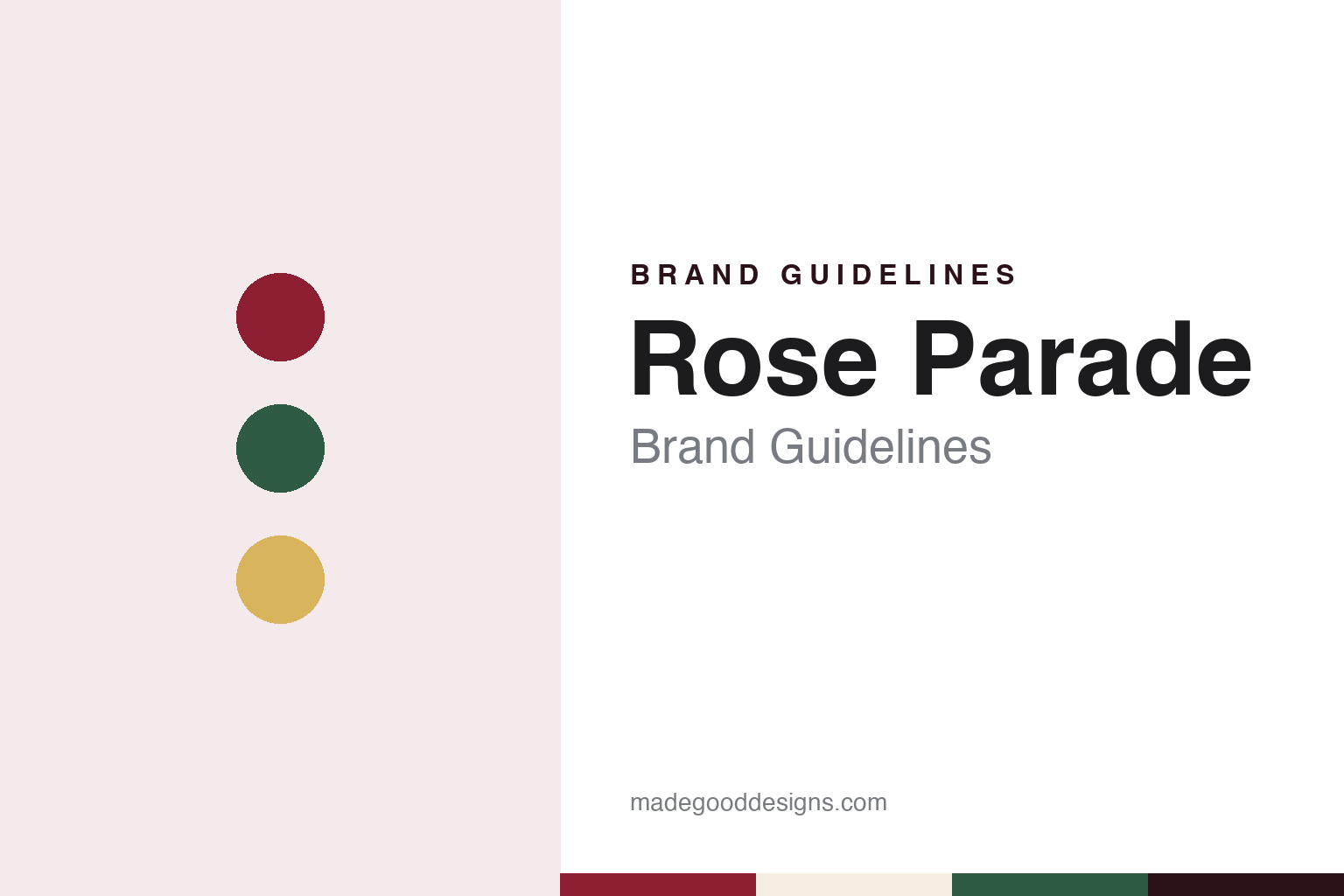
Two constants: a rose red, float green and cream palette and a New Year serif register. Abstract homage — not a Rose Parade float, logo or mark; nothing of the Tournament of Roses identity is reproduced.
A Valley Hunt Club idea
Flowers in midwinter, on a Pasadena street.
The Rose Parade, also called the Tournament of Roses Parade, is a parade of flower-covered floats, marching bands and riders held each New Year’s Day in Pasadena, California, mostly along Colorado Boulevard, English Wikipedia says. It is produced by the non-profit Pasadena Tournament of Roses Association, and in the afternoon it is followed by the Rose Bowl, a college football game that grew up alongside it.
The parade began with a social club. Members of Pasadena’s Valley Hunt Club staged the first one on 1 January 1890, according to both Wikipedia and the Tournament of Roses. Many of the members had moved west from the East and the Midwest, and they wanted to show off the mild southern Californian winter. The Tournament’s own history quotes the club member Charles Frederick Holder telling a meeting that “in New York, people are buried in snow,” while in Pasadena the flowers were blooming and the oranges about to bear, and proposing a festival to tell the world about it.
The first event, the Tournament says, was a parade of flower-decorated carriages followed by an afternoon of games: chariot races, jousting, foot races and tug-of-war. On that first morning the grand marshal, Francis Rowland, and Holder, as president, rode out on horseback at its head. In 1891 a town band from Monrovia joined the second parade, the start of the musical side of the event.
By 1895, Wikipedia says, the event had grown too large for the club to run, and the Pasadena Tournament of Roses Association was formed to take it over. The lot where the festivities were held was renamed Tournament Park by 1900. The first football game linked to the event was played on 1 January 1902; the game returned in 1916 and has been played each year since, and it took its present name from the Rose Bowl stadium, built for the 1923 game.
Two rules from the early years still shape the calendar. In 1893 New Year’s Day fell on a Sunday, and the organisers moved the parade to Monday so as not to disturb horses tied up outside churches during services; ever since, when 1 January is a Sunday the parade runs on 2 January, a custom Wikipedia calls the “Never on Sunday” rule. The parade was not held in 1942, 1943 and 1945, during the Second World War, or in 2021, Wikipedia says; when it returned in January 2022 it was numbered the 133rd, keeping the count it would have had.
Colour
Every surface covered in something that grew.
The floats are the parade’s visual signature. In the early years they were horse-drawn carriages decked with flowers; the Tournament says the 31st Rose Parade marked the end of the horse-drawn era, when floats driven by electric and petrol engines took over completely. Today, Wikipedia says, floats are self-propelled, usually on old truck chassis.
The defining design rule is about materials. Every surface of a float’s framework must be covered in natural materials — flowers, plants, seaweed, seeds, bark, vegetables or nuts — and artificial flowers and artificially coloured materials are not allowed, according to Wikipedia. The Tournament describes the same rule as “every inch” covered, and says delicate blooms such as roses are set one at a time in individual vials of water.
Most floats now take nearly a year to build and are made by professional float-building companies, Wikipedia says; as of 2025 those included Artistic Entertainment Services and Phoenix Decorating Company, while earlier builders included Fiesta Parade Floats, from 1988 to 2024. A handful of entries are still built by volunteers: Wikipedia names six “self-built” floats, among them the City of Burbank, the City of South Pasadena and the Cal Poly Universities entry made by students. In the last days of December, volunteers cover floats in flowers and seed mixes in “float barns” around the Arroyo Seco area, and the public can watch.
Each year has a theme. The newly elected president of the Tournament picks it shortly after the January parade, and most floats are designed around it, Wikipedia says. For the 137th Rose Parade on 1 January 2026, the theme was “The Magic in Teamwork,” chosen by the 2026 president, Mark Leavens, and the grand marshal was Earvin “Magic” Johnson. ABC7 Los Angeles reported that 39 floral floats, 17 equestrian teams and 19 marching bands made the 5½-mile journey that morning in steady rain, the first wet parade in 20 years.
Alongside the floats, the Tournament lists equestrian units, marching bands and its own entries. The only cars in the parade are those carrying the grand marshal, the mayor of Pasadena, the Rose Bowl Hall of Fame inductees and the Tournament president, and the Tournament says its floral partner, FTD, decorates those antique automobiles in flowers.
Typography
Shows, parades and festivals.
Flower shows, flower parades and garden festivals present themselves through a small set of recurring elements: a show name, often with the organiser’s initials or a place in front of it; a venue that stays the same for years; a fixed month or week; and a dated history of editions. The RHS Chelsea Flower Show, for example, is still formally the Great Spring Show, and has been staged in the grounds of the Royal Hospital Chelsea since May 1913.
Most of what visitors see is temporary. Show gardens are built for a few days and taken down again; floral marquees and pavilions hold the nursery and grower displays; parades carry floats along a set route. Each edition’s posters, programmes, maps and signage therefore carry much of the identity work, alongside the show name itself, and many organisers give each year a theme, as the RHS did with “Wonder” at Hampton Court in 2025.
Organisers vary widely. Some events are run by horticultural societies, some by public bodies or host municipalities, some by foundations or associations set up for the purpose, and some began as partnerships before changing hands, as the Hampton Court show did when the Royal Horticultural Society took it over in 1993. Names change too: in 2019 that show became a Garden Festival rather than a Flower Show.
This guide sets out what can be checked about each event — who organises it, where and when it is held, when it began and how its name has changed — and marks clearly what rests only on the organiser’s own word. The focus is on names, venues, editions and the way each event is presented.
Aa
A high-contrast serif for a parade with a long history. (Specimen set in Playfair Display, a serif STAND-IN; NOT the Rose Parade logo or any Tournament of Roses lettering.)
Rose Parade
White suits, a rose mark and a fixed route.
The parade runs on a set route. On the morning, the units leave the formation area in front of Tournament House, head north on Orange Grove Boulevard from Green Street, turn east on Colorado Boulevard past the main grandstands and television stands, and turn north on Sierra Madre Boulevard, Wikipedia says; floats must pass under the Interstate 210 overpass on the way, so tall designs have to lower their height. ABC7 reported the 2026 parade starting at 8 a.m. and ending at Sierra Madre Boulevard and Villa Street. Tournament House, the former Wrigley mansion on Orange Grove Boulevard, is the organisation’s headquarters, and the Tournament says the Wrigley family gave the house and gardens to the city for that use.
The people are part of the look. The Tournament says its 935 volunteer members give more than 80,000 hours a year and are known as “White Suiters” for their white uniforms. Each year a Rose Queen and six princesses, chosen from young people in the Pasadena area, make up the Rose Court, which rides on its own float, Wikipedia says. Television has carried the parade since 1947, when KTLA showed it, and English Wikipedia says the 1954 parade was the first programme broadcast nationwide on NBC in the NTSC colour system. Honda has been the parade’s presenting sponsor since 2011 and leads it with the first float.
The organisation treats its identity as protected property. Its brand-use page says the Pasadena Tournament of Roses Association owns logos, word marks, photographs and telecast footage, including the “rose logos” on its website, that any use needs written permission from its marketing team, and that uses must follow its usage guidelines and Brand Style Guide.
For a design guide, the Rose Parade shows how a single material rule — everything must be covered in something that grew — can become a whole visual language, renewed each year through a theme. Compare the Philadelphia Flower Show, another long-running American flower event, and the RHS Chelsea Flower Show. For this guide we use a rose red, a float green and a cream with a serif, an unofficial interpretation; no product or logo is reproduced.
Explore & save
Keep Rose Parade’s identity on hand — save it to a board in the Made Good inspiration library.
Rose Parade identity set
Pin the rose red, float green and cream palette and the New Year serif register to your own board.
Source & notes
Frequently Asked Questions
What font can I use to match the Rose Parade look?
This guide describes Rose Parade’s type as “A high-contrast serif for a parade with a long history”. Its type specimen is set in Playfair Display from Google Fonts as a stand-in; Playfair Display is not Rose Parade’s own lettering.
What colours are in the Rose Parade palette?
This guide’s Rose Parade palette is Parade rose #8E1F33, Float green #2F5A43, White suit #F5EFE3, Marigold #D8B45C and Night ink #2A1218. The tones are the guide’s own unofficial interpretation, not official Rose Parade hex codes.