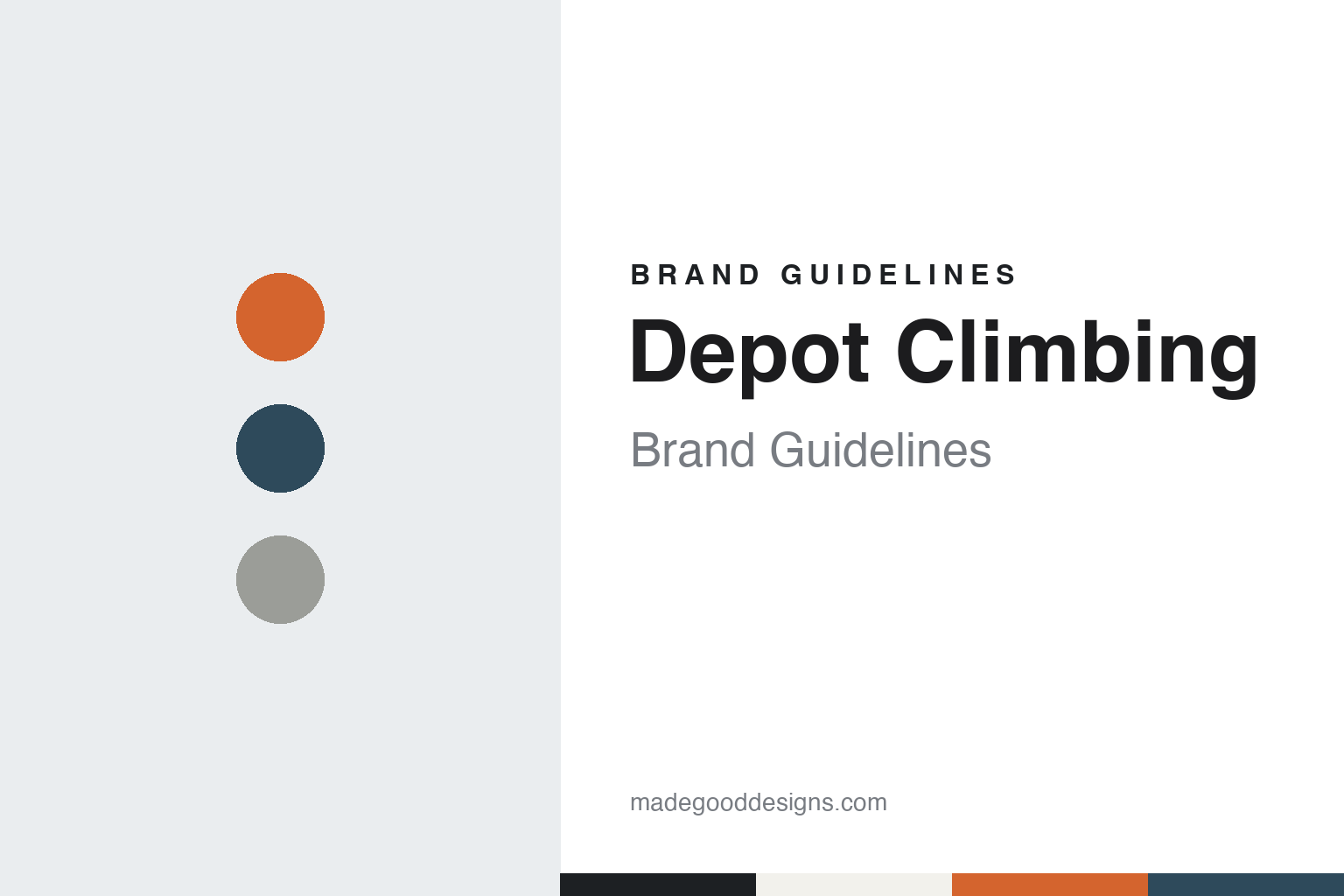
Depot Climbing Brand Guidelines
From an old bus depot in Pudsey to a chain of climbing centres.
Aa
Two constants: an ink, chalk and route-orange palette and an industrial condensed sans register. Abstract homage — not a Depot Climbing asset; no logo, sign or wall is reproduced.
The bus depot
A Leeds wall that took its name from its building.
Depot Climbing began in Leeds, West Yorkshire, in 2009. The company says it started in an old bus depot building in Pudsey, on the west side of the city, and that the building gave it its name. Its website carries the line “Making everybody strong since 2009,” and the shorter motto “Make Everybody Strong” runs through its pages.
The operating company is the Yorkshire Climbing Company, a Leeds-based business that trades as Depot Climbing, according to a January 2024 report in TheBusinessDesk.com, which named Steve Dunning as a director. By December 2014, Climber magazine reported, Depot already had walls in Leeds and Nottingham and had announced a bouldering centre at Trafford Park in Manchester. Climber said that project was being led by Steve Dunning and Luke Bowers, working with the team behind the Lakeland Climbing Centre, and quoted them describing an area of more than 30,000 square feet, including an outdoor space for summer bouldering.
The 2014 announcement also pointed to the chain’s influences. Dunning and Bowers told Climber they had been impressed by the quality of continental walls such as Boulderwelt and wanted to bring that standard to the UK market. The Trafford Park site remains part of the chain, listed today as Manchester Trafford Park.
Colour
From two walls to eight centres.
The chain grew in steps. In April 2022 a Depot news post announced a bouldering centre in the Armley area of Leeds as the company’s seventh, joining its original Pudsey centre and its roped centre on Gelderd Road, BIG Depot Leeds; another Depot post on the Armley project described about 2,500 square metres of space, with bouldering, a gym, a café, a shop and an outdoor climbing area. In January 2024 TheBusinessDesk.com reported that the company already had seven centres in the north, including Trafford Park, and had taken 50,864 square feet of space at the Southmoor Industrial Estate in Wythenshawe, south Manchester.
That building became BIG Depot Manchester. The company says it opened on 21 December 2024. Its July 2024 announcement described roped climbing, bouldering and children’s walls, up to 25 auto-belay lines, a gym, a yoga studio, a café, working spaces and a climbing shop. In November 2024 the British Mountaineering Council announced that the British Boulder and Lead Championships would be held there in January and February 2025, calling it the newest venue in the Depot Climbing Group’s portfolio. In 2026 the company hosted the British Bouldering Championships in January at Depot Manchester in Trafford Park and the British Lead Climbing Championships in February at BIG Depot Manchester, according to its own event posts.
Older centres have been reworked rather than replaced. The company says Depot Nottingham was refurbished in 2020, 2023 and 2025, and in July 2025 described a further phase that turned its mezzanine climbing area into a gym and training space and added a Tension Board 2, an adjustable LED training board. It describes Depot Nottingham as an associate member of the Association of British Climbing Walls.
Today the company lists eight centres: six bouldering and training centres and two roped centres branded BIG Depot, one in Leeds and one in Manchester. Its centres are in Leeds, Manchester, Sheffield, Nottingham and Birmingham, with three of them in Leeds. The original Pudsey centre closed on 6 September 2026 for a refurbishment with no fixed end date, the company says, while its two other Leeds sites stay open.
The company describes each of its centres as having a climbing shop, and says its pay-monthly options include entry to all Depot Climbing centres. It runs events under its own name, including the Battle of Britain bouldering competition at Depot Manchester and the Depot Youth Cup for junior climbers, and it hosts rounds of the British Mountaineering Council’s Youth Climbing Series at BIG Depot Leeds.
Typography
Climbing gyms and their buildings.
Climbing-gym and bouldering-gym chains present themselves less through a single product than through places. Each gym has a name, and chains handle those names in different ways: some put every site under one company name, while others let each gym keep a name of its own, often taken from its neighbourhood or from the building it occupies. In Climbing Business Journal’s accounts, the American company Movement moved its Earth Treks and Planet Granite gyms under one name in 2021, while Touchstone Climbing in California runs gyms called Mission Cliffs, Pacific Pipe and The Post.
Inside the gyms, the visual language is set largely by the walls. Holds and volumes come in many colours, and routes are usually marked by colour and labelled with grades on small signs or tags at the foot of the wall. Wall builders and hold makers supply much of what climbers see, and a few chains make some of their own holds; Touchstone says it shapes and pours holds at its Sacramento gym.
Buildings carry much of the character. Chains have taken over converted warehouses, factories, former big-box stores, cinemas and a post office, and their own history pages often describe what each building was before. Membership cards, day passes, gear shops and merchandise carry the gym or chain name, and many sites also offer yoga and fitness classes alongside climbing.
Ownership has changed quickly in this sector. Gym groups have merged, been backed by private equity and bought smaller regional chains, and a gym’s name on the door can outlast several owners. The guides in this series set out what can be checked about each chain — who founded it, who owns it, when its gyms opened — and mark clearly what rests only on the company’s own word.
Aa
An industrial condensed sans for a name taken from a bus depot. (Specimen set in Barlow Condensed, a sans STAND-IN; NOT the Depot Climbing logo.)
Depot Climbing
One working word, carried across a chain.
The name is the chain’s central design idea. A bus depot is a working shed, and the company kept the word as it opened sites at Trafford Park and on the Southmoor Industrial Estate. The capitalised “BIG” in front of the name marks the two roped centres apart from the bouldering sites without creating a second brand, and the motto “Make Everybody Strong” gives every centre the same short line.
The naming is consistent down to the centre level: each site takes the Depot name plus its city or district, from Leeds Armley to Manchester Trafford Park, and the company’s website, shop and competitions all sit under the one name. Its competitions take the same approach, with the Depot Youth Cup carrying the brand directly.
Inside the roped centres the naming turns to climbing itself. At BIG Depot Manchester the company refers to areas called Biographie, Demi Lune and Un Pont sur l’Infini, alongside a Comp Wall and a Gallery bouldering area, and numbers its roped lines, so a route can be found by area name and line number.
The palette for this guide pairs a dark ink and chalk white with a route orange and a deep shed blue, tones chosen here as an interpretation of a working depot rather than taken from the company’s own materials.
For a design guide, Depot Climbing shows how a name taken from its first building can scale across a chain. Compare The Castle Climbing Centre, a single London centre inside a Victorian pumping station, and Boulderwelt, which Depot’s team cited in 2014. For this guide we use ink, chalk, a route orange and a deep blue with a sans, an unofficial interpretation; no product or logo is reproduced.
Explore & save
Keep Depot Climbing’s identity on hand — save it to a board in the Made Good inspiration library.
Depot Climbing identity set
Pin the ink, chalk and route-orange palette and the industrial condensed sans register to your own board.
Source & notes
Frequently Asked Questions
What font can I use to match the Depot Climbing look?
This guide describes Depot Climbing’s type as “An industrial condensed sans for a name taken from a bus depot”. Its type specimen is set in Barlow Condensed from Google Fonts as a stand-in; Barlow Condensed is not Depot Climbing’s own lettering.
What colours are in the Depot Climbing palette?
This guide’s Depot Climbing palette is Depot ink #1D2023, Chalk #F2F1EC, Route orange #D4642E, Shed blue #2E4A5B and Concrete #9B9D98. The tones are the guide’s own unofficial interpretation, not official Depot Climbing hex codes.
When was Depot Climbing founded?
Depot Climbing was founded in 2009, in Pudsey, Leeds, England.