Rebecca Solomon built her pictures like scenes from a novel: a handful of figures, a doorway or a table, and one relationship that the viewer has to read in seconds. Many of her paintings are now known mostly through the printed copies made for magazines, which means the evidence of her design sense often survives as black ink on paper. This guide covers her career, the works that museums can date, how her compositions are built, and what designers can take from them. More public-domain prints from the period sit in the MGD museum inspiration collection.
Who was Rebecca Solomon?
The Metropolitan Museum of Art records her as British, born in London in 1832 and died in London in 1886. The Jewish Women’s Archive gives her birthday as 26 September and places her in a Jewish family of artists; her brothers Abraham and Simeon were painters too. The Met’s collection includes an Illustrated London News wood engraving of 1851 after Abraham Solomon, titled Scandal, so the family’s habit of telling stories in a single scene is visible across two siblings. For her younger brother’s very different work, see our guide to Simeon Solomon.
Biographies on the Jewish Women’s Archive and the Victorian Web describe her exhibiting at the Royal Academy. She also illustrated magazines such as London Society and The Churchman’s Family Magazine, according to the Victorian Web.
Rebecca Solomon and the push for women artists
In 1859 she was among a group of women artists who petitioned the Royal Academy to open its schools to women, according to the Victorian Web. Laura Herford’s admission to the schools followed in 1860. The petition matters for designers because it shows how much of this period’s visual culture was made by women who were working outside the main institutions: in illustration, in exhibitions of women’s work and in commissions for magazines.
Key works by Rebecca Solomon
A lot of her painted work is hard to trace, and the Victorian Web notes that she is often known only from engravings. The works below can be placed from museum or scholarly accounts:
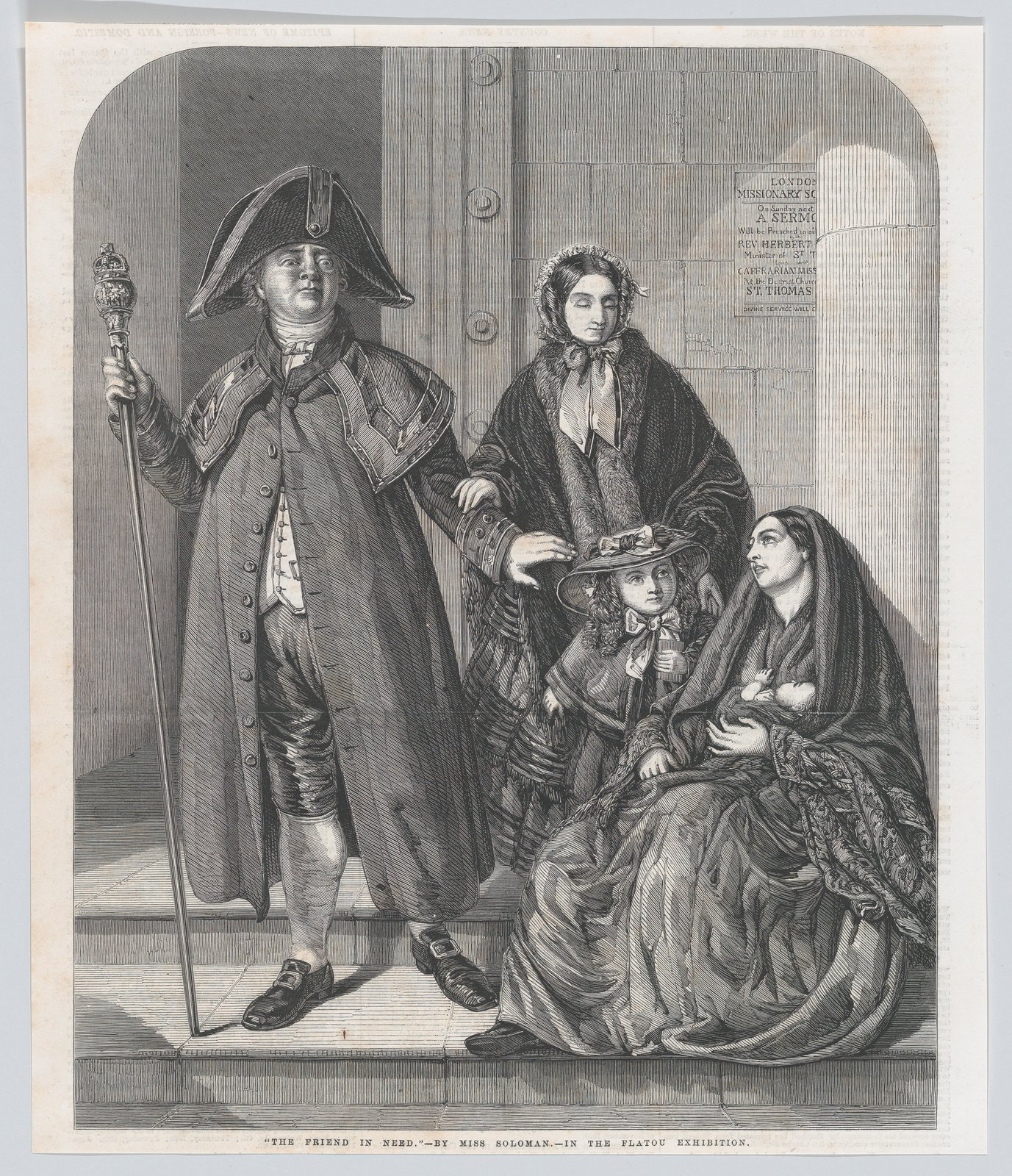
- The Friend in Need, reproduced as a wood engraving in the Illustrated London News on 23 April 1859; the Metropolitan Museum of Art’s impression is in the image above and measures 30.8 × 26.3 cm as a sheet.
- A Young Teacher, 1861, shown that year at Henry Wallis’s French Gallery in London and again in Liverpool in 1862. Tate and the Museum of the Home now own it jointly, and it hangs in Tate Britain’s Pre-Raphaelite galleries.
- The Governess, an earlier picture on a related theme, which La Tribune de l’Art describes as a counterpoint to A Young Teacher.
- Behind the Curtain, listed among her principal pictures by the Victorian Web, which records that it belonged to Baroness Burdett-Coutts.
What to look at: staging a story in one frame
The Met’s print is a good place to begin. A man in a cocked hat and long coat stands at the left holding a tall staff that rises almost the full height of the picture. A woman in a bonnet and dark cloak stands behind a small child, and on the right a woman in a shawl sits on the ground with an infant. The seated woman is low and wrapped in heavy cloth, and the standing man is tall and formal. The difference in posture tells you most of what you need about the situation before you read any caption.
A few compositional habits stand out:
Vertical against horizontal. The staff and the stone door-frame give strong verticals, and the seated figure creates a low horizontal mass in the corner. The eye travels from the tall figure down to the child and on to the woman and infant.
A bridge figure. The small child stands at the centre of the group, between the standing and the seated adults. In a layout, this is the connecting element, the thing your eye passes through on its way across the page.
Costume as information. Hat, cloak, bonnet and shawl tell the viewer rank and circumstance without text. Brand and character design use the same shorthand today: a single garment can place a person.
A Young Teacher: the picture and its model
Tate’s account of A Young Teacher describes a child teaching a maid to read while the maid holds the child’s younger sister. The maid’s model was Fanny Eaton, a Jamaican-born woman who worked as an artist’s model. Tate dates the picture to 1861. A sale at Sotheby’s in 2022 led to a purchase by Princeton University Art Museum, as The Art Newspaper reported, and Tate and the Museum of the Home then announced joint ownership.
The composition does what her magazine scenes do: three figures, one gesture. The act of reading carries the story, and the clothes mark who is who. The picture sits within the wider story of Pre-Raphaelite painting and the broader field of Victorian art.
Technique: from painting to wood engraving
Most people in 1859 saw Solomon’s pictures as engravings rather than paintings. In a wood engraving, an engraver cuts a block so that fine lines hold the lights, mid-tones and shadows, and the printer reproduces the result in black ink on paper. The Met’s sheet is credited “After Rebecca Solomon”, which means the engraver translated her painting into line, and the lines you see are the engraver’s, not hers.
Measured from the Metropolitan Museum’s scan of this impression, the page falls into a small group of greys: paper near #e8e2dc, light grey near #d4d3d3, mid-greys near #a9a59f and #8c8884, a darker grey near #777572 and the heavy shadow at around #575755. These are screen values from a photograph of a 19th-century print, not the ink itself. The point is the structure: six steps are enough to carry a crowded scene when they are placed well. See the museum’s engraving collection for more.
How designers can borrow from Rebecca Solomon
Cast the scene with three or four figures
Each added person needs a job. Name the relationship you want the viewer to read and remove anyone who does not support it. Editorial illustration, onboarding screens and storyboards all benefit from this discipline.
Contrast height and posture
Stand one element tall and set another low. The difference reads instantly and gives you a diagonal path for the eye without any extra graphics.
Plan the greys first
Convert a layout to greyscale, reduce it to five or six steps and check that the story still reads. Sample the tones with the image colour picker if you are working from a scan. If the picture survives in grey, colour can only help.
Let clothing do the labelling
Costume or props can carry status and mood, which reduces the need for captions. In interface design, a small icon or object can do the same job as the shawl or hat does here.
Frequently asked questions
Who was Rebecca Solomon?
She was a London-born painter and illustrator, recorded by the Metropolitan Museum of Art as living from 1832 to 1886. She belonged to a family of artists that included her brothers Abraham and Simeon, and her pictures were widely reproduced as wood engravings.
What is Rebecca Solomon known for?
She is known for narrative pictures of domestic and social life, including A Young Teacher of 1861, and for her part in the 1859 petition asking the Royal Academy to admit women to its schools.
Where can I see Rebecca Solomon’s work?
A Young Teacher is jointly owned by Tate and the Museum of the Home and is shown in Tate Britain’s Pre-Raphaelite galleries. The Metropolitan Museum of Art holds an Illustrated London News wood engraving after her The Friend in Need.
Was Rebecca Solomon a Pre-Raphaelite?
Museum and scholarly accounts place her in the Pre-Raphaelite circle, and Tate shows her work in its Pre-Raphaelite galleries. She was never a member of the original Brotherhood, which was formed by seven men in 1848.