Jean Clouet is a name that carries more certainty than the surviving evidence. He was an established painter at the court of François I, and his portraits and portrait drawings set the pattern for French likenesses in the sixteenth century. Yet the museums that hold works under his name are careful about attribution, and his son François shared his nickname, which makes the two easy to confuse. What is clear, and useful to a designer, is the look of the two Jean Clouet pictures in the Metropolitan Museum: a plain colour field, a few heavy dark shapes, and a face drawn with great care.
Both Met works are public domain and appear below. For other cleared historic images, browse the MGD museum inspiration collection.
Who was Jean Clouet?
The Met describes him as French, active by 1516 and died 1540/41 in Paris. Beyond that, reference works differ. Encyclopaedia Britannica places him among the chief painters to François I as early as 1516 and names him groom of the chamber from 1523. Other accounts summarised in standard reference entries date his promotions to 1518, 1519 and 1524. The sources also disagree on where he came from: some give Tours, others the Burgundian Netherlands, and some describe him as Flemish by origin.
He was known as Janet or Jehannet, and his son François Clouet, who took over the court post after 1540, used the same name. According to the National Gallery of Art in Washington, the dividing line between the work of father and son is not always clear. That is why a careful guide to Jean Clouet treats attribution as part of the story. If you are researching the next generation, our guide to Renaissance art gives the wider context.
A dated outline of key works
- Active by 1516. The Met’s date for the start of his documented activity at the French court.
- About 1535, Charles de Cossé (1506–1563), Count of Brissac. A portrait miniature on vellum, 37 mm in diameter, in the Metropolitan Museum of Art (accession 35.89.1, Fletcher Fund, 1935).
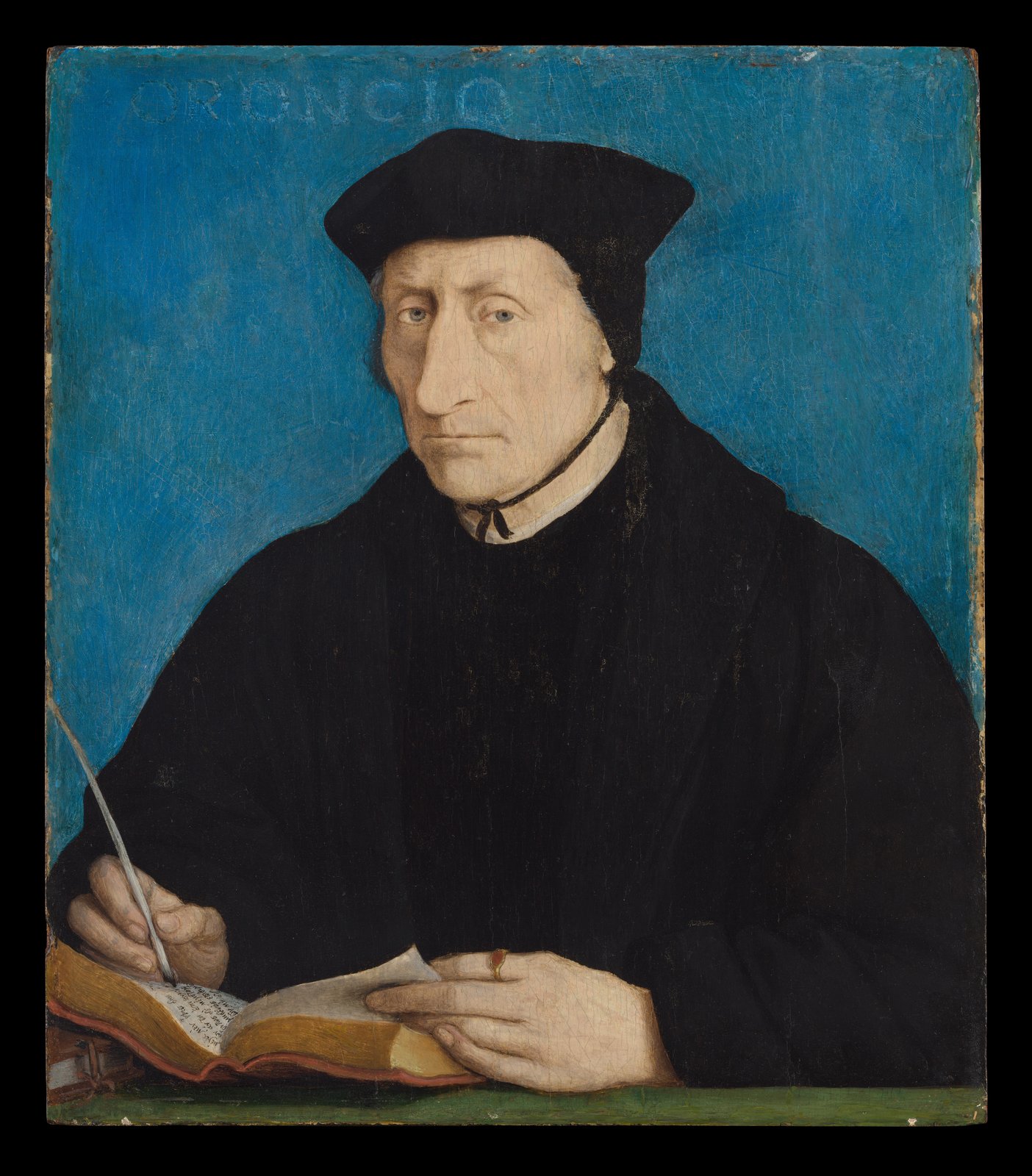
- About 1536, Guillaume Budé (1467–1540). Oil on wood, 39.7 by 34.3 cm, in the Metropolitan Museum of Art (accession 46.68, Maria DeWitt Jesup Fund, 1946).
- Portrait drawings. The National Gallery of Art notes that about fifty chalk portrait drawings are attributed to his son François, and that many portrait drawings in the Bibliothèque nationale de France, the Musée Condé at Chantilly and the British Museum have been tied to the Clouet family. Counts and attributions vary by source.
The Met also credits other portraits of French royalty to François Clouet, his workshop or his style. This guide keeps to the two objects the museum catalogues under Jean’s own name.
What to look at in the Budé portrait
Look first at the ground. The panel is a flat field of strong blue with no landscape or architecture behind the sitter, and a trace of lettering near the top edge. Measured from the museum’s scan of this panel, the dominant blue is close to #1b647e and the darkest masses close to #1d1b1d. These describe the scan, not the original pigments.
The sitter fills the frame from the lower edge up to just below the top. A black cap, black robe and dark shirt make one large silhouette, and the pale face and hands are the only strongly lit areas. The Met’s title gives the sitter’s dates, 1467 to 1540, so the portrait of an older man was painted late in his life.
Then look at the props. The sitter holds a quill in one hand and keeps the other hand on an open book, and a narrow green ledge runs along the bottom edge. The objects are small, but they tell you in a glance what he did. The portrait is built as a clear hierarchy: the face first, the hands second, the book third, everything else quiet.
What to look at in the Brissac miniature
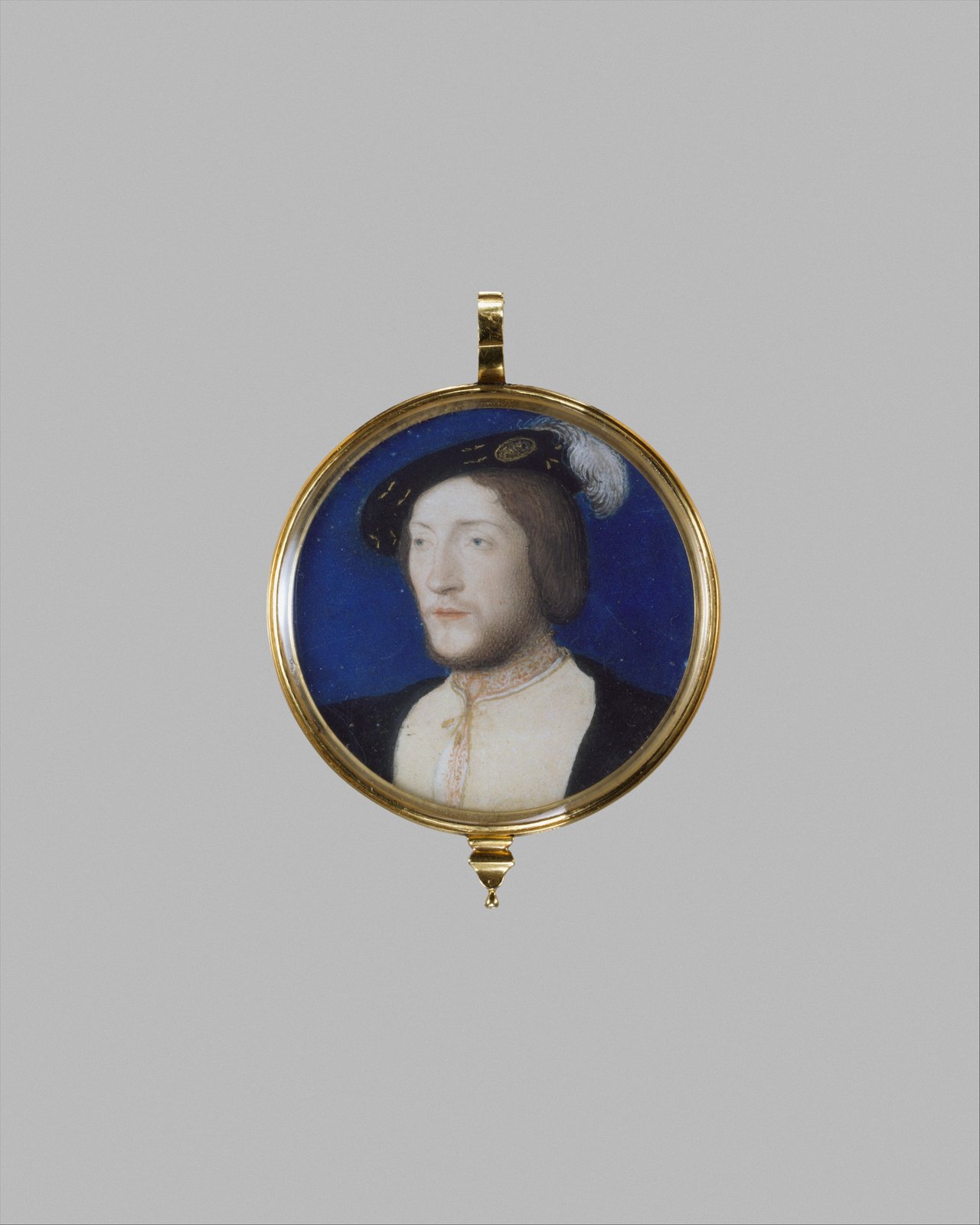
The Met records this work as a miniature on vellum, 37 mm across, with a date of about 1535. It is a tiny image, the size of a coin, but it uses the same grammar as the larger panel: a deep blue background, a dark cap with a pale feather, and a white shirt that frames the face. The inner area, measured from the museum’s scan, is close to #202f61.
The round format is worth noting. The sitter’s head and shoulders sit comfortably inside a circle, and the gold surround, which has a loop at the top, shows the miniature was made to be worn or carried. Designers who work on avatars, badges and app icons deal with the same problem: a likeness that must read at a very small size inside a fixed shape. Clouet’s answer is high contrast between face and ground and very few competing details.
Technique and format
The Met catalogues the Budé portrait as oil on wood and the Brissac miniature as painted on vellum. A panel of about 40 by 34 cm and a disc of 37 mm sit at opposite ends of a court painter’s range.
The National Gallery of Art’s account of the Clouet family also points to portrait drawings in black and red chalk. Britannica notes that a preparatory drawing helped scholars link François to a finished portrait, which shows how such studies served painted work. The line between Jean’s drawings and François’s is, as the same museum notes, not always clear. For a designer, the lesson is practical: a quick, accurate study of a face is an asset you can keep, adapt and redeploy.
Because the Clouet name is shared across father, son and workshop, a label such as “after Clouet” or “style of Clouet” in a museum record means something specific. If you plan to use a historic portrait in a project, read the credit line before you pick it. A work catalogued to Jean Clouet himself, such as the two Met objects here, is a different thing from a workshop version.
Colour: why blue and black work together
The blue ground does a job that goes beyond decoration. It separates the head from the black clothing, since a black robe against a black or brown ground would disappear. It also sets up a warm and cool contrast with the skin, which reads warmer next to blue. The range is small: one strong blue, one near-black, and the lit colours of the skin and linen.
If you want to test a similar scheme, load the measured values into the colour palette generator and look at the neighbours it proposes. For more historical palettes to start from, see our vintage colour palettes guide. For a German portraitist of the same era, our guide to Hans Holbein the Elder is a useful companion.
How designers can borrow from Jean Clouet
- Use one flat colour field behind a face. A plain, saturated ground keeps attention on the person and makes a headline or caption easy to place at the edge.
- Build a big dark shape. Treat clothing or a jacket as a single mass so the lit face and hands read at once. This works on team pages, author cards and book jackets.
- Give the sitter one small prop. A quill and a book say “writer and scholar” without a caption. Choose one object that explains the person and keep it small.
- Design for a circle. Test a portrait in a round crop before you commit. Keep the eyes in the upper third, and keep the background simple enough that nothing important sits near the edge.
- Keep a study. Photographing a subject in plain light, as a reference to be reused, echoes the role of chalk portrait drawings in a sixteenth-century workshop.
- Label attribution honestly. If you use historic art, record whether the museum says “by”, “workshop of” or “after”, and credit it as the museum does.
Frequently asked questions
Who was Jean Clouet?
Jean Clouet was a French court painter, active by 1516 and died 1540 or 1541 in Paris, according to the Metropolitan Museum of Art. He worked for François I and was known as Janet or Jehannet.
What is Jean Clouet known for?
He is known for portraits of the French court, including the oil portrait of Guillaume Budé from about 1536 and a miniature of the Count of Brissac from about 1535, both in the Metropolitan Museum of Art. Portrait drawings in chalk are also associated with the Clouet family.
What is the difference between Jean Clouet and François Clouet?
Jean was the father and François the son, who succeeded him as court painter around 1540. Both were called Janet, and the National Gallery of Art notes that the line between their works is not always clear.
Is Jean Clouet’s work public domain?
The Metropolitan Museum of Art flags its portrait of Guillaume Budé and its Brissac miniature as public domain, and both are shown here. Check the rights status of any other work with the institution that holds it.