Scottish Open Brand Guidelines
From Downfield in 1972 to a links home on the Firth of Forth.
Aa
Two constants: a slate, marram and gorse palette and a condensed sans register. Abstract homage — not a Scottish Open asset or mark; no trophy, logo or sponsor mark is reproduced.
Downfield, 1972
Two editions, a gap and a revival.
The Scottish Open was first played in 1972. English Wikipedia says the first edition, the Sunbeam Electric Scottish Open, was part of that year’s European Tour and was held at Downfield Golf Club in Dundee; National Club Golfer, writing in July 2024, gives the same year and venue. In 1973 the event moved to the Old Course at St Andrews. Both editions were broadcast on ITV, Wikipedia says, and the tournament was cancelled in 1974 when television coverage could not be arranged.
There was then no Scottish Open until 1986, a gap National Club Golfer points out. That year, under a new sponsorship with Bell’s, the Glasgow Open, held at Haggs Castle Golf Club since 1983, was renamed the Scottish Open, according to Wikipedia. After a first year at Haggs Castle the tournament moved to Gleneagles in 1987 and took a slot the week before the Open Championship; the BBC carried live coverage from 1987 to 1993. Bell’s ended its sponsorship in 1994, and in 1995 and 1996 the event was played without a title sponsor at Carnoustie, Wikipedia says. National Club Golfer counts eight consecutive editions at Gleneagles.
The late 1990s produced a tangle of names. From 1997 the pre-Open place on the schedule went to the Loch Lomond World Invitational, first played at Loch Lomond Golf Club in September 1996. Those events did not carry the Scottish Open name, the rights to which were held by the sports management company ISM, Wikipedia explains. From 2001 the Loch Lomond event became the Scottish Open and its earlier editions were given Scottish Open status, which left two “Scottish Opens” in the record for 1996. Golf News Net’s list of names, published in July 2026, gives Gulfstream as the 1997 title sponsor and Standard Life from 1998 to 2000.
A longer sponsorship followed. From 2002 the event was the Barclays Scottish Open, and it stayed at Loch Lomond until 2010, according to Wikipedia; Golf News Net dates the Barclays name from 2002 to 2011, and National Club Golfer counts fifteen editions at Loch Lomond. Wikipedia notes that some players and commentators were concerned that its parkland course was very different from the links on which the Open is played.
Colour
A run of links courses, then one home.
The tournament moved to links golf in 2011. That year it was held at Castle Stuart Golf Links near Inverness, because of financial difficulties at Loch Lomond, and play was cut to 54 holes by heavy rain, Wikipedia says. Aberdeen Asset Management took over the sponsorship in 2012. The event stayed at Castle Stuart in 2012 and 2013, moved to Royal Aberdeen in 2014, to Gullane in 2015, back to Castle Stuart in 2016, to Dundonald Links in Ayrshire in 2017 and to Gullane again in 2018, according to the same account. Over those years the sponsor name changed with the sponsor’s own company names, from Aberdeen Asset Management to Aberdeen Standard Investments and then abrdn, through 2021, Golf News Net lists.
Since 2019 the tournament has been played at The Renaissance Club at North Berwick in East Lothian. National Club Golfer reported in 2024 that the club was founded in 2008 and designed by the American architect Tom Doak, that it runs alongside the Firth of Forth, and that it is the eleventh venue the tournament has used. The same piece quoted the DP World Tour’s head of championships on the value of a settled home close to Edinburgh, and described the grandstands built around the short par-three sixth hole as the “Sixth Hole Stadium Experience.”
The calendar has shaped the event’s character. Wikipedia says that since 1987 the Scottish Open has been one of the last chances to qualify for the Open, and that it has been part of the Open Qualifying Series since that series began in 2014. Golf News Net describes it as the lead-in to the Open Championship, with many players coming to Scotland early to prepare on links courses, and National Club Golfer notes the nearby links at Gullane, North Berwick and Muirfield. The Scottish Open became part of the tour’s Rolex Series of premium events in 2017, when the series began, according to Wikipedia. The format, as Golf News Net describes it in 2026, is four rounds of stroke play over 72 holes, with a field of 156 players cut to the top 65 and ties after two rounds.
Typography
Tournament identities.
Professional golf tournaments and team cups present themselves through a small set of recurring elements: an event name, often joined to a title sponsor’s name, a trophy, a host course and a date in the season’s calendar. The organiser behind each event is usually named plainly, whether a professional association, a tour or a governing body, and sponsors and organisers can change over the decades while the event name carries on.
Trophies do much of the visual work. Many events are identified with a single cup that passes from one champion to the next, with a smaller replica kept by the winner, and the trophy’s history, from its donor to its travels, often becomes part of the event’s own story. Team cups add the colours of the sides that contest them.
The course is the other constant. Some events rotate between host clubs, so their identity has to travel from venue to venue; others have a permanent home, where a single hole, a clubhouse or a stretch of water becomes the image most closely tied to the event. On site, the look carries through tee markers, flags, scoreboards, grandstands and hospitality areas, all sharing the event’s name and colours during tournament week.
The events’ own histories are written as dated records: the year and venue of the first edition, changes of format such as the move from match play to stroke play, changes of date in the calendar, and the list of past host courses. This guide sets out what can be checked about each event from dated sources — who organises it, where it is played and how its format has changed — and describes the identity in words, with an unofficial palette and stand-in typefaces rather than any official mark.
Aa
A condensed sans for a links event on the Firth of Forth. (Specimen set in Barlow Condensed, a sans STAND-IN; NOT the Scottish Open logo.)
Scottish Open
Two tours, one title sponsor.
The most recent change came in 2022. Golf News Net reported in November 2021 that the Scottish Open would be co-sanctioned by the PGA Tour and the European Tour, now the DP World Tour, for the first time in its history, with a field split evenly between members of the two tours. The same report named the new title sponsor as Genesis, the luxury car brand under the same ownership as Hyundai, and said the 2022 edition would be played the week before the 150th Open Championship. National Club Golfer confirmed in 2024 that Genesis had held the title since 2022, following Barclays and Aberdeen Asset Management.
The organisers describe the arrangement in their own terms. In a July 2025 announcement of a multi-year renewal with Genesis, the PGA Tour and DP World Tour said the event dates to 1972, has been a permanent fixture on the European schedule since 1986, and now has a split field of 75 players from each tour, with extra places for players from the Korean Professional Golf Association. The 2026 edition at The Renaissance Club was won by Tom Kim, Wikipedia records.
Across five decades the title has changed with almost every new sponsor, from Sunbeam Electric and Bell’s to Barclays, Aberdeen and Genesis, and for a few years the pre-Open slot belonged to a separately named event at Loch Lomond. What has held is the plain phrase “Scottish Open,” and since 2019 a single links venue.
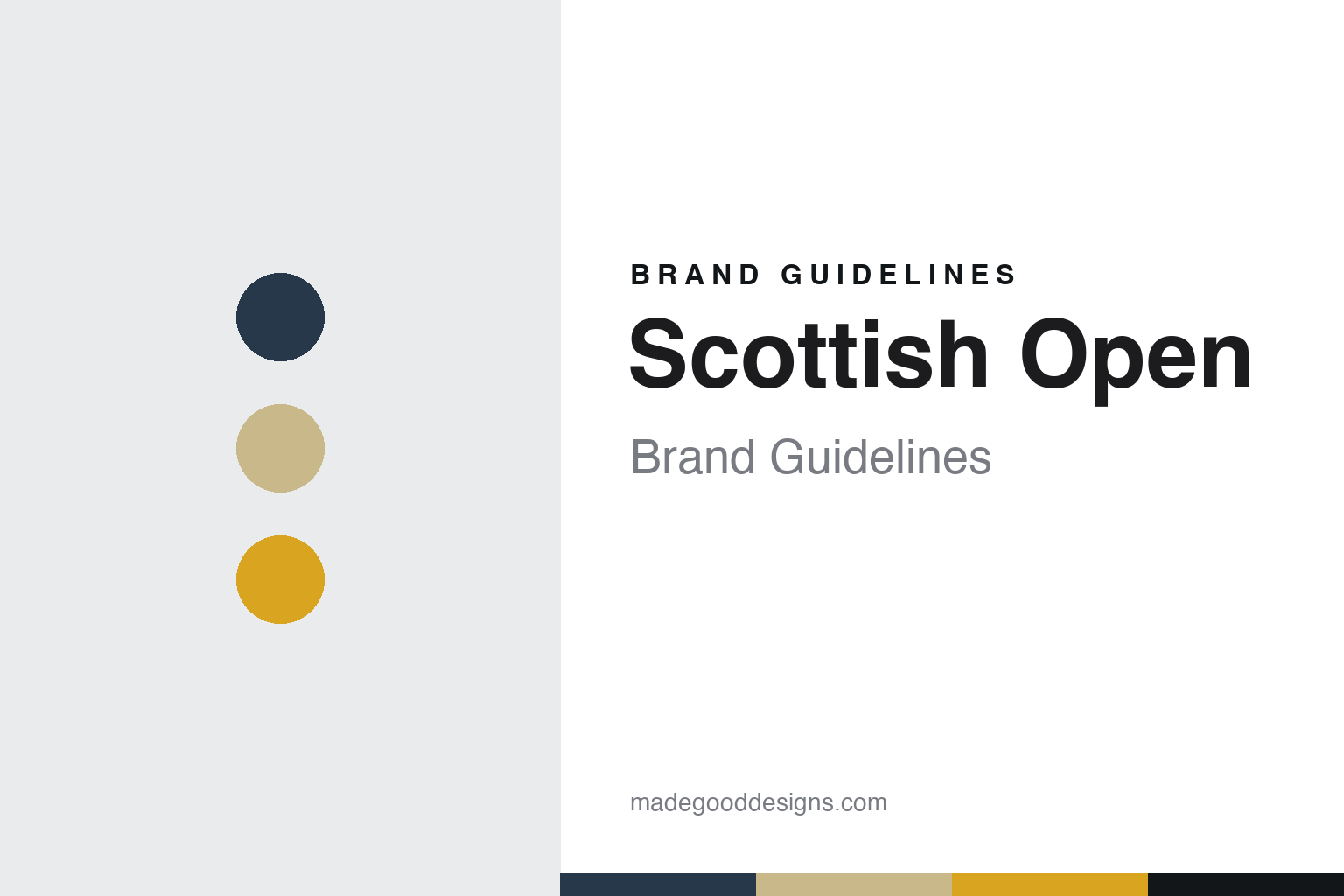
For a design guide, the Scottish Open shows how a national title can outlast many sponsors and venues once it finds a settled place in the calendar. Compare The Open Championship, which it precedes each July, and Carnoustie Golf Links, which hosted it in 1995 and 1996. For this guide we use a slate blue, a pale marram tone and a gorse yellow with a condensed sans, an unofficial interpretation; no product or logo is reproduced.
Explore & save
Keep Scottish Open’s identity on hand — save it to a board in the Made Good inspiration library.
Scottish Open identity set
Pin the Scottish Open slate, marram and gorse palette and the condensed sans register to your own board.
Source & notes
Frequently Asked Questions
What font can I use to match the Scottish Open look?
This guide describes Scottish Open’s type as “A condensed sans for a links event on the Firth of Forth”. Its type specimen is set in Barlow Condensed from Google Fonts as a stand-in; Barlow Condensed is not Scottish Open’s own lettering.
What colours are in the Scottish Open palette?
This guide’s Scottish Open palette is Firth slate #26384A, Ink #121619, Marram #C9B98A, Gorse #D9A520 and Haar #F2F2EE. The tones are the guide’s own unofficial interpretation, not official Scottish Open hex codes.