Luisa Roldán made sculpture that was meant to be read at close range, and that makes it useful to anyone who designs for a screen or a page. Her figures are small enough to hold a viewer’s attention at arm’s length, but they are organised like a poster: one clear shape, a handful of strong colours, and gestures that point the eye where she wants it. Spanish writers call her La Roldana, and she worked in polychrome wood and in terracotta, a material then less common in Spain than in Italy.
This guide looks at her work as a designer would: composition, colour, surface and signature, followed by a short outline of her career and a few ways to borrow her methods. One work, held by the Metropolitan Museum of Art and flagged public domain, is shown below. For more free images, see the MGD museum inspiration collection.
Who was Luisa Roldán?
Luisa Roldán was born in Seville and was one of several children of the sculptor Pedro Roldán, in whose workshop she trained. The Metropolitan Museum gives her dates as 1652–1706; other references give a birth year as early as 1650 and one encyclopedia entry lists 1656–1704, so treat the birth year as approximate. Accounts drawing on the Getty Museum record that she married Luis Antonio de los Arcos, a sculptor from her father’s shop, in 1671 and that the match went against her father’s wishes. Most accounts place the marriage in 1671, while one gives 1672.
According to the Indiana University Art Museum’s biography, she worked in Cádiz from about 1686 to 1688 and moved to Madrid in 1688 or 1689, hoping for a court appointment. The Getty Museum and other sources record that she was named escultora de cámara, sculptor to the royal chamber, in 1692, serving Charles II. After his death in November 1700 and the arrival of Philip V, she presented the new king with two small terracotta works in 1701, according to the Met, and petitioned to keep her post. She died in Madrid in January 1706; the Getty gives 19 January, while the Galería de las Colecciones Reales gives 10 January.
What to look at in a Luisa Roldán sculpture
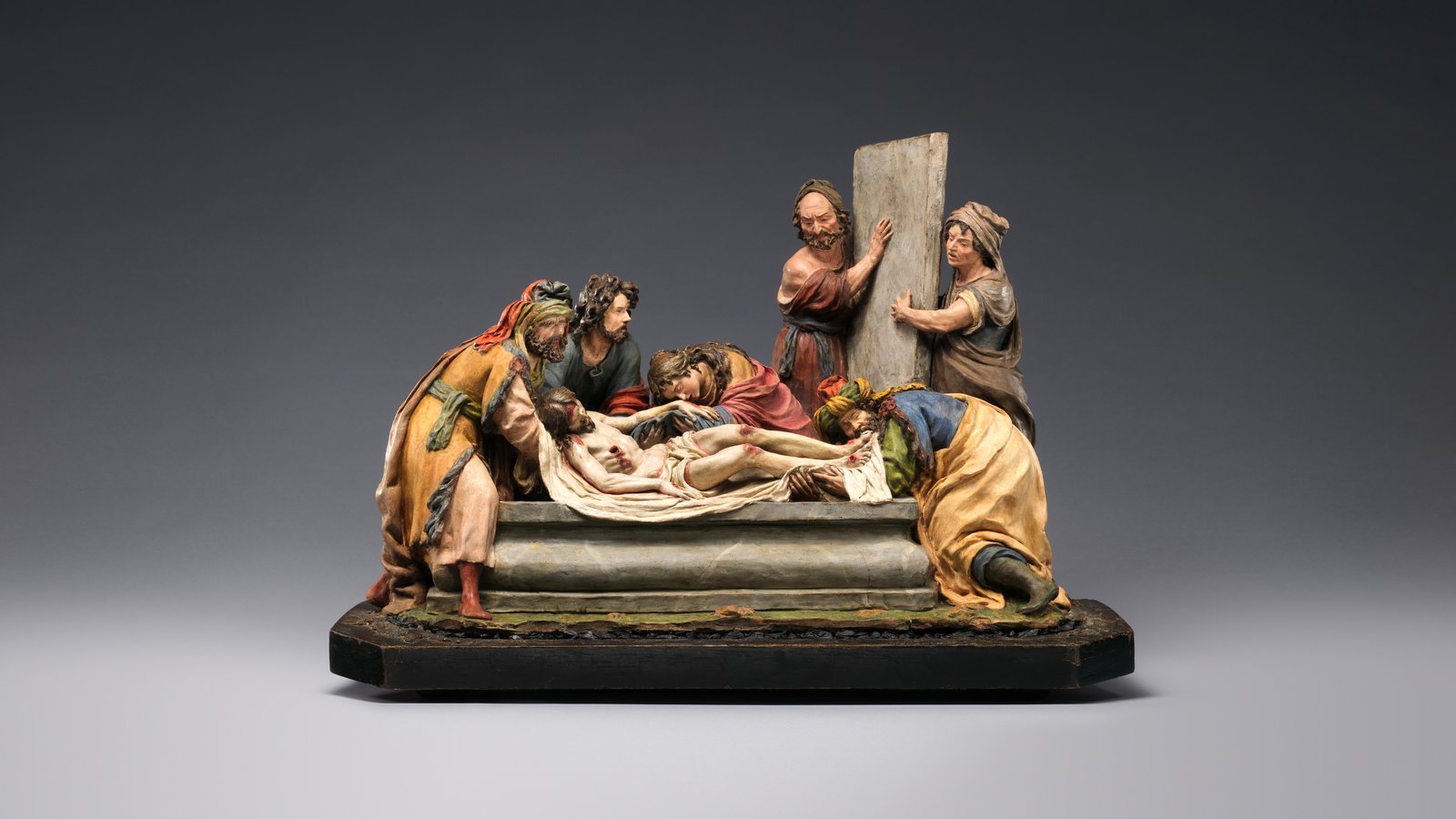
Start with the silhouette. In The Entombment of Christ, now at the Met, the mourners lean inward toward a single point, the shrouded body laid across a plain stone tomb. The group forms a low, wide triangle with a slab of stone rising behind it, so the eye has a vertical anchor to balance the horizontal body. Designers will recognise the principle: one dominant diagonal, one counter-weight, and every secondary figure pointing back to the focal point.
Next, count the gestures. Each mourner has a distinct task: one supports, one kneels, one steadies the slab. Nobody is a spectator, which is also how good editorial layouts work: each element has a job.
Then look at scale. The Met lists the group at about 49.5 × 66 × 43.2 cm, small enough to be read at arm’s length. At that size the faces carry much of the emotion, and the painted details matter as much as the modelling.
Colour: saturated hues against quiet neutrals
In the Met’s photograph the garments are the loudest notes: mustard and ochre, a blue sleeve, a red, green trim. The stone tomb and slab are a muted grey-green, so the colour sits on the figures and the setting stays calm.
Measured from the museum’s scan of this group, using a quantised crop of the sculpture, the dominant tones include a warm tan (#ba9873), a pale cream (#e7c8a1), a burnt orange-brown (#9c734f), a dark brown (#644839) and a near-black (#271e14); the studio backdrop reads as a neutral grey (#4d4b4c). These values describe the photograph, not the original pigments.
For a designer, the takeaway is the ratio. Roldán does not spread colour evenly. She puts the most saturated hues where the story happens and surrounds them with desaturated passages. Try the same structure in a brand layout: one or two vivid accent colours on the focal content, neutral grounds everywhere else. To test combinations, the colour palette generator can pull a palette from any reference image you are allowed to use.
Surface: carving, gesso and estofado
Roldán’s large wooden figures were collaborative objects. The Getty’s study of her Saint Ginés de la Jara, dated about 1692 and inscribed as the work of Luisa Roldán, sculptor to the royal chamber, records a division of labour: she carved the figure from pine and cedar, with glass eyes, and the polychromer Tomás de los Arcos painted it. The Getty describes the skin as built up in thin layers of glue and gesso, and the robe as finished with estofado, a technique in which gold leaf is covered with paint and then scratched through so the gold shows in a pattern that imitates brocade.
For screen work, treat surface as a layer system: form, ground, colour and a metallic pattern layer, each with its own job, much like layout, base colour, type and a finishing detail.
Terracotta and the court: a change of material
The Met’s record describes The Entombment of Christ as polychrome terracotta dated 1700–1701, and says it was one of two small sculptures Roldán gave to Philip V in 1701 when asking to be appointed to the court. The museum’s MetCollects feature notes that, in adapting to court tastes, she turned to clay, a material more widely used in Italy than in Spain.
Clay is built up rather than cut away, so it suits crowded groups. In the Met group the figures overlap, bend and reach in ways that would be difficult to cut from a single piece of timber. It is a good example of a material choice driving composition, and of a maker pitching a new client with a small, portable sample of her work.
Key works and where to see them
- Saint Ginés de la Jara, about 1692, J. Paul Getty Museum. Polychromed wood with glass eyes, with painting by Tomás de los Arcos, as described by the Getty.
- Saint Michael, 1692, El Escorial. Accounts of her career, including the Indiana University Art Museum’s, place a Saint Michael with the devil at the monastery of El Escorial in that year.
- The Entombment of Christ, 1700–1701, Metropolitan Museum of Art. Polychrome terracotta, 49.5 × 66 × 43.2 cm, acquired by the Met in 2016.
- Angels mourning over Christ after the flagellation, early 18th century, Metropolitan Museum of Art. Terracotta, polychromed and gilt, about 26.7 × 24.1 cm; not shown here.
- Virgin and Child, National Gallery of Art. A small carved and painted statue, noted in the museum’s acquisition announcement.
Her sculptures sit within the wider story of Spanish and European Baroque art. For another Spanish Baroque artist, see Alonso Cano.
How designers can borrow from Luisa Roldán
- Give every element a job. Audit a layout the way you would audit the Entombment: remove any figure, or card, that is only watching.
- Lead with a diagonal, balance with a vertical. A low horizontal group plus one upright, like the slab behind the tomb, stabilises a busy composition.
- Concentrate saturation. Put your loudest colour on the focal content and keep the surrounding ground quiet.
- Build surface in layers. Form, ground, colour, pattern: a pattern scratched through to a metallic or contrasting layer is the estofado idea, and it translates to a foil, a spot varnish or a gradient accent.
- Design for the distance of use. If your piece is read at hand’s length, spend detail on the faces and focal points.
Before reusing any museum photograph, check its rights status; the guide to public domain art explains what to look for.
Frequently asked questions
Who was Luisa Roldán?
Luisa Roldán, called La Roldana, was a Spanish Baroque sculptor born in Seville and trained in the workshop of her father, Pedro Roldán. She worked in Cádiz and Madrid and held the post of sculptor to the royal chamber from 1692, under Charles II and then Philip V.
When did Luisa Roldán live?
The Metropolitan Museum gives 1652–1706. Other references give an earlier birth year, between 1650 and 1656, and some list her death as 1704. For her death in Madrid in January 1706, the Getty gives 19 January and some other sources give 10 January.
What materials did La Roldana use?
She carved polychrome wood, such as the pine and cedar Saint Ginés de la Jara at the Getty, and modelled polychrome terracotta, such as the Entombment of Christ at the Met. The Getty also describes estofado, a technique of scratching through paint to reveal gold beneath.
Where can I see Luisa Roldán’s work?
Museum holdings include the Metropolitan Museum of Art in New York, the J. Paul Getty Museum in Los Angeles and the National Gallery of Art in Washington. Her works also remain in Spain, including at El Escorial, according to accounts of her career. Check each institution’s catalogue for what is on display.