Moïse Kisling is a painter whose pictures reward a designer’s eye: a figure, a plain ground, a small number of colour decisions. He arrived in Paris as a teenager from Kraków, worked among the foreign-born artists of Montparnasse, and left portraits, still lifes and landscapes that museums on both sides of the Atlantic still show. The Met and the Art Institute of Chicago do not flag his objects as public domain, so this guide describes the work in words and points you to the museums that hold it. For public domain images you can reuse, browse the MGD museum inspiration collection.
Who was Moïse Kisling?
The Metropolitan Museum of Art records him as French, born in Poland, Kraków 1891 to 1953 Sanary-sur-Mer. Biographies from galleries and reference sites give his birth as 22 January 1891 and his death as 29 April 1953, and say he studied at the School of Fine Arts in Kraków before moving to Paris in 1910 at the age of nineteen. One gallery biography, from Hélène Bailly, gives 1911 for the move, so treat the year as 1910 or 1911 depending on the source.
Several biographies report that he joined the French Foreign Legion when the First World War began, was wounded, and afterwards became a French citizen. After the war he lived and worked in Paris, spent the Second World War years in the United States, and returned in 1946 to settle at Sanary-sur-Mer on the Mediterranean coast, according to the gallery biographies consulted.
He is usually placed in the École de Paris, the loose grouping of artists from many countries who worked in the city between the wars. That label describes a place and a moment rather than a style, which is useful to know before you search for his influences: you will not find a manifesto, only a studio habit.
What museums say about his work
The Metropolitan Museum of Art lists several objects connected with him, and each tells you something different.
Boy in Blue, about 1928. An oil on canvas measuring 25 3/4 by 20 1/8 inches (65.4 by 51.1 cm), bequeathed to the Met by Adelaide Milton de Groot in 1967. The Met classes it as a portrait and tags it with the subject “boys”. The canvas is vertical, about four units wide to five high.
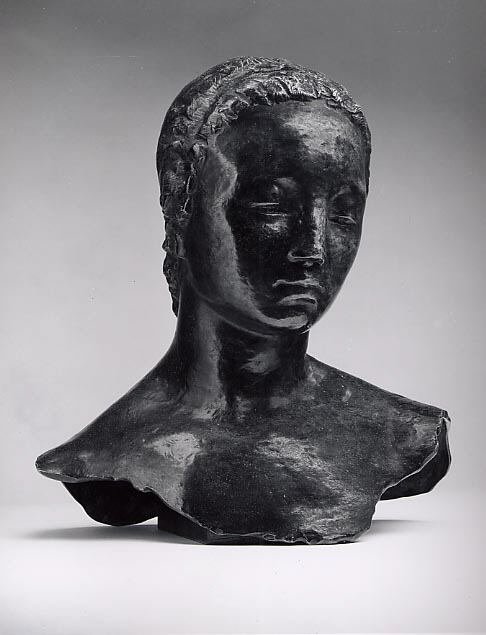
Death Mask of Modigliani, about 1920. A bronze, 8 1/2 by 5 1/2 by 4 3/4 inches, a gift of Phyllis Lutyens in 1972, credited by the Met to Kisling. Amedeo Modigliani died on 24 January 1920. The National Gallery of Art in Washington credits its bronze cast to Jacques Lipchitz, assisted by Conrad Moricand and Kisling, with the model dated 1920 and the cast 1929, so attribution of the mask varies by museum and by cast. If you cite it, name the museum you are quoting.
André Derain, Moïse Kisling, 1921. The Met holds this oil portrait of him by a fellow painter, which is a useful reminder of how he was seen by his own circle.
His calling card. The Met also holds a letterpress calling card for Moïse Kisling, dated about 1910 to 1924, from the F. C. Schang gift. It is a tiny piece of printed ephemera, and a good prompt for the lettering section below.
The Art Institute of Chicago holds André Kertész’s 1933 gelatin silver print Chez Kisling, Paris, showing the interior of his Paris home. Several gallery and reference biographies say that the Petit Palais museum in Geneva holds a large collection of his paintings.
What to look at: face, ground and palette
Because his paintings are not available as public domain files, study them the way a designer studies a reference: in person where you can, in museum catalogues and online records, and by making your own notes. These are the questions worth bringing to a Kisling portrait.
- Where does the face sit? In a vertical portrait, check how far the eyes are from the top edge and how much ground surrounds the head. Sketch the thumbnail in three tones. The portrait ratio is a ready-made template for social cards and book jackets.
- How many colours carry the picture? Take a museum photograph, run it through a palette extractor and count the colours that cover most of the canvas. Our colour palette generator will do this in a minute. Use the result as a starting point, and note that a photograph of a painting records the photograph’s colour, not the pigment.
- What is the edge like? Look at where the figure meets the ground: is it a crisp contour or a soft transition? That choice is the same as choosing between a sharp mask and a feathered one in layout software.
- How is the signature handled? Check each museum record or catalogue entry for the inscription and its position before you borrow the idea.
Career outline for designers
The dates below come from museum records where possible and from reference biographies otherwise.
- 1891: born in Kraków, then part of Austria-Hungary.
- About 1910: moves to Paris, joining the community of foreign-born artists in Montparnasse.
- 1914 onward: serves with the French Foreign Legion, according to biographies from several galleries.
- 1920: Modigliani dies; Kisling is credited by the Met with a death mask of him, made about this year.
- 1921: Derain paints his portrait, now at the Met.
- About 1928: Boy in Blue, now at the Met.
- 1946: returns to France and settles at Sanary-sur-Mer.
- 1953: dies at Sanary-sur-Mer.
Montparnasse context: neighbours worth reading
Kisling is easiest to understand next to the people who surrounded him. The Modigliani mask places him beside a painter whose elongated faces are a standard reference in portrait design. Jules Pascin, another foreign-born Paris painter of the period, is covered in our own guide and makes a useful comparison: look at how each handles line, flat colour and the edge of a figure. For the movements around them, read our guides to post-impressionism, whose structured colour was part of the background for painters of his generation, and to expressionism, for contrast.
One reference biography names Derain and Cézanne as early influences. Hold that loosely, but it gives you a reading list: look at Cézanne and Derain, then return to Kisling and see what you recognise.
Technique: what the records say
The Met records Boy in Blue as oil on canvas and the mask as bronze. That is all the open museum data says about his materials, so do not describe brushwork or pigments you have not seen documented. Exhibition catalogues and museum technical files are the next step.
The mask is a lesson in credit lines. The Met credits Kisling, while the National Gallery of Art credits Lipchitz with two assistants. When you work with collaborators, name roles precisely.
How designers can borrow the ideas today
- Design a portrait template around one face. Use a vertical frame, a quiet single-colour ground and a figure that fills most of the height. Add a headline in one corner and nothing else.
- Limit the palette to four. Pick a background, a skin or product tone, one accent and one dark. Test with the image colour picker on a photograph you are allowed to use.
- Make the credit line part of the design. The Met’s calling card for Kisling is a small piece of letterpress printing. Try a name-only layout in a free typeface such as a plain serif from Google Fonts, set small and low.
- Write captions like a museum. Artist, title, date, medium, size, credit line. Copying that order makes any gallery page look trustworthy, as long as every detail is correct.
Where to see his work
Start with the Metropolitan Museum of Art in New York, which shows how his portraits and the mask are catalogued, then the Petit Palais in Geneva, which several biographies describe as holding a large collection of his paintings. The Art Institute of Chicago holds Kertész’s 1933 photograph of his studio home. Check each museum’s website for what is on view before you travel, since displays change. For more museum material you can reuse, the museum collection is the place to begin.
Frequently asked questions
Who was Moïse Kisling?
A painter born in Kraków in 1891 who worked in Paris from about 1910 and is associated with the École de Paris. The Met describes him as French, born in Poland, and gives his death place as Sanary-sur-Mer in 1953.
Where can I see Moïse Kisling’s paintings?
The Metropolitan Museum of Art holds Boy in Blue, about 1928, and the Petit Palais in Geneva is described by several sources as holding a large group of his work. Check the museums’ own pages for current display.
Are Kisling’s paintings public domain?
The open-access records for the Met and the Art Institute of Chicago do not flag his objects as public domain, so this guide uses no images. Do not assume that a museum photograph of his work is free to reuse.
What did Kisling have to do with Modigliani?
The Met credits Kisling with a bronze death mask of Modigliani made about 1920. The National Gallery of Art credits its cast to Jacques Lipchitz with assistance from Conrad Moricand and Kisling, so credits differ between museums.