AIG Women’s Open Brand Guidelines
From the Women’s British Open of 1976 to The R&A.
Aa
Two constants: a links navy, heather and sand palette and a clubhouse sans register. Abstract homage — not an AIG Women’s Open asset or mark; no trophy, logo or flag is reproduced.
Women’s British Open
An amateur championship opened to professionals, 1976.
The AIG Women’s Open was first played in 1976, BBC Sport reported in July 2020. English Wikipedia explains how it began: the Ladies’ British Open Amateur Stroke Play Championship, run by the Ladies’ Golf Union since 1969, was opened to professionals that year after two professionals, one of them Vivien Saunders, reached agreement with the LGU, citing The Glasgow Herald of July 1976. Only five professionals took part, Wikipedia says, and the title went to an amateur, Jenny Lee Smith, with Saunders the top-placed professional.
From 1979 the professional championship was separated from the stroke-play event, which went back to being amateur only. English Wikipedia says the organisers at first found it hard to persuade the most prestigious courses to act as hosts; Royal Birkdale was the exception, in 1982 and 1986. No championship was played in 1983, and the event then settled at courses such as Woburn, which held it in 1984, in every year from 1990 to 1996, and in 1999.
Recognition by the American tour came in stages. Until 1993 the championship was an official stop on the Ladies European Tour only, apart from 1984, when the LPGA Tour co-sanctioned it. From 1994 it became a permanent LPGA event, and since 2001 it has been an LPGA major, English Wikipedia says; it is recognised as a major by both tours. In 2005 the starting field was set at 150 players, with the low 65 and ties going through to the final two rounds.
Colour
Weetabix, Ricoh, AIG and The R&A.
The championship’s name has followed its title sponsors. English Wikipedia lists twenty editions, from 1987 to 2006, sponsored by Weetabix, the breakfast cereal, and the Ricoh Women’s British Open from 2007 to 2018. BBC Sport reported that AIG became title sponsor in 2019, the year the event was played as the AIG Women’s British Open.
The organiser changed in the same period. In February 2016 The Irish Times reported that the Ladies’ Golf Union and The R&A, both based in St Andrews, had agreed to merge. At the time a subsidiary of the LGU, LGU Championships Limited, ran the Ricoh Women’s British Open, the paper said, and the LGU’s business operations were to move into the R&A group of companies from 1 January 2017. English Wikipedia says The R&A has organised the championship since 2017, so that the men’s and women’s Opens are now run by the same body. The Irish Times described the LGU as the organising body for women’s amateur golf in Great Britain and Ireland, with its subsidiary also preparing teams for matches such as the Curtis Cup, and The R&A as the organiser of the Open Championship and of major amateur events and international matches, which governs the game worldwide together with the United States Golf Association.
The present name dates from July 2020. BBC Sport reported on 22 July 2020 that the Women’s British Open was being rebranded as the AIG Women’s Open as part of an extended sponsorship with AIG, and described the championship as one of five majors in women’s golf; that year’s edition was held at Royal Troon, the BBC said. English Wikipedia adds that dropping “British” brought the name into line with The R&A’s men’s and senior men’s championships, and that the older name is still widely used outside the UK.
Typography
Event identity, venue and format.
Professional golf tournaments and team cups present themselves through a small set of recurring elements: an event name, often joined to a title sponsor’s name, a trophy, a host course and a date in the season’s calendar. The organiser behind each event is usually named plainly, whether a professional association, a tour or a governing body, and sponsors and organisers can change over the decades while the event name carries on.
Trophies do much of the visual work. Many events are identified with a single cup that passes from one champion to the next, with a smaller replica kept by the winner, and the trophy’s history, from its donor to its travels, often becomes part of the event’s own story. Team cups add the colours of the sides that contest them.
The course is the other constant. Some events rotate between host clubs, so their identity has to travel from venue to venue; others have a permanent home, where a single hole, a clubhouse or a stretch of water becomes the image most closely tied to the event. On site, the look carries through tee markers, flags, scoreboards, grandstands and hospitality areas, all sharing the event’s name and colours during tournament week.
The events’ own histories are written as dated records: the year and venue of the first edition, changes of format such as the move from match play to stroke play, changes of date in the calendar, and the list of past host courses. This guide sets out what can be checked about each event from dated sources — who organises it, where it is played and how its format has changed — and describes the identity in words, with an unofficial palette and stand-in typefaces rather than any official mark.
Aa
A clear clubhouse sans for championship names, venues and dates. (Specimen set in Manrope, a sans STAND-IN; NOT the AIG Women’s Open logo.)
A rota of links and heathland
Woburn, St Andrews, Muirfield and more.
Unlike the men’s Open, the women’s championship has not adopted a links-only policy, English Wikipedia says, which widens the choice of venues, including courses close to England’s larger cities. Sunningdale, in Berkshire, hosted it in 1997, 2001, 2004 and 2008. As its standing grew, courses on the men’s Open rota followed: Royal Lytham & St Annes in 1998, 2003, 2006 and 2026; Royal Birkdale in 2000, 2005 and 2010; and the Old Course at St Andrews for the first time in 2007.
Since 2010 four more Open venues have hosted the women’s championship for the first time: Carnoustie in 2011, Royal Liverpool in 2012, Royal Troon in 2020 and Muirfield in 2022, English Wikipedia records. Since becoming an LPGA major the championship has generally been played in late July or early August; the 2012 edition moved to mid-September because of the London Olympic Games that summer, and the 2014 edition was played in mid-July.
The championship has its own piece of silverware for amateurs. The Smyth Salver goes for one year to the top-placed amateur who completes all 72 holes, together with a silver medal; it was given by Moira Smyth, a past president of the Ladies’ Golf Union, English Wikipedia says.
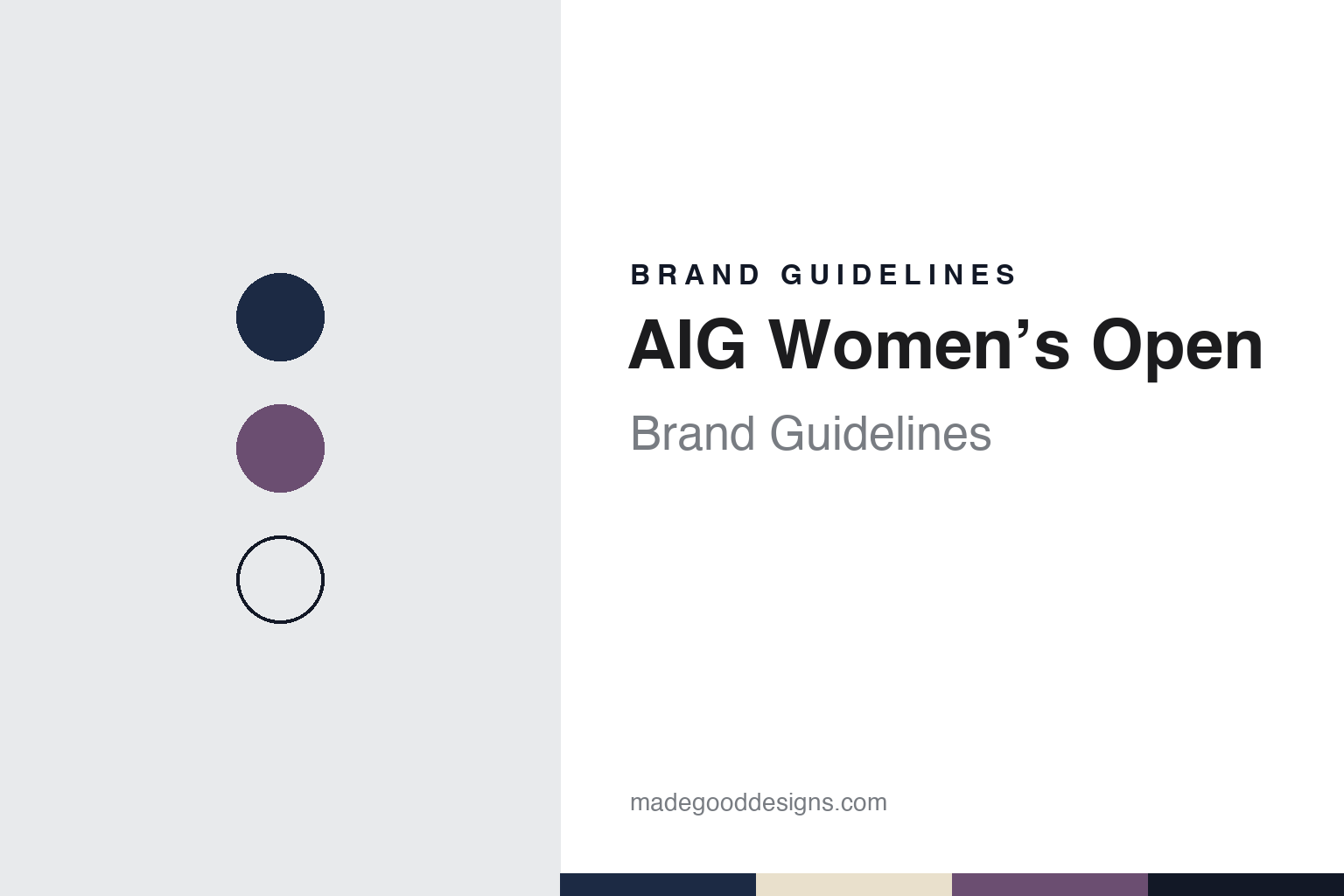
For this guide’s interpretation, the palette draws on the settings the venue list describes: a dark navy for the coastal links, a heather purple for heathland courses such as Sunningdale and Woburn, and a pale sand as the ground for dates, venue names and results. A clean geometric sans carries the championship name.
For a design guide, the AIG Women’s Open shows how a championship’s name can carry its history, from a Ladies’ Golf Union amateur event to the Weetabix and Ricoh Women’s British Open and the AIG Women’s Open run by The R&A. Compare The Open Championship, the men’s championship run by the same organiser, and Evian Championship, the other women’s major co-sanctioned by the two tours. For this guide we use a dark links navy, a heather purple and a pale sand with a sans, an unofficial interpretation; no product or logo is reproduced.
Explore & save
Keep AIG Women’s Open’s identity on hand — save it to a board in the Made Good inspiration library.
AIG Women’s Open identity set
Pin the AIG Women’s Open links navy, heather and sand palette and the clubhouse sans register to your own board.
Source & notes
Frequently Asked Questions
What font can I use to match the AIG Women’s Open look?
This guide describes AIG Women’s Open’s type as “A clear clubhouse sans for championship names, venues and dates”. Its type specimen is set in Manrope from Google Fonts as a stand-in; Manrope is not AIG Women’s Open’s own lettering.
What colours are in the AIG Women’s Open palette?
This guide’s AIG Women’s Open palette is Links navy #1C2A44, Ink #121826, Heather #6B4E71, Links sand #E9E0CC and Paper #F7F5F0. The tones are the guide’s own unofficial interpretation, not official AIG Women’s Open hex codes.