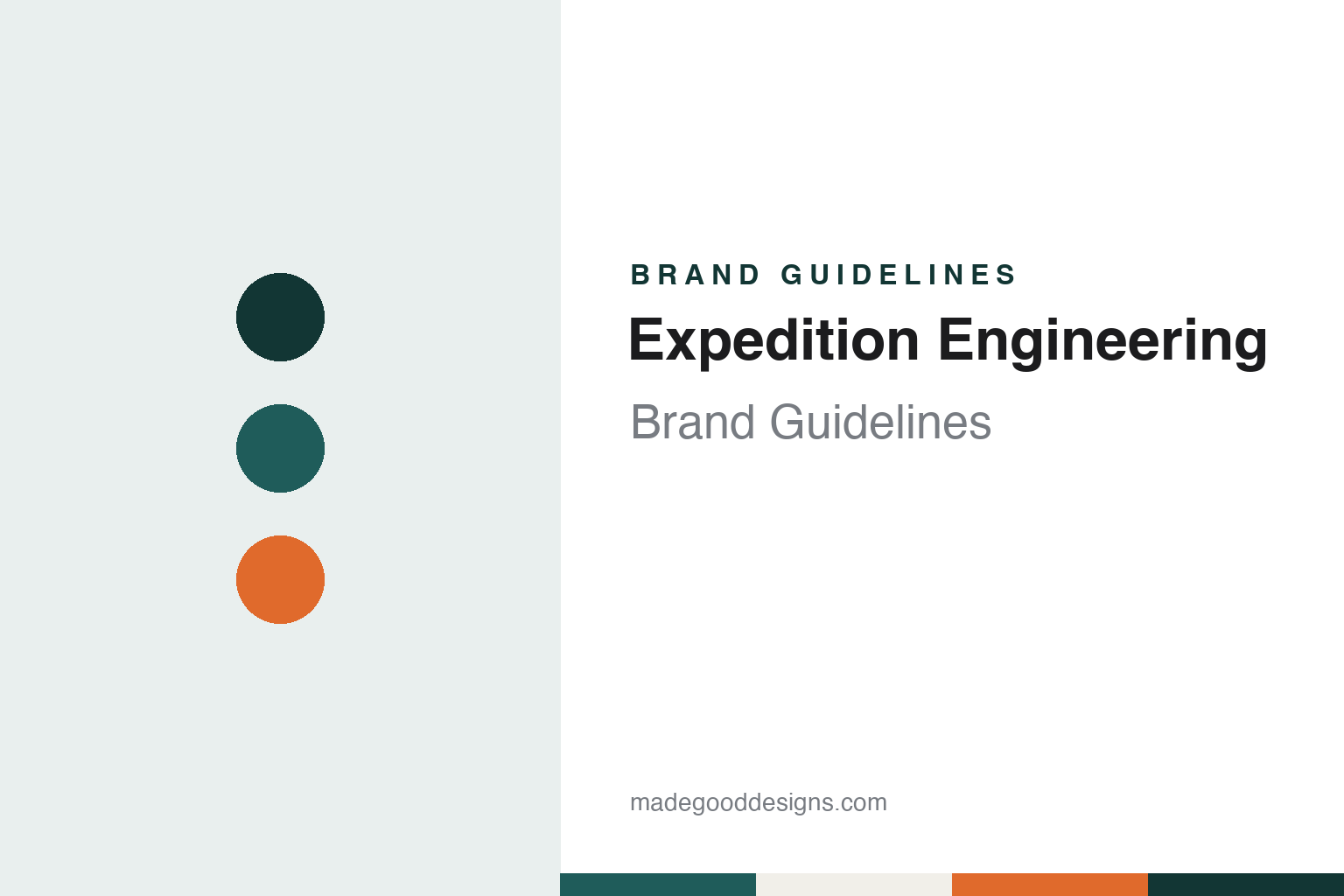
Expedition Engineering Brand Guidelines
The London engineers owned by a trust since 2008.
Aa
Two constants: an Expedition Engineering teal, chalk and orange palette and an Engineered sans register. Abstract homage — not an Expedition Engineering drawing or mark; no structure, logo or project image is reproduced.
Two engineers from Arup
A London practice founded in 1999.
Expedition Engineering is a London engineering consultancy founded in 1999 by Chris Wise and Seán Walsh, both formerly of Arup, according to English Wikipedia. Wikipedia’s entry on Wise says he joined Ove Arup and Partners in 1979, worked in the United Kingdom, Australia and the United States, and became a director of the firm in 1992 before leaving in 1999 to start the new practice with Walsh.
The practice began as a structural engineering firm, and Wikipedia still describes it that way. Its own website now groups the work into four areas: infrastructure performance consulting, structural engineering, civil engineering and utilities infrastructure, and sustainability masterplanning. Under structural engineering it lists bridges, timber structures, the transformation of existing buildings and forensic engineering, among other services.
The name has stayed the same since the start. The website sits at expedition.uk.com, and the practice is written in full as Expedition Engineering, or simply Expedition in its own news items and in trade-press reports. It is not connected with Exped, the outdoor-equipment maker, or with any vehicle of that name.
Wise has also kept an academic role. English Wikipedia says that since 2012 he has spent two days a week at University College London as Professor of Civil Engineering Design, and that he was earlier a professor of creative design at Imperial College. In 2026 the practice’s website lists both Wise and Ed McCann as senior directors.
Colour
Bridges, a velodrome and a gantry.
The projects most often credited to Expedition are bridges and sports buildings. In May 2009 New Civil Engineer reported the opening of the Infinity Bridge across the River Tees at Stockton-on-Tees, linking a waterfront development with the Teesdale area and Durham University’s Queen’s campus. The magazine credited the bridge’s double-arch design to Expedition Engineering, with fabrication by Cleveland Bridge, construction by Balfour Beatty and project management by White Young Green, for Stockton-on-Tees Borough Council.
Three years later, in September 2012, the same magazine described the practice’s group as the London structural engineering company “behind the 2012 Velodrome,” the cycling track building for the London Olympic Games, which English Wikipedia lists among Expedition’s projects with a date of 2011. The report concerned a new office in Rio de Janeiro and quoted Ed McCann as a director of Useful Simple, the trust that owns the practice. English Wikipedia also lists 55 Baker Street in London, dated 2007, among its projects.
Its work has also reached road infrastructure. In March 2023 New Civil Engineer reported that a design by Useful Studio and Expedition Engineering, both part of the Useful Simple Trust, had been chosen as the new design for National Highways’ motorway gantries, the frames that carry signs over England’s motorways and A-roads. The magazine described a thick trapezoidal upright that tapers slightly at the top and sits on a steel foundation grillage, a trapezoidal cantilevered arm whose underside narrows to a thin end, and a modular system that can be built off site and adapted to spans from one lane to eight. The team was led by Useful Studio founding director Catherine Ramsden with Chris Wise and Ed McCann.
Beyond projects, English Wikipedia notes the practice’s involvement in teaching, including Constructionarium, a hands-on construction programme for students, and the Expedition Workshed website, a set of educational tools for engineering students.
Typography
Design and documentation.
Structural and façade engineering consultancies rarely sell a product, so their identity rests on a name and a record. Many carry the surnames of founders or partners, sometimes joined by a plus sign or an ampersand, sometimes run together in lower case, and many shorten to initials in everyday use. The wordmark is usually typographic rather than pictorial: a plain sans or a restrained serif, set on a quiet background, with one accent colour at most.
The work itself does most of the talking. Websites, brochures and monographs lead with project photography of bridges, stadium roofs, glass façades, towers and temporary pavilions, often shot at dusk or from below to show cables, members and joints. Alongside the photographs come drawings, sections, physical and digital models and construction sequences, and the projects are credited together with the architects and builders who worked on them, since an engineer’s name rarely appears on a building alone.
Writing about these firms tends to follow the same pattern. Founders and partners are described in their professional roles, with dates for when they joined or took over; ownership is set out plainly, whether a partnership, a firm owned by its employees or a practice absorbed into a larger group; and renamings and mergers are dated. History pages trace a practice back through earlier names, and office pages list the cities where teams are based, often with the year each office opened.
This guide follows that approach. It sets out what dated sources say about each firm: who founded it, how its name and ownership changed, where it works and which projects independent publications credit to it. It describes what was engineered rather than what it achieves, and it treats the palette and typefaces shown here as an unofficial interpretation, not the firms’ own identity.
Aa
An engineered sans — a practice name written in full. (Specimen set in Archivo, a sans STAND-IN; NOT the Expedition Engineering logo.)
Expedition Engineering
Owned by its trust since 2008.
Ownership is the defining fact of the practice’s structure. On 2 October 2008, English Wikipedia says, Expedition’s ownership was restructured and passed to an employee benefit trust called the Useful Simple Trust. Wikipedia’s entry on Wise adds that he, Walsh and McCann, the three remaining shareholders, gave the company over to the benefit of its employees. Wikipedia lists the trust’s trustees as including Mike Davies, a founding director of the Richard Rogers Partnership, Duncan Michael, a former chairman of Ove Arup & Partners, and the theatre designer Tim O’Brien, alongside Wise, Walsh and McCann, so the board joined engineering, architecture and the stage. The practice’s website now describes it as a B Corp, a social enterprise and an employee benefit trust business, independent of external shareholders.
The trust has gathered several practices under one roof. Wikipedia lists the communication design studio Thomas Matthews, the education company Think Up, the consultancy Useful Simple Projects and the architecture studio Useful Studio alongside Expedition. A 2022 article on Expedition’s website named Useful Projects, Expedition Engineering, Thomas.Matthews and Useful Studio as the group’s members. In 2026 the trust’s own website lists three brands, Expedition Engineering, Useful Projects and Useful Studio, and says it has closed the Thomas.Matthews studio and brought its design work into the trust.
That shared ownership shows in how the practice presents itself. Expedition’s pages carry the trust’s name in staff titles, with group roles marked UST, and the trust’s site links each brand from a single page. The 2023 gantry design, credited jointly to Expedition and Useful Studio, is an example of two of the trust’s practices working on one commission. The trust’s site also marks 25 years of Expedition, which matches the 1999 founding.
For a design guide, Expedition Engineering shows a practice whose name has stayed fixed while its ownership moved to a trust and its services widened from structures to infrastructure and masterplanning. Compare Arup, the firm both founders came from, and Elliott Wood, another London structural engineering practice. For this guide we use a deep teal, chalk and a warm orange with a sans, an unofficial interpretation; no product or logo is reproduced.
Explore & save
Keep Expedition Engineering’s identity on hand — save it to a board in the Made Good inspiration library.
Expedition Engineering identity set
Pin the Expedition Engineering teal, chalk and orange palette and the Engineered sans register to your own board.
Source & notes
Frequently Asked Questions
What font can I use to match the Expedition Engineering look?
This guide describes Expedition Engineering’s type as “An engineered sans — a practice name written in full”. Its type specimen is set in Archivo from Google Fonts as a stand-in; Archivo is not Expedition Engineering’s own lettering.
What colours are in the Expedition Engineering palette?
This guide’s Expedition Engineering palette is Tees teal #1F5C5A, Deep channel #123634, Chalk #F1EFE9, Arch orange #E06A2C and Paper #F8F7F4. The tones are the guide’s own unofficial interpretation, not official Expedition Engineering hex codes.
When was Expedition Engineering founded?
Expedition Engineering was founded in 1999, in London, England. Expedition Engineering is known for Infinity Bridge, London 2012 Velodrome.
Who founded Expedition Engineering?
Expedition Engineering was founded by Chris Wise and Seán Walsh in 1999.
Who owns Expedition Engineering?
Expedition Engineering is owned by Useful Simple Trust (since 2 October 2008).