Domus Academy Brand Guidelines
The Milan design school that grew out of a publishing house.
Aa
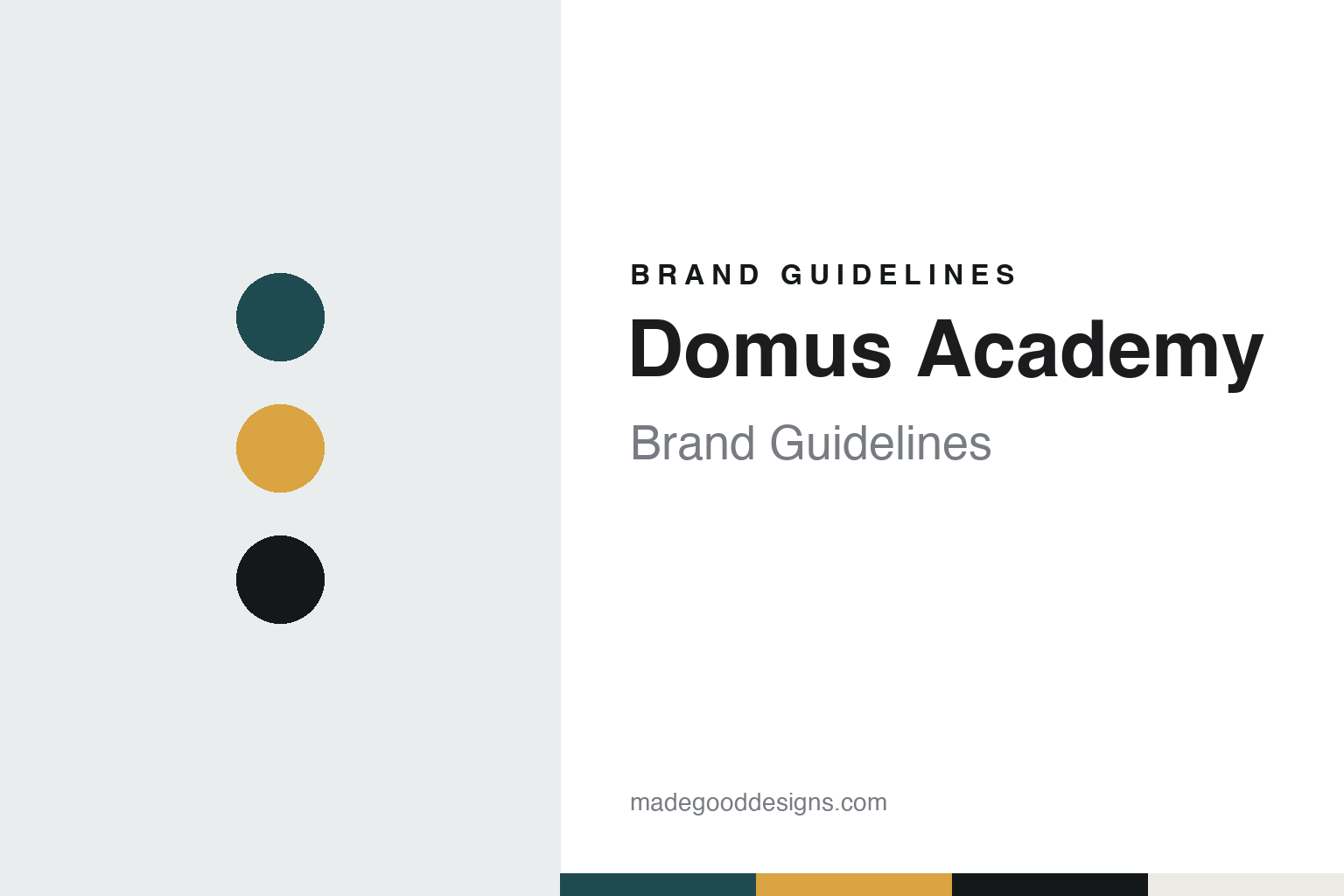
Two constants: a teal, ochre and black palette and a grotesque sans register. Abstract homage — not a Domus Academy mark; no logo, student work or building is reproduced.
A school from a publisher
The Mazzocchi family, Editoriale Domus and Andrea Branzi.
Domus Academy was founded in Milan in 1982. English and Italian Wikipedia, citing a 2004 history of Italian design and a 2010 report in La Repubblica, say it was founded by the Mazzocchi family, the owners of the publishing house Editoriale Domus, which publishes the architecture and design magazine Domus and the motoring magazine Quattroruote. Maria Grazia Mazzocchi served as president of the school, according to both articles.
The school and the magazine share a name but are separate organisations: the academy was a project of the same publishing family, set up as a school rather than as part of the magazine itself.
The architect and designer Andrea Branzi, a founder of the studio Archizoom Associati, was closely involved from the start. Dezeen reported in October 2023 that Branzi co-founded the Domus Academy postgraduate school of design in 1982 and acted as its cultural director for a decade. The school’s own magazine, in a December 2025 article, says the idea of a new school came from Maria Grazia Mazzocchi with two designers, that an art critic recommended Branzi as its first director, and that Branzi helped define the school’s teaching approach, in which faculty were meant to guide rather than lecture and students were treated as collaborators.
The school says it was set up because, in the early 1980s, Milan had become a centre of Italian design without a school teaching design in a formal way. Italian Wikipedia places its beginnings in the context of Italian radical design and the experimental Global Tools network of 1973 to 1975.
Colour
Fashion, a methodology and two owners.
Fashion was part of the school early on. English Wikipedia, citing a 2008 book on his career and Italy’s national archive of twentieth-century fashion, says the fashion designer Gianfranco Ferré was on the staff from 1983 to 1989. Italian Wikipedia says that in the 1980s and 1990s the school developed master’s programmes in fields such as fashion design, industrial design and communication, often with companies and cultural institutions.
The school calls its teaching method “learning by designing,” and says most of its curriculum is built around cross-disciplinary workshops with companies. It describes the early years as a time when well-known designers took part as lecturers and workshop leaders. Italian Wikipedia names company partners for these workshops including Ferrari, IKEA, Samsung and Condé Nast. On its website in 2026 the school says its students represent more than 65 nationalities and that 93 per cent of them are international.
Ownership changed twice. A press release from Laureate Education of Baltimore, issued in January 2010, announced that Domus Academy and NABA, the Nuova Accademia di Belle Arti in Milan, had joined the Laureate International Universities network; English and Italian Wikipedia date the purchase to 2009. In November 2017, The PIE News reported that Galileo Global Education had acquired three Laureate schools: Domus Academy, NABA and European University Cyprus. The report said Galileo would create an Italian division, Gruppo Galileo Italia, and that the schools would keep their own brand identity and courses. Galileo already owned the Milan fashion school Istituto Marangoni, and the report said the group then operated in eight countries, including France, India, China and Senegal. Italian Wikipedia dates the change of control to the end of 2018. Domus Academy and NABA have shared owners since 2009.
Italian Wikipedia says the school now offers three-year undergraduate courses, two-year specialist courses and master’s courses in fashion design, industrial design, design management, business design, product design and luxury brand management, taught in English, and that its academic master’s titles are awarded through NABA, which is on the Italian ministry’s list of institutions authorised to award higher arts qualifications. It adds a dual-award master’s route with Regent’s University London, and places the campus in Milan’s Navigli district, with design and fashion laboratories, a library and digital spaces. English Wikipedia lists the school as a member of the Cumulus Association, the international network of art and design schools.
Typography
Design and documentation.
Fashion schools often introduce themselves through their names. Many name a city or a country outright, or describe what they teach in plain words, as the Fashion Institute of Technology in New York and the Fashion Institute of Design & Merchandising in Los Angeles did. Long names tend to shrink into acronyms in everyday use — FIT, FIDM, LCF, IED, IFM, NABA — and the short form often becomes the name people know, set as a wordmark on signage, websites and graduate-show material.
Buildings carry much of the identity. Some schools began in borrowed space: FIT, its own history says, opened in 1944 on the top two floors of a New York trade high school before moving into its first building on Seventh Avenue in 1959. New buildings are presented as statements of their own, such as the Joyce F. Brown Academic Building that SHoP Architects designed for FIT, which opened in October 2025 with exhibition cases showing student work to the street.
Parent bodies shape how a school is named and described. FIT is a college of the State University of New York; London College of Fashion belongs to University of the Arts London; other schools sit within private education groups. Names also change hands. FIT dropped the word “Design” from its original title early on, and in 2023 Arizona State University renamed its fashion programme ASU FIDM, a name that continued after the independent Los Angeles college closed in March 2025.
Graduate shows are a recurring public face. FIT holds fashion shows of work by graduating Bachelor of Fine Arts students each year, and graduate collections elsewhere are typically shown under the school’s own name. This guide looks at how each school documents its founding, owners, buildings and shows, and treats colours and type as our own interpretation.
Aa
A plain grotesque for a school that came out of a design magazine’s publisher. (Specimen set in Archivo, a sans STAND-IN; NOT the Domus Academy logo.)
Domus Academy
A borrowed name and a workshop method.
The name carries much of the identity. “Domus” is the Latin word for house, and in Milan it is also the title of one of the country’s design magazines. By carrying that word, the academy signals its origin in the publishing family behind the magazine, while the second word, “Academy,” written in English, frames it as an international school. The school teaches in English, and its name works in the same language.
The second thread is method. “Learning by designing,” the school’s own phrase, describes study organised around workshops and projects rather than lectures, and the school links that method to the founding ideas it attributes to Branzi. For a visual system this suggests a working, studio-like register: grids, sketches, project boards and plain type rather than ornament.
The third thread is ownership. Since 2009 the school has belonged to large education groups, first Laureate Education and then Galileo Global Education, and in both cases it has kept its own name alongside sister schools in Milan.
For a design guide, Domus Academy shows how a school can borrow the authority of a publication’s name while building a separate identity around its teaching method. Compare Domus, the magazine published by the founding family’s company, and NABA, its Milan sister school under the same owners. For this guide we use a deep teal, an ochre and a near-black with a sans, an unofficial interpretation; no product or logo is reproduced.
Explore & save
Keep Domus Academy’s identity on hand — save it to a board in the Made Good inspiration library.
Domus Academy identity set
Pin the Domus Academy teal, ochre and black palette and the grotesque sans register to your own board.
Source & notes
Frequently Asked Questions
What font can I use to match the Domus Academy look?
This guide describes Domus Academy’s type as “A plain grotesque for a school that came out of a design magazine’s publisher”. Its type specimen is set in Archivo from Google Fonts as a stand-in; Archivo is not Domus Academy’s own lettering.
What colours are in the Domus Academy palette?
This guide’s Domus Academy palette is Navigli teal #1F4A4F, Workshop ochre #D9A441, Press black #151819, Studio grey #ECEBE6 and Paper #F8F8F5. The tones are the guide’s own unofficial interpretation, not official Domus Academy hex codes.
When was Domus Academy founded?
Domus Academy was founded in 1982, in Milan, Italy. This guide lists Laureate Education (2009); Galileo Global Education (deal agreed 2017) as its owner.
Who founded Domus Academy?
Domus Academy was founded by the Mazzocchi family of Editoriale Domus in 1982.
Who owns Domus Academy?
Domus Academy is owned by Laureate Education (2009); Galileo Global Education (deal agreed 2017).