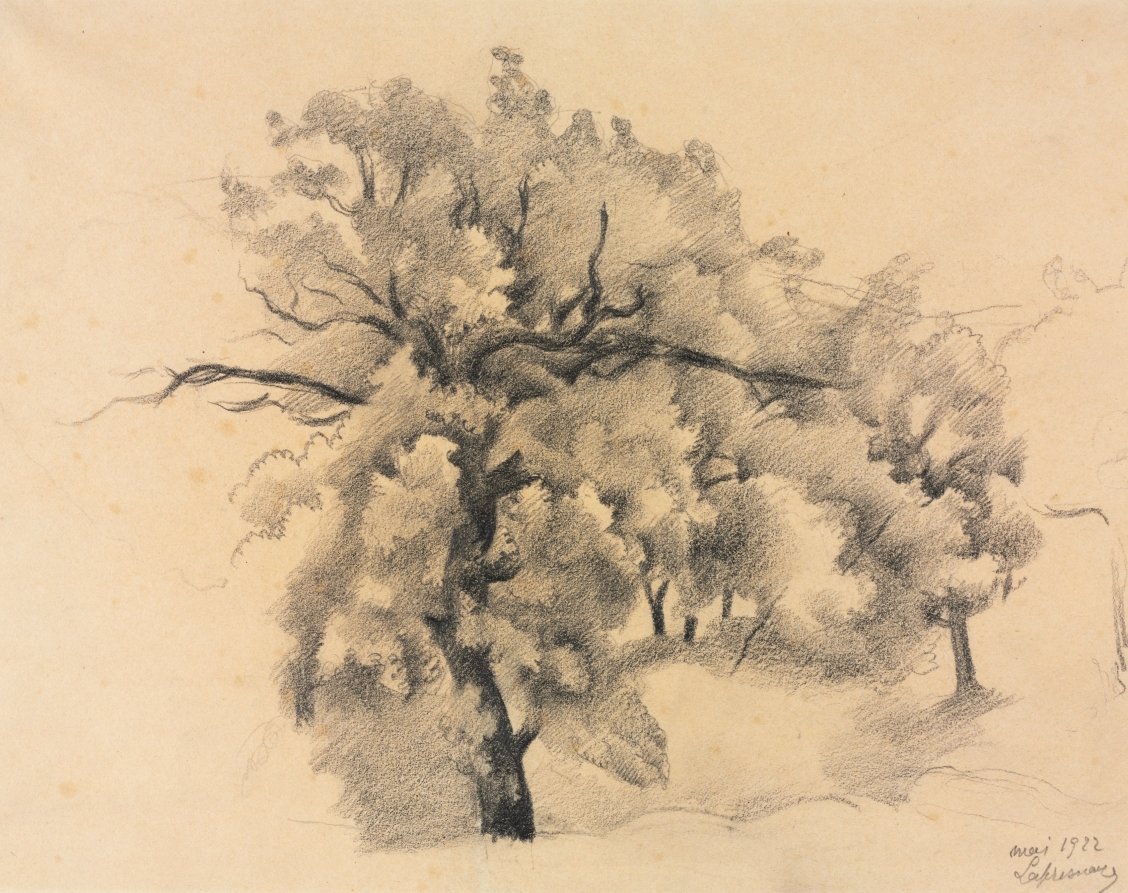
Roger de La Fresnaye is the Cubist to study if you like structure but still need the viewer to recognise what they are looking at. Where Picasso and Braque took objects apart, he kept his figures, flags and balloons whole and set them among clean, flat planes of colour. His career lasted barely fifteen years, and most of his paintings belong to museums that do not flag them as public domain, so they are described here in words. One drawing, a 1922 study of trees in the Cleveland Museum of Art, is released as CC0 and is shown below.
Who was Roger de La Fresnaye?
La Fresnaye was born in Le Mans in 1885 into an old Norman family. He trained in Paris at the Académie Julian and then at the Académie Ranson, where he was taught by the Nabi painter Maurice Denis, whose influence the Encyclopaedia Universalis sees in his early work. He also worked at sculpture with Aristide Maillol, and in 1911 he travelled in northern Italy.
His public career began at the Salon des Indépendants of 1911 with Cuirassier. In 1912 he joined the painters who met at the studio of Jacques Villon in Puteaux, a circle that included Albert Gleizes and Jean Metzinger, and he showed at their Section d’Or exhibition in Paris that autumn. The same year he worked on the Maison Cubiste at the Salon d’Automne.
When war broke out in 1914 he enlisted in the French army. His health collapsed during the war; The Art Story records that he contracted tuberculosis and was discharged in 1918. He spent his last years in Grasse, on the Riviera, working mainly on paper, and died there on 27 November 1925, aged forty.
Cuirassier and Artillery: the military pictures
Cuirassier (1910–11) is a square canvas of 179.5 × 179 cm in the Centre Pompidou’s Musée national d’art moderne, which bought it in 1938. The Pompidou describes it as a reworking of Théodore Géricault’s Romantic Wounded Cuirassier: instead of a defeated soldier, La Fresnaye paints a mounted horseman full of strength and determination, and the museum notes that Guillaume Apollinaire singled the picture out at the 1911 Indépendants.
Artillery (1911), in the Metropolitan Museum of Art, takes the same theme into a crowded scene: a gun carriage, horses, riders and a military band moving across the canvas. Both pictures break forms into faceted planes, but the subject stays legible at a glance, a trait that runs through all his Cubist work. The Art Institute of Chicago also owns a small woodcut of artillery by him, a reminder that he translated these motifs into print.
The Conquest of the Air: how the picture is built
The Conquest of the Air (1913) is his key painting and belongs to the Museum of Modern Art in New York. The Encyclopaedia Universalis and The Art Story both identify the two seated men as the artist and his brother; The Art Story adds that the brother was an engineer with the Nieuport aircraft company. They sit at an outdoor table above a landscape of fields, houses, a river and a sailing boat, with a small yellow balloon and a French flag in the sky.
Three decisions make it work as design.
- Flat planes of colour as the grid. Sky, clouds and land are cut into large, clean shapes of blue, white, green and ochre. The picture is held together by these colour fields rather than by perspective.
- Recognisable symbols at small scale. The balloon, the flag and the boat are tiny but unmistakable, set against the abstract planes the way icons sit on a dashboard.
- Figures large and calm. The two men fill the lower part of the frame and anchor everything around them.
The Art Story links the painting to the Orphism of Robert Delaunay, with its prismatic colour, while noting that La Fresnaye kept his images representational. The Centre Pompidou also holds a colour woodcut of the same title and year, 43.1 × 36.5 cm, bequeathed by Simone de La Fresnaye in 1982, which shows how readily the composition converted into a print.
Interiors, objects and the Maison Cubiste
The Maison Cubiste, shown at the 1912 Salon d’Automne, was a model house with a Cubist façade by Raymond Duchamp-Villon and interiors coordinated by André Mare. The Art Story credits La Fresnaye with doors, clocks, candlesticks and other fittings; the Encyclopaedia Universalis says more briefly that he helped decorate it. For designers this is the point where Cubism stops being only a way of painting and becomes a way of furnishing a room.
The same interest in objects runs through his still lifes. The Met holds Still Life with a Diabolo (about 1914), and the Art Institute of Chicago has a charcoal Still Life with Books, Bottle and Pitcher (about 1912) and a large charcoal Woman with a Parasol (1912). In the Centre Pompidou, Seated Man (1913–14), also called The Architect, is a canvas of 130 × 165 cm split into two parts: a geometric still life on the left and a faceless seated figure filling the full height on the right, against blocks of primary colour. The museum notes that the left-hand still life later became a painting of its own, a useful example of a composition working as two separate modules.
Line and palette in the late drawings
After the war La Fresnaye largely left Cubism behind. The Encyclopaedia Universalis describes his classicism as coming to dominate his Cubism, and The Art Story describes smaller landscapes, portraits and self-portraits, mostly on paper. The Art Institute of Chicago’s holdings trace the shift: a watercolour titled Symphony in Blue (March 1918), a gouache The White Leaves (1920) and a red Conté crayon Classic Head (1924).
The Cleveland Study of Trees belongs to this period. It is a graphite drawing on wove paper, 21.8 × 28.5 cm, and the museum records it as signed lower right “mai 1922 / Lafresnaye”, the name run together as one word. The tree is built from blocks of hatching in a few directions, with dark contours along the trunk and branches and the paper left bare for light. Shadow and foliage are separated as planes, an echo of his Cubist habit carried into a quiet nature study.
Measured from the Cleveland Museum of Art’s scan of this sheet, the warm paper sits around #F0D7B6 and #E6CBA6, the mid-tone hatching around #AF987A and the densest graphite cluster around #776855. These are values from a photograph of an aged sheet, not the original materials. They make a calm, warm neutral set for print or packaging; the image colour picker will pull similar values from any open-access scan.
Prints and book illustration
In 1921 La Fresnaye illustrated André Gide’s Paludes with six lithographs in black, published by Gallimard; the Art Institute of Chicago holds a copy, and auction records give the same year and number of plates. With the woodcuts of The Conquest of the Air and the artillery subject, the book shows that he thought in terms of reproduction as well as painting. The woodcut collection gathers open-access prints that use similar flat cutting.
How designers can borrow from Roger de La Fresnaye
- Fragment the ground, not the subject. Break backgrounds into flat colour planes and keep people and key objects whole and readable.
- Let small symbols carry the theme. A flag, a balloon or a boat at icon size can tell the viewer what the picture is about.
- Design in modules. Seated Man split cleanly into two pictures. Build layouts whose panels still work when separated.
- Hatch in planes. In illustration, group pencil or pen hatching into blocks with a single direction each, as in the Cleveland tree study.
- Carry a style into objects. The Maison Cubiste fittings are a reminder that a visual language can extend to clocks, doors and packaging.
Browse more open-access images in the MGD museum inspiration collection.
Frequently asked questions
What is Roger de La Fresnaye known for?
He is known for The Conquest of the Air (1913, Museum of Modern Art, New York), for Cuirassier (1910–11, Centre Pompidou) and for his part in the Section d’Or group and the 1912 Maison Cubiste.
Was Roger de La Fresnaye a Cubist?
Yes, in the years 1911–14. He exhibited with the Section d’Or painters around Jacques Villon, but kept his subjects recognisable, and after the war he moved towards a classical style.
Where is The Conquest of the Air?
The 1913 oil painting is in the Museum of Modern Art in New York. A colour woodcut of the same title and year is in the Centre Pompidou in Paris.
Can I use Roger de La Fresnaye’s work in my designs?
Only images that a museum releases under an open licence should be reused. The Cleveland Museum of Art releases its Study of Trees as CC0; the other works named here are not flagged public domain by their museums, so they are described in text only.