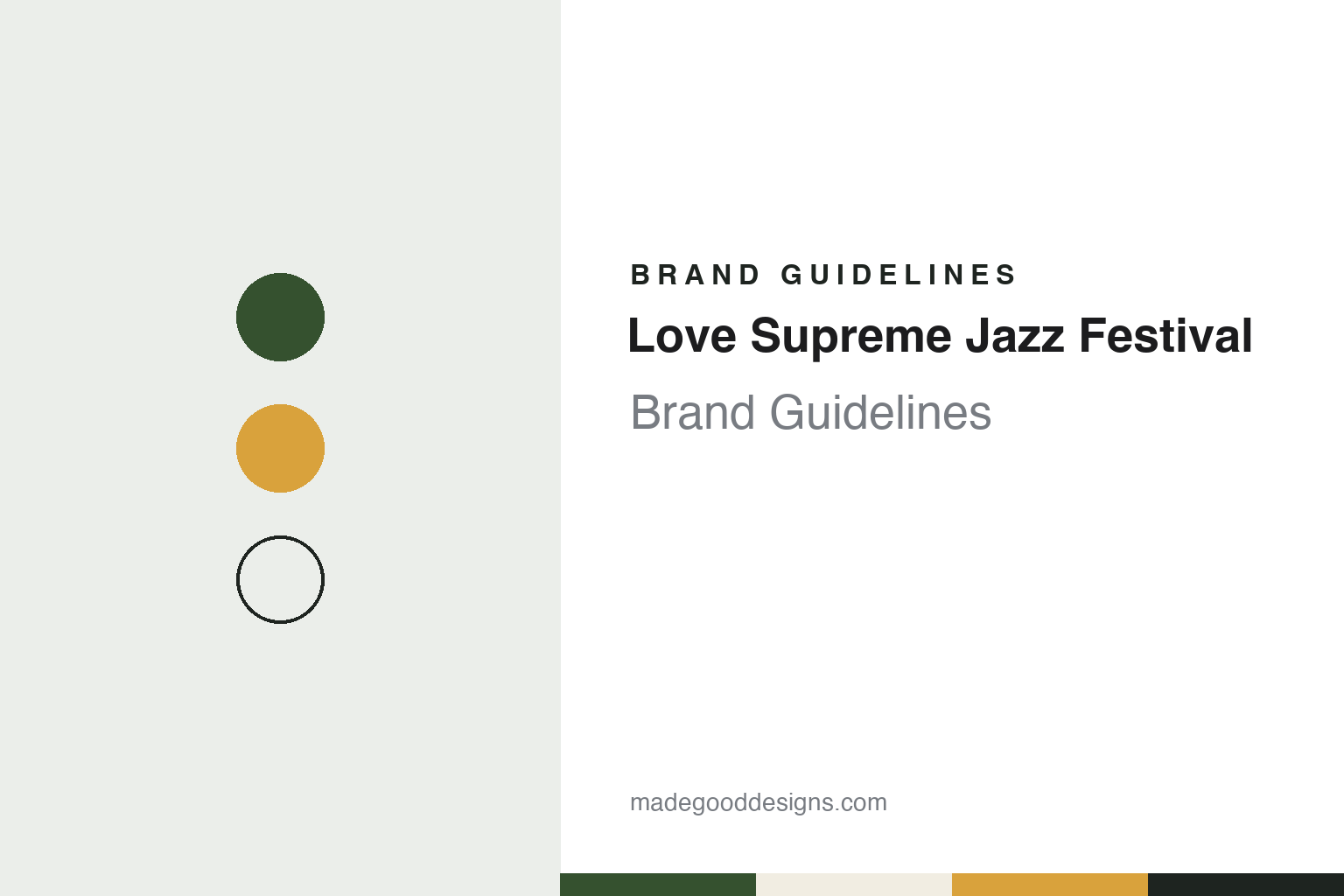
Love Supreme Jazz Festival Brand Guidelines
Three days of jazz, soul and funk in a Sussex park, every July since 2013.
Aa
Two constants: a downland green, chalk and summer gold palette and an open-air sans register. Abstract homage — not a Love Supreme Jazz Festival poster or mark; no logo, artwork or wristband is reproduced.
Glynde Place
A jazz festival in a Sussex park.
The Love Supreme Jazz Festival is a three-day greenfield festival held each July in the grounds of Glynde Place, near Lewes in East Sussex, on the edge of the South Downs. Its first edition ran from 5 to 7 July 2013. A festival notice published on the Europe Jazz Network website on 2 July 2013 described four stages across the site and said the event was produced by Love Supreme Ltd, with the music producer Serious acting as programme consultants. English Wikipedia names the founder as Ciro Romano, a former lawyer and record executive, and gives the festival’s producers as Neapolitan Music and U-Live.
Writing in the Camden New Journal in June 2025, the paper’s jazz critic noted that the festival had been held at Glynde every year since that first edition in 2013. The same article quoted the festival’s programme director, Barney Dufton, who recalled that in the early years the organisers were working against “a very stuffy image” of jazz, one that treated the music as something closer to a museum piece than a living form. Dufton described the saxophonist Branford Marsalis, who played in 2013, as the festival’s first booking, and the 2013 notice listed Jools Holland on the opening bill alongside soul, funk and jazz acts.
The site has its own long history. Glynde Place is an Elizabethan manor house built in 1569, according to English Wikipedia’s article on the village of Glynde, which lies about two miles east of Lewes. The same article notes that Glyndebourne, the house known for its opera festival, stands at the northern end of the same parish, so two very different summer music events share a corner of the Downs.
English Wikipedia records that the 2020 edition was not held and that the festival returned to Glynde from 2 to 4 July 2021. Over the years the name has also travelled beyond Sussex: the same source lists a one-day Love Supreme event at the Roundhouse in Camden, London, in 2018 and 2019, a sister platform called Supreme Standards launched in October 2018 with a website, podcast and live shows, and a Japanese edition that ran from 2021 to 2023.
Colour
Stages named after the landscape.
Love Supreme has always mixed jazz with neighbouring styles. English Wikipedia describes a programme that runs from jazz into funk, soul, blues and hip-hop, and lists stages that have included a Main Stage, a Big Top, an Arena, a Bandstand for newer and local acts, and Bands & Voices for spoken word, dance and cabaret. In the Camden New Journal interview, Dufton explained how the bill is put together: the team thinks in terms of “about four to six kinds of musical tribes” and checks which of them a draft line-up still leaves out. He also pointed to what he called the festival’s “intergenerational quality,” with fans of different ages at the same shows.
The 2026 edition, reviewed by Brighton and Hove News on 9 July 2026, ran from 3 to 5 July at Glynde Place. The paper counted six stages operating each day: North Downs, South Downs, Supreme Standards, Bands & Voices, Blue In Green and New Generation Jazz. It reported that Ezra Collective led the Friday bill, with soul, funk, R&B and jazz acts spread across the weekend, and that the National Youth Jazz Orchestra opened the South Downs stage on the Saturday morning. The review also described non-music activities for all ages and a Rough Trade record tent on site.
The stage names are a large part of the festival’s visual vocabulary. Two of them borrow the names of the North Downs and the South Downs, and one carries the name of the festival’s own Supreme Standards platform. Together they turn the site map into a short lesson in where the festival sits and what it plays, which is useful for anyone designing wayfinding for an outdoor event: names that are easy to say, easy to signpost and tied to the place.
Typography
Design and documentation.
A jazz festival is often remembered first by where it happens and when. Some take over a city park in high summer, with stages set between lawns and old trees; others fill the courtyard of a former abbey, the seats of a concert hall, an island in a river or the streets of a small town that changes character for a week. The same name can stay attached to a place for decades, and when a festival does move, the old site often survives in its title.
The calendar works in the same way. A fixed weekend, a fortnight in July or a run of autumn evenings becomes part of the identity, as recognisable to regular visitors as any logo. Many festivals also carry a series of annual posters, and in some cases the designers and illustrators behind them become part of the festival’s own story, with each year’s image added to a visible archive.
Behind the name there is usually an organisation that keeps it going: a non-profit association, a public broadcaster, a municipal body, a foundation or a concert promoter. Names, owners and organisers can change over the years, and a festival title may be held by one body while another runs the days. Following those changes through dated sources is often the clearest way to understand how a festival has lasted.
Then there is the practical layer that audiences handle: programme booklets, day schedules, wristbands and payment cards, maps, stage signage and the names given to the stages themselves. These pieces are rarely documented as design, yet they are where a festival’s identity meets its visitors most directly. The guides in this collection describe them plainly, as their sources do.
Aa
An open-air sans — clear at the distance of a field sign. (Specimen set in Archivo, a sans STAND-IN; NOT the Love Supreme Jazz Festival logo.)
Love Supreme
A festival defined by its field.
What gives the festival its character is the setting. It has stayed in the same parkland at Glynde since 2013, reached by train from London Victoria, as both the 2013 notice and the Camden New Journal in 2025 pointed out, and the first-year notice already offered both camping and day visits. Unlike a city festival spread across clubs and concert halls, the whole programme sits on one site, so tents, stage signs, maps and programme sheets carry most of the identity work.
The programming gives that identity two registers at once. One is the large outdoor show, with soul and funk bands on the main stages; the other is the smaller tent, where the Camden New Journal piece advised readers to look for newer jazz groups playing to a few dozen people. A design system for an event like this has to work for both: bold, legible headline type for the main stages, and a quieter, more detailed voice for set times, artist notes and the smaller stages.
For a design guide, Love Supreme Jazz Festival shows how a greenfield event can build an identity from its landscape and its stage names rather than from a city skyline. Compare Glyndebourne, its neighbour in the same Sussex parish, and the Edinburgh Jazz & Blues Festival, a July jazz festival that spreads across a whole city. For this guide we use a downland green, chalk, flint and a summer gold with a sans, an unofficial interpretation; no product or logo is reproduced.
Explore & save
Keep Love Supreme Jazz Festival’s identity on hand — save it to a board in the Made Good inspiration library.
Love Supreme Jazz Festival identity set
Pin the Love Supreme downland green, chalk and summer gold palette and the open-air sans register to your own board.
Source & notes
Frequently Asked Questions
What font can I use to match the Love Supreme Jazz Festival look?
This guide describes Love Supreme Jazz Festival’s type as “An open-air sans — clear at the distance of a field sign”. Its type specimen is set in Archivo from Google Fonts as a stand-in; Archivo is not Love Supreme Jazz Festival’s own lettering.
What colours are in the Love Supreme Jazz Festival palette?
This guide’s Love Supreme Jazz Festival palette is Downland green #35512F, Flint #1E2420, Chalk #F1EDE2, Summer gold #D9A23C and Hay #D8C9A3. The tones are the guide’s own unofficial interpretation, not official Love Supreme Jazz Festival hex codes.
When was Love Supreme Jazz Festival founded?
Love Supreme Jazz Festival was founded in 2013 (first edition 5–7 July), in Glynde Place, East Sussex.
Who founded Love Supreme Jazz Festival?
Love Supreme Jazz Festival was founded by Ciro Romano in 2013 (first edition 5–7 July).


