Most people meet ukiyo-e through woodblock prints, but Miyagawa Choshun never made one. He painted by hand, on silk and paper, for clients who wanted a single original rather than an edition. That choice shows in every scroll: smooth contour lines, kimono patterns painted motif by motif, and large areas of plain ground that a print publisher would rarely have left empty. For a designer, his work is a compact study in figure placement, pattern scale and negative space.
Who was Miyagawa Choshun?
Museums and reference works give two sets of dates. The National Diet Library’s name authority, the Cleveland Museum of Art and the Art Institute of Chicago list him as 1683–1753. The Agency for Cultural Affairs’ Cultural Heritage Online database gives 1682–1752. The National Diet Library also records the common name Kiheiji.
Traditional biographies say his family came from a village called Miyagawa in Owari Province, and that the village gave him his surname. He worked in Edo, and the Agency for Cultural Affairs describes him as building directly on the ukiyo-e foundations laid by Hishikawa Moronobu, borrowing Moronobu’s figure types and compositions, adding his own, and becoming popular enough to set the style of his day.
The key fact for designers is his medium. The MOA Museum of Art in Atami states that he worked only as a painter and left no woodblock prints, and the British Museum, in its catalogue entry on Google Arts & Culture, calls this unusual for an ukiyo-e artist. Painted ukiyo-e, called nikuhitsu (“from the hand”), was sold as unique scrolls.
His studio carried the style forward. According to the print scholar John Fiorillo, his pupil Miyagawa Shunsui was also his son, and Shunsui in turn taught Katsukawa Shunshō, whose actor prints shaped the next generation of ukiyo-e. The Honolulu Museum of Art likewise lists Shunshō as a pupil of Shunsui.
Key works you can date and see
The Agency for Cultural Affairs notes that Choshun rarely dated his paintings and that no work with a secure date is known, so museum dates are ranges.
- Genre Scenes (Fūzokuzu), handscroll, colour on paper, 36.9 × 390.8 cm, National Institutes for Cultural Heritage, Tokyo. Designated an Important Cultural Property in 2011, it shows a troupe of performers travelling in plum-blossom season and then a dance staged inside a samurai residence. The Agency treats it as a representative, fairly late work.
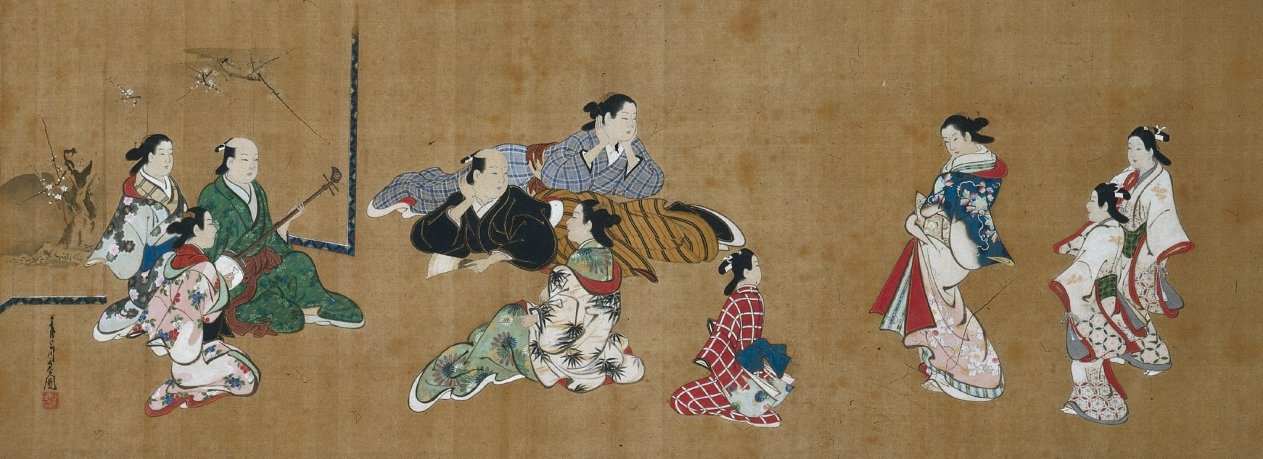
- Entertainment Scene, c. 1710–53, hanging scroll, ink and colour on silk, image 56.4 × 135.5 cm, the Cleveland Museum of Art (1985.17).
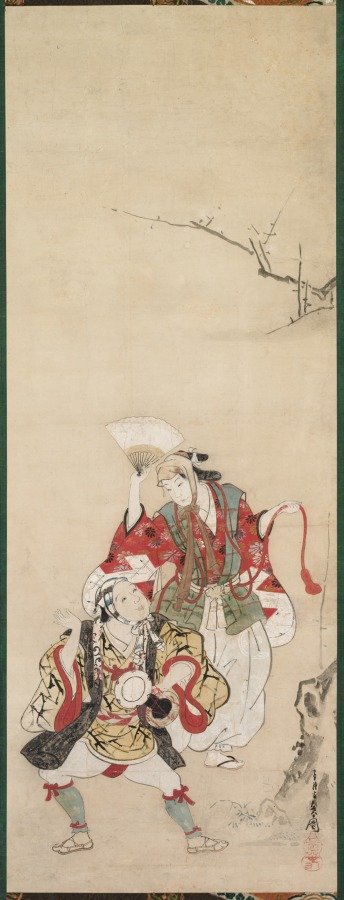
- Spring Dancers (Manzai), early to mid-1700s, hanging scroll, ink and colour on paper, 84.1 × 31.4 cm, the Cleveland Museum of Art (1985.252).
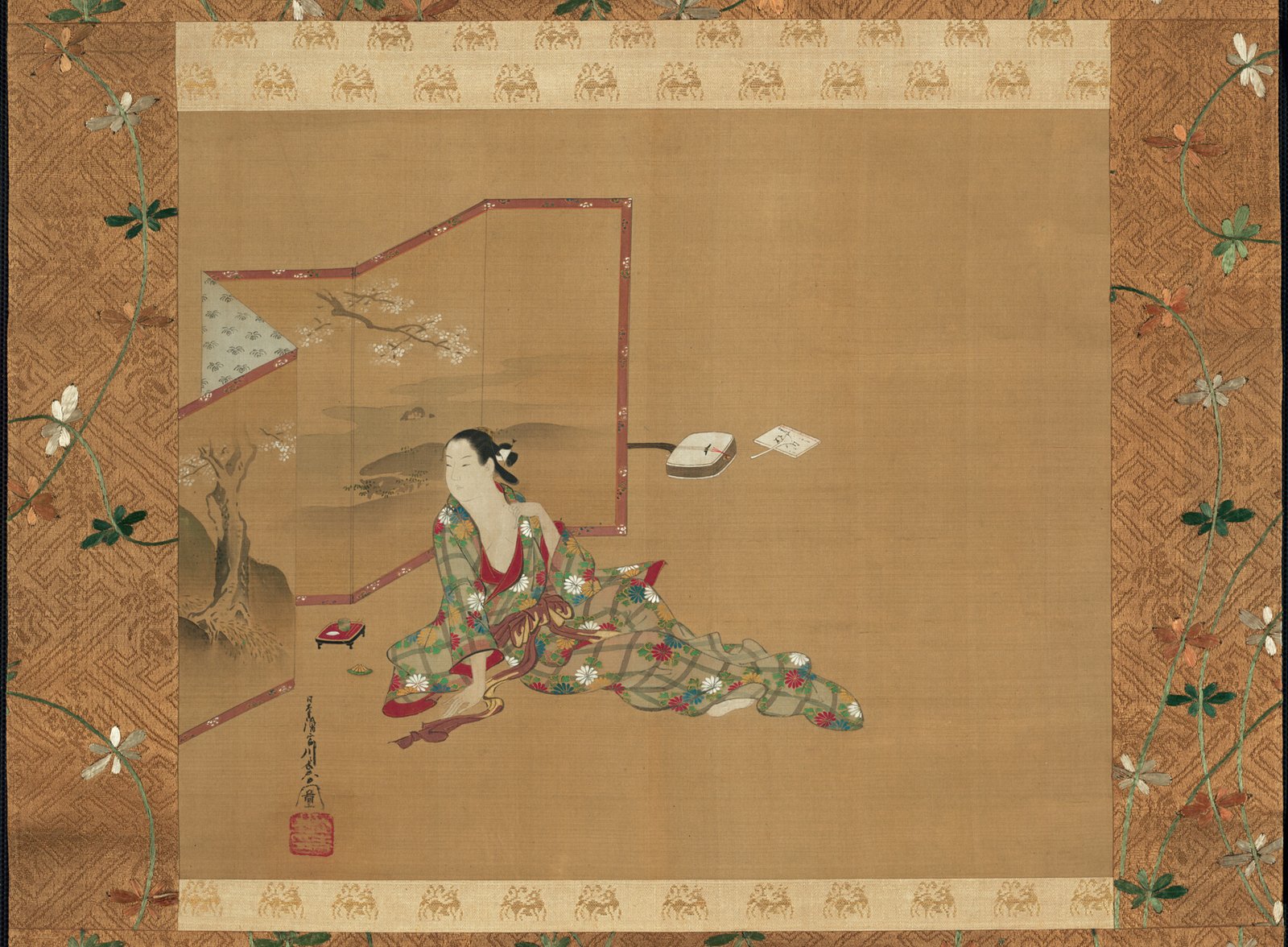
- A Beauty Behind a Screen, about 1750, hanging scroll, ink and colours on silk, 30.4 × 37.1 cm, the Art Institute of Chicago (151047).
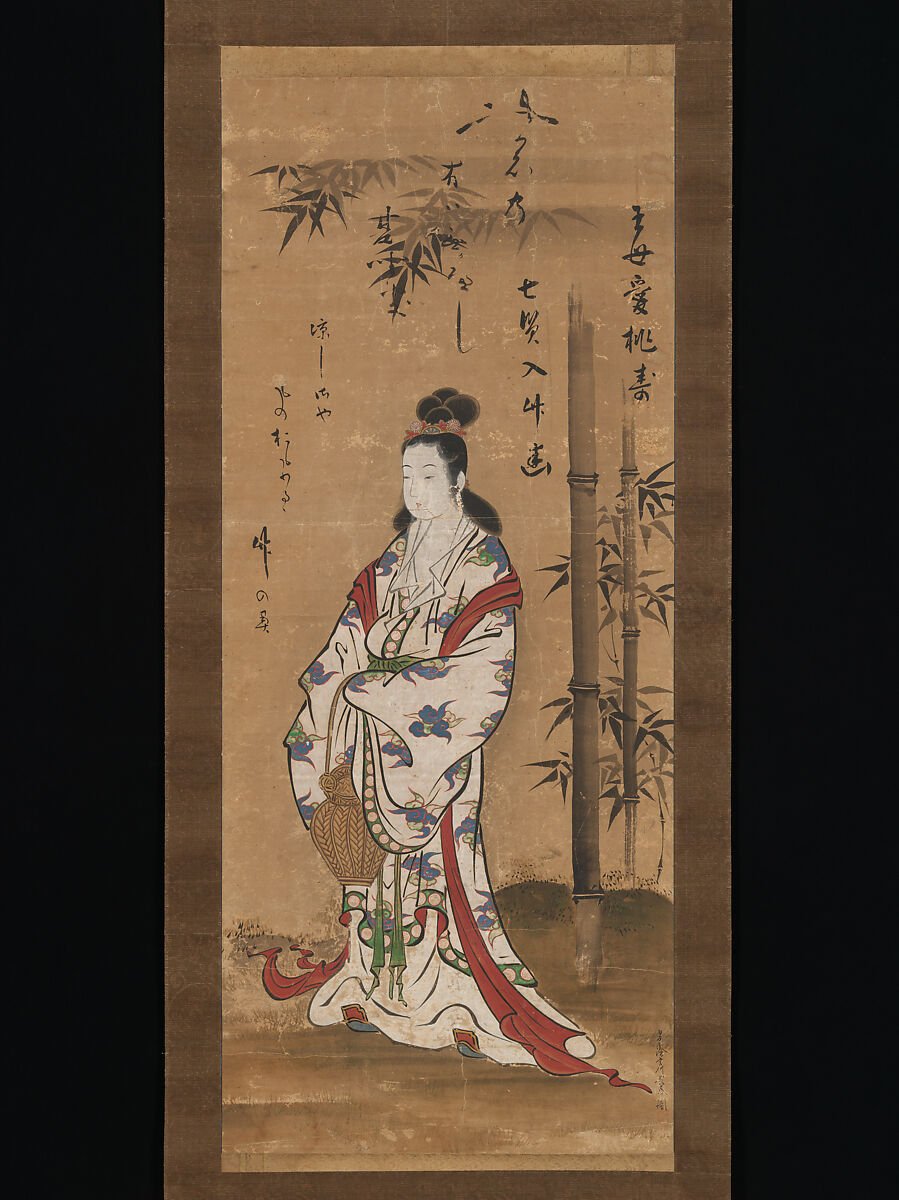
- Gyoran Kannon, hanging scroll, ink and colour on paper, 126.4 × 53 cm, the Metropolitan Museum of Art (2015.300.129).
- Pastimes of the New Year and Flower Viewing, a pair of handscrolls dated 1716/1736, the British Museum. New Year games on one scroll, picnics under cherry blossom on the other; the museum notes that in places he closely follows Moronobu’s figure groups.
- Beauty Seated under a Willow, eighteenth century, hanging scroll, colour on silk, the MOA Museum of Art.
What to look at in Miyagawa Choshun’s paintings
A frieze of figures across empty silk
The Cleveland Entertainment Scene is more than twice as wide as it is tall, and it reads like a banner. Musicians sit at the left, the guest of honour reclines in the centre, and at the right a courtesan sweeps in with two young attendants. There is no floor or wall; the figures, and the gaps between them, make the room.
In layout terms it is a grid without lines: three modules, unequal gutters and one direction of travel, towards the arrival.
Pattern as the main event
Choshun’s robes are where the colour lives. In the Chicago A Beauty Behind a Screen, the reclining woman wears a checked lattice scattered with flower roundels, and the pattern follows the folds as one continuous sheet. In Cleveland’s Spring Dancers, one dancer’s robe is a bold mustard ground with black brush marks and the other is a red jacket over white trousers. The faces stay calm, so the textiles do the talking.
Smooth, even contour
The MOA Museum of Art describes the smooth lines that set out the posture of its seated beauty. Across Choshun’s work, outlines are fine and unbroken, with long, slightly swelling strokes for hems and sleeves. There is very little hatching or modelling; shape comes from contour and from the flat colour inside it.
Hand-painted colour on a warm ground
Measured from the Cleveland Museum of Art’s scan of Entertainment Scene, the dominant tones are a honey-brown silk ground near #9a7337 and a lighter tan near #a4895f, with small accents of near-black ink #131817, deep red #852727 and slate blue #385b6c. These figures describe the aged silk and pigments as photographed today, not the colours the painting had when new. Even so, the proportion is instructive: a large warm neutral, with saturated colour held back for small, high-contrast moments.
Technique: painting, not printing
Because Choshun painted rather than designed for the woodblock, the constraints were different. A print designer had to think in carved line and a limited set of colour blocks. A painter could lay ink and colour directly on silk or paper and leave the surface untouched where he wanted.
The museum records show both supports. Chicago’s A Beauty Behind a Screen and Cleveland’s Entertainment Scene are on silk; Cleveland’s Spring Dancers and the Met’s Gyoran Kannon are on paper. In each the figures sit on an unpainted or lightly toned field. Signatures are small and placed low in a margin, followed by a seal, so they work as a quiet foot to the composition rather than a headline.
The Agency for Cultural Affairs points to one detail scholars use to place his work in time: in his later signatures, the characters for “river” and “picture” flare outwards. It also notes that in the Tokyo handscroll he draws samurai women slim and reserved and the actors larger and livelier, a contrast that keeps the eye moving.
Formats: the hanging scroll as a page
The formats in these collections are a useful set of aspect ratios. Spring Dancers is about 2.7 times taller than wide, a slim vertical close to a phone screen or a pull-up banner. Gyoran Kannon is about 2.4 to 1. A Beauty Behind a Screen is a near-square that becomes tall once it is mounted, and Entertainment Scene is a wide frieze. The handscroll in Tokyo is more than ten times longer than its height, unrolled section by section like a horizontal scrolling page.
In the tall formats height becomes pacing: in Chicago’s Male Figure one small walking figure crosses a tall, empty silk panel, and the patterned mount does the framing.

How designers can borrow from Miyagawa Choshun
- Let one patterned shape lead. Keep faces, type and backgrounds simple, and give the richest pattern to a single large silhouette, such as a garment, a product or a packaging panel.
- Scale the pattern to the shape. Choshun’s motifs stay small relative to the robe, so the outline still reads at a distance. Test a surface pattern at thumbnail size before you commit.
- Use bare ground as structure. Space groups of content like the figures in Entertainment Scene: clusters with generous, uneven gaps and one clear direction of reading.
- Hold saturated colour back. Build on a warm neutral and spend red and blue in small amounts. Pull starting values from a cleared scan with our image colour picker.
- Sign small. A modest signature and seal placed low in a margin balance a tall layout better than a large logo at the top.
For the wider print tradition that grew alongside painters like Choshun, read our guide to ukiyo-e, and browse more cleared works in the MGD museum inspiration collection.
Using Miyagawa Choshun images
The five paintings shown here are flagged in the museums’ open-access data: the Cleveland Museum of Art marks its two scrolls CC0, and the Art Institute of Chicago and the Metropolitan Museum of Art mark theirs as public domain. Other works, including the Tokyo handscroll and the MOA scroll, belong to collections with their own image rules, so check the owning museum’s rights statement before reproducing them. Some museum scrolls are catalogued only as “in the style of” Choshun, so read the attribution line first.
Frequently asked questions
Did Miyagawa Choshun make woodblock prints?
No. The MOA Museum of Art and the British Museum both record that he worked only as a painter, which sets him apart from most ukiyo-e artists of his time.
When did Miyagawa Choshun live?
The National Diet Library and several museums give 1683–1753; Japan’s Agency for Cultural Affairs gives 1682–1752.
What did Miyagawa Choshun paint?
Mostly beautiful women and scenes of entertainment and seasonal pleasures, painted on hanging scrolls and handscrolls in ink and colour on silk or paper.
Who were Miyagawa Choshun’s followers?
His pupil and son Miyagawa Shunsui continued the Miyagawa school, and Shunsui taught Katsukawa Shunshō, according to John Fiorillo and the Honolulu Museum of Art.