Henri Evenepoel had a short working life and a sharp eye for the edges of a picture. Born in Nice in 1872 and trained in Brussels, he moved to Paris in 1892 and died there in December 1899, aged 27, according to the Museum of Fine Arts Ghent and the Städel Museum. In those years he painted the crowds of the city from above, set a life-size figure against the Moulin Rouge, and drew a woman with a red parasol for a monthly print portfolio. Each of these pictures solves a design problem: where to cut the frame, where to put the one strong colour, and how much empty space to leave.
What to look at in Henri Evenepoel’s work
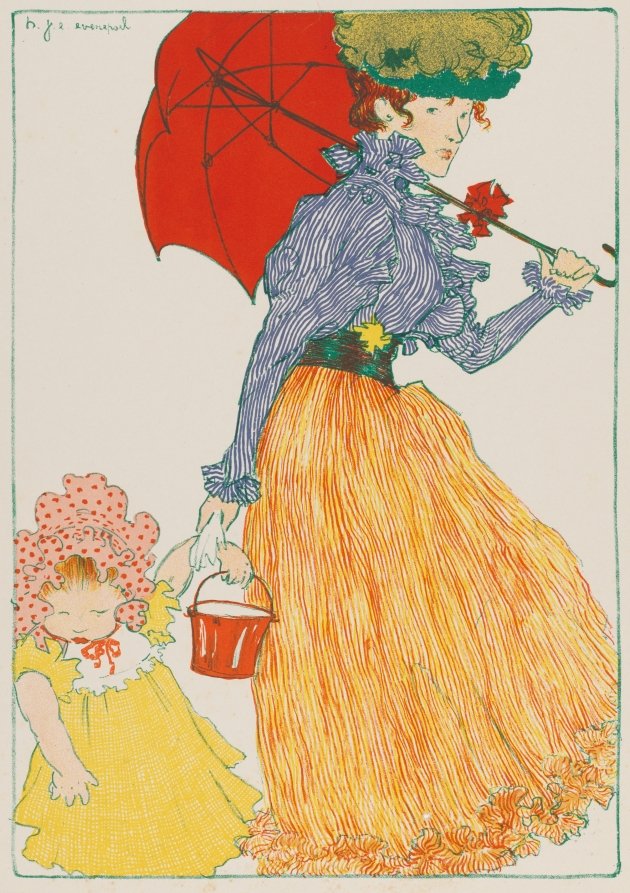
Start with the crop. In In the Square, the colour lithograph the Cleveland Museum of Art holds, the woman walks out of the frame on the right: her skirt runs into the thin ruled border, and the child in the lower left is cut off at the bottom of the sheet. The left middle of the sheet is bare paper. The result feels like a glance at the street, not a posed scene.
Then look at the accents. A red parasol fills the top left corner, a red bucket swings from the woman’s hand and a red bow sits at her shoulder. Three small reds lead the eye down the sheet from corner to centre. The Royal Museum of Fine Arts Antwerp (KMSKA) makes a similar point about his painting Sunday Fair at Les Invalides, 1897: full vermilion reds guide the composition and order its forms, sometimes set beside complementary blue to separate zones of the picture.
Look, too, at the signature. In the top left corner of the print, “h. j e. evenepoel” is written small in lowercase script, the same form he used on The Spaniard in Paris, where the Ghent museum records “h.j e. evenepoel. / 99” at the lower left. The lettering never competes with the image.
Colour built from line in In the Square
In the Cleveland lithograph the skirt is not a solid field of orange. It is built from many vertical strokes of orange, yellow and red, and the blouse is a pattern of fine violet-blue stripes over the white paper. Colour and drawing are the same mark.
Measured from the museum’s scan of this impression, the main colours are a parasol red close to #d02f1b, a skirt orange near #dc9645 with paler strands around #f9c77a, a child’s dress yellow near #e4c557, a slate blue-violet in the blouse stripes near #5e6a7a, and a dark green sash around #405442, all on a warm paper tone close to #e0d8cc. The structure is one hot red, a family of warm yellows, one cool stripe and one dark anchor. You can test the scheme with the colour palette generator.
The print was issued in L’Estampe Moderne, a monthly portfolio of original prints by French and foreign artists published in Paris between 1897 and 1899, as the Davison Art Collection at Wesleyan University describes it. The Cleveland Museum of Art notes that the portfolio was issued in editions of 150 and calls this the only major print Evenepoel made. For the medium itself, see the guide to lithography.
Career outline and key works
Evenepoel was born in Nice in 1872, as both the Ghent museum and the Städel Museum record. The Ghent museum says he trained at the art academy in Brussels before moving to Paris in 1892. There, according to the Flemish journal Openbaar Kunstbezit in Vlaanderen, he studied first at the school of decorative arts and then in the studio of Gustave Moreau; the Städel Museum also names Moreau as his teacher and lists Henri Matisse as a friend.
In the Café d’Harcourt in Paris, 1897, oil on canvas, 114 by 148 centimetres, is in the Städel Museum in Frankfurt. The museum describes a crowded café on the Place de la Sorbonne, crossed by a young woman in a red dress whom nobody notices. Sunday Fair at Les Invalides, 1897, oil on canvas, 64 by 92 centimetres, is in the KMSKA in Antwerp. The museum explains that it is a bird’s-eye view from the window of his studio on the sixth floor of a building on the avenue de la Motte-Piquet.
From late 1897 he spent the winter in Algeria. The KMSKA notes that he was in Algiers while his first solo exhibition, of 60 works, ran at the Cercle Artistique et Littéraire in Brussels from 30 December 1897 to 7 January 1898. Openbaar Kunstbezit in Vlaanderen names Algiers, Blida and Tipasa as places where he worked, adding bright pink, blue and white to his burnt ochres. Focus on Belgium sees the Algerian pictures, including a series on the orange market at Blida, as a shift toward flat tints and simplified design.
He returned to Paris in 1898, according to Openbaar Kunstbezit in Vlaanderen, and in 1899 painted two portraits now in Belgian museums. The Spaniard in Paris (Portrait of the Artist Francisco Iturrino), 1899, was bought at the Ghent Salon that year and is in the Museum of Fine Arts Ghent, which notes that it was the only work he sold to a museum; Art in Flanders reports that the poet Emile Verhaeren called it an almost perfect masterpiece. Henriette with the Large Hat, 1899, oil on canvas, 72 by 58 centimetres, is in the Royal Museums of Fine Arts of Belgium in Brussels, according to Openbaar Kunstbezit in Vlaanderen. He died of typhoid fever in Paris on 27 December 1899, as that journal and Focus on Belgium both record.
Technique: the painter of patches
Evenepoel painted mostly in oil on canvas, and the KMSKA records that critics of his day called him a “peintre de la tache”, a painter of patches or touches of colour. For the Antwerp fair scene, the museum says, he sketched first on paper in bright sunshine, then placed rapid red dabs beside moving figures on the canvas.
In Henriette with the Large Hat, Openbaar Kunstbezit in Vlaanderen traces how the brushwork loosens the further it gets from the face: smooth and almost invisible on the skin, circling in the hat brim, falling vertically in the cape and running diagonally across the dress. The same article reads the picture as a three-colour scheme of blue, ochre and pink, with the pink plume as the one loud note that balances the blues.
In The Spaniard in Paris, a life-size figure 217 by 152 centimetres overall, studio photographs show the figure was painted before the background, the Ghent museum notes. Art in Flanders describes a harmony of black, blue and ochre with one red accent in the Moulin Rouge behind.
How designers can borrow Evenepoel’s ideas today
Crop with intent. Let the main figure touch or cross the frame edge, and leave a calm area of open ground on the other side. The cut edge and the empty space give a layout movement without adding elements.
Ration the red. Use one saturated red in two or three small places and let them form a path through the page. On a poster or a landing page, the eye will follow the reds before it reads anything else.
Make colour out of line. Instead of flat fills, build tone from parallel strokes or stripes, as the skirt and blouse do in In the Square. A line texture inside a shape adds energy at any size.
Rule a thin border. A fine coloured keyline around an image, like the green rule on the Cleveland print, holds a loose drawing together and gives a cropped figure something to break.
Evenepoel and the Paris print and poster scene
Evenepoel’s café and street subjects belong to the same Paris that Henri de Toulouse-Lautrec drew in his lithographs, and the guide to Toulouse-Lautrec’s posters shows how flat colour and cropped figures worked at poster scale. The overview of Post-Impressionism sets out the wider move from observed light to simplified colour that his Algerian pictures touch on. More public-domain prints and paintings are gathered in the MGD museum collection.
Frequently asked questions
Who was Henri Evenepoel?
A Belgian painter, born in Nice in 1872, who trained in Brussels, moved to Paris in 1892 and studied with Gustave Moreau. He painted Paris scenes, portraits and Algerian subjects, and died in Paris in 1899.
What is Henri Evenepoel known for?
He is known for The Spaniard in Paris, 1899, in the Museum of Fine Arts Ghent, Henriette with the Large Hat, 1899, in Brussels, and Paris scenes such as In the Café d’Harcourt in Paris, 1897, in the Städel Museum.
Did Henri Evenepoel make prints?
Yes. In the Square, 1897, is a colour lithograph issued in the Paris portfolio L’Estampe Moderne. The Cleveland Museum of Art, which holds an impression under a CC0 licence, describes it as his only major print.
Where can I see Evenepoel’s work?
Key paintings are in Ghent, Antwerp and Brussels, and in the Städel Museum in Frankfurt. The Cleveland Museum of Art holds In the Square.