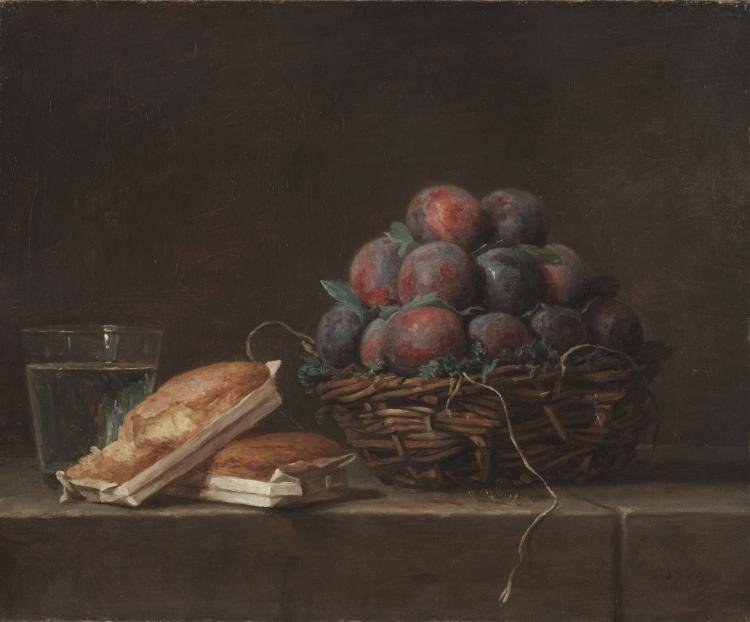
Anne Vallayer-Coster painted objects the way a good art director shoots them. A basket of plums, two cakes in folded paper and a glass of water sit on a bare stone shelf against a dark wall; nothing else competes. Her flower pieces work the same way, with one vase, one shell or a pair of fruit, and a background that drops away into shadow.
Related public-domain material is collected in the MGD museum inspiration collection.
Who was Anne Vallayer-Coster?
The Metropolitan Museum of Art, the Louvre and the French Ministry of Culture all record her as born in Paris in 1744 and dying there in 1818. Her father was a goldsmith: the Cleveland Museum of Art and the National Museum of Women in the Arts (NMWA) both say so, and the Ministry of Culture adds that Louis-Joseph Vallayer worked first at the Gobelins manufactory before opening his own workshop. NMWA notes that her mother painted miniatures.
Accounts of her training name different people. The Ministry of Culture describes her as a pupil of Madeleine Basseporte, a draughtswoman at the royal botanical garden, while Cleveland says she was apprenticed to the marine painter Joseph Vernet, who encouraged her to paint professionally.
In 1770 she presented two still lifes to the Académie royale de peinture et de sculpture and was admitted. Cleveland titles them The Attributes of Painting, Sculpture, and Architecture and The Attributes of Music; NMWA says the vote was unanimous. The Louvre still holds the music picture, catalogued as Instruments de musique (INV 8260), signed “Me Vallayer 1770” and recorded as her reception piece, shown at the Salon of 1771 and paired with a companion canvas, INV 8259. NMWA records that she exhibited at the Salon from 1771 until 1817.
Court patronage and later career
Royal favour followed. NMWA dates her appointment as painter to Queen Marie-Antoinette to 1780, and the Ministry of Culture says the queen entrusted her with her cabinet of paintings. Cleveland records that in 1781 she married Jean-Pierre-Silvestre Coster at Versailles, with the queen in attendance. The Ministry of Culture describes Coster as a lawyer and member of the Parlement de Paris, and both Cleveland and the Ministry say the couple lived in an apartment in the Louvre.
The two museums tell the Revolution slightly differently. Cleveland says her output nearly stopped until 1804, when she showed two works at the Salon and received two commissions from the Empress Josephine; NMWA stresses that she kept exhibiting at the Salon despite her ties to the queen. Cleveland adds that her Still Life with Lobster was given to Louis XVIII and shown at the Salon of 1817.
NMWA also records that after a harsh review at the Salon of 1785 she gave up portraits to concentrate on still life. Her work was the subject of a touring retrospective in 2002–03, organised by the Dallas Museum of Art and shown at the National Gallery of Art and the Frick Collection.
What to look at: the stone ledge as a stage
Both paintings shown here use the same device: a horizontal stone shelf running across the lower third, with objects set along it and a dark, unfocused wall behind. In Basket of Plums (1769) the shelf edge is a single straight line, and the fruit, cakes and glass are arranged in a low pyramid that peaks at the basket on the right. Cleveland describes the plums and basket emerging from deep shadows, with vivid reds and violets, and points to the moss, the crisp paper around the cakes and the glass of water as details that give the scene immediacy.
Look at how the weight is distributed. The tall glass and the basket bracket the composition, the flat cakes link them, and a loose strand from the basket hangs over the shelf edge, breaking the hard line and pulling the picture forward into the viewer’s space.
Palette: dark grounds and single accents
Measured from the museum’s scan of this impression, Basket of Plums is overwhelmingly a dark brown picture. The dominant colour is a warm near-black, #342C26, followed by a mid brown, #926C52, and a pale biscuit tone in the cakes and paper, #C5B498. The red of the plum skins, around #823C35, covers only a sliver of the surface.
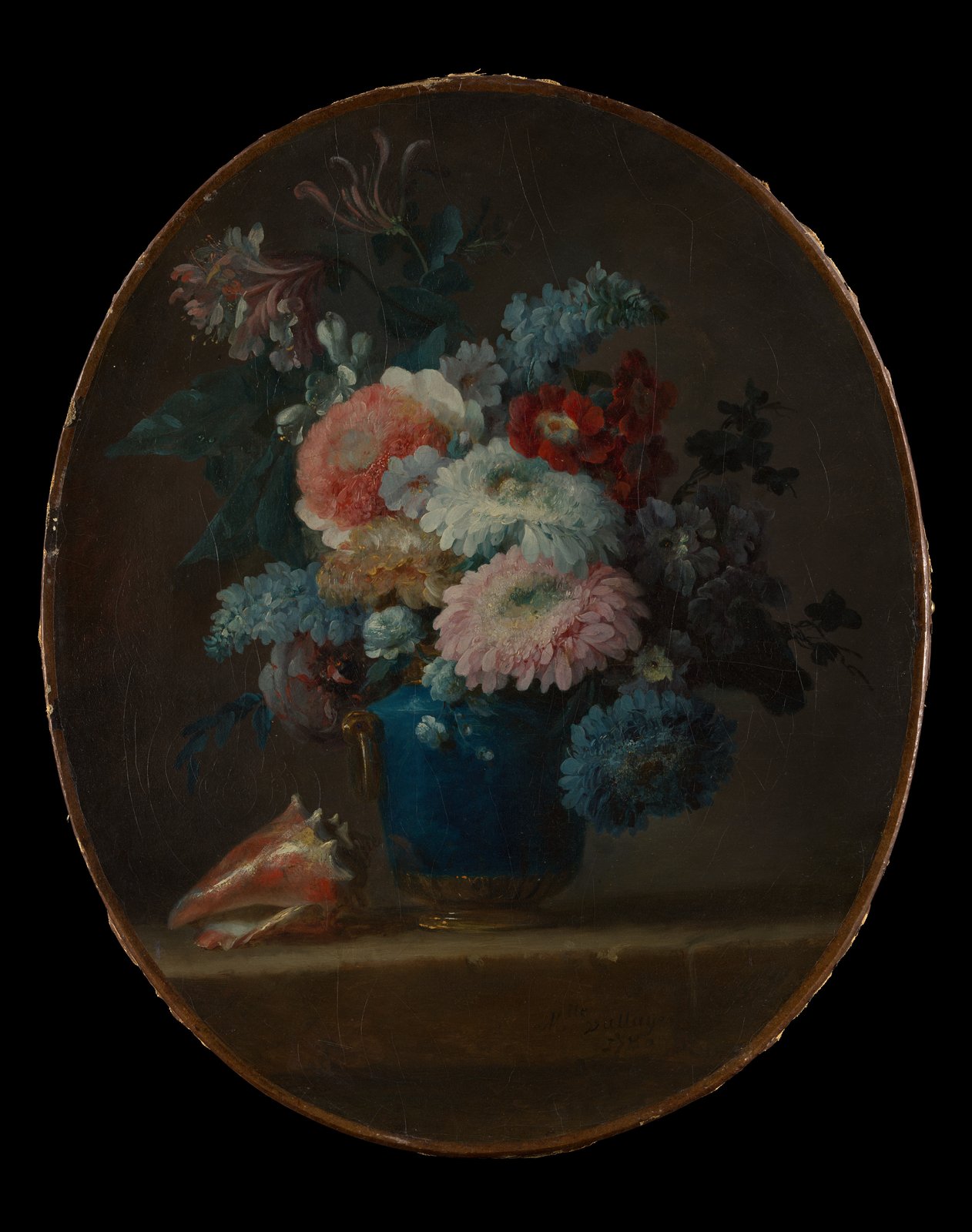
The Met’s oval Vase of Flowers and Conch Shell (1780) uses the same logic with a cooler accent. Measured from the museum’s scan, the ground is #221D16, the vase a deep blue-green around #193A42, and the brightest warm note a brick red, #82392A, in the flowers. The oval format, which the Met lists at 50.2 by 38.1 cm, crops the corners into darkness and concentrates attention on the bouquet. The shell on the left balances the vase, a smaller pink mass against a larger blue one.
To test these values on your own work, sample them with the image colour picker. For the broader tradition behind her pictures, see our guide to still life painting, and for the decorative culture of her early career, Rococo art.
Designs for other media
Her compositions travelled beyond oil paint. The Met holds a small oval tapestry, Flowers in a Vase and Two Plums, which it catalogues with Vallayer-Coster as designer: designed in 1781, woven in wool and silk between 1800 and 1804.
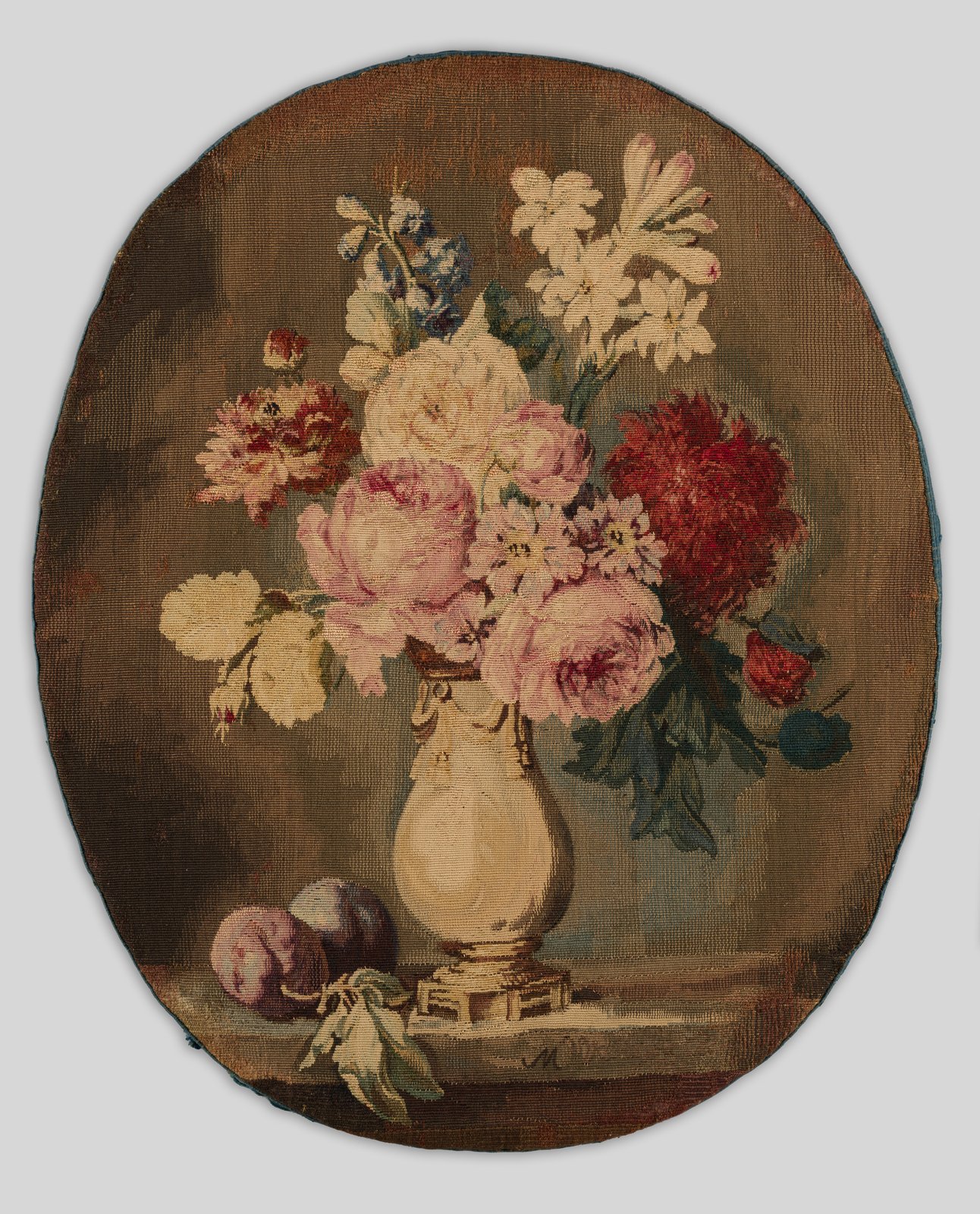
For designers, the tapestry shows how well her layouts survive a change of medium. The motif is legible at a coarse weave, because the silhouette of vase and bouquet is clear and the background is a single field.
Technique: drawing flowers in grey
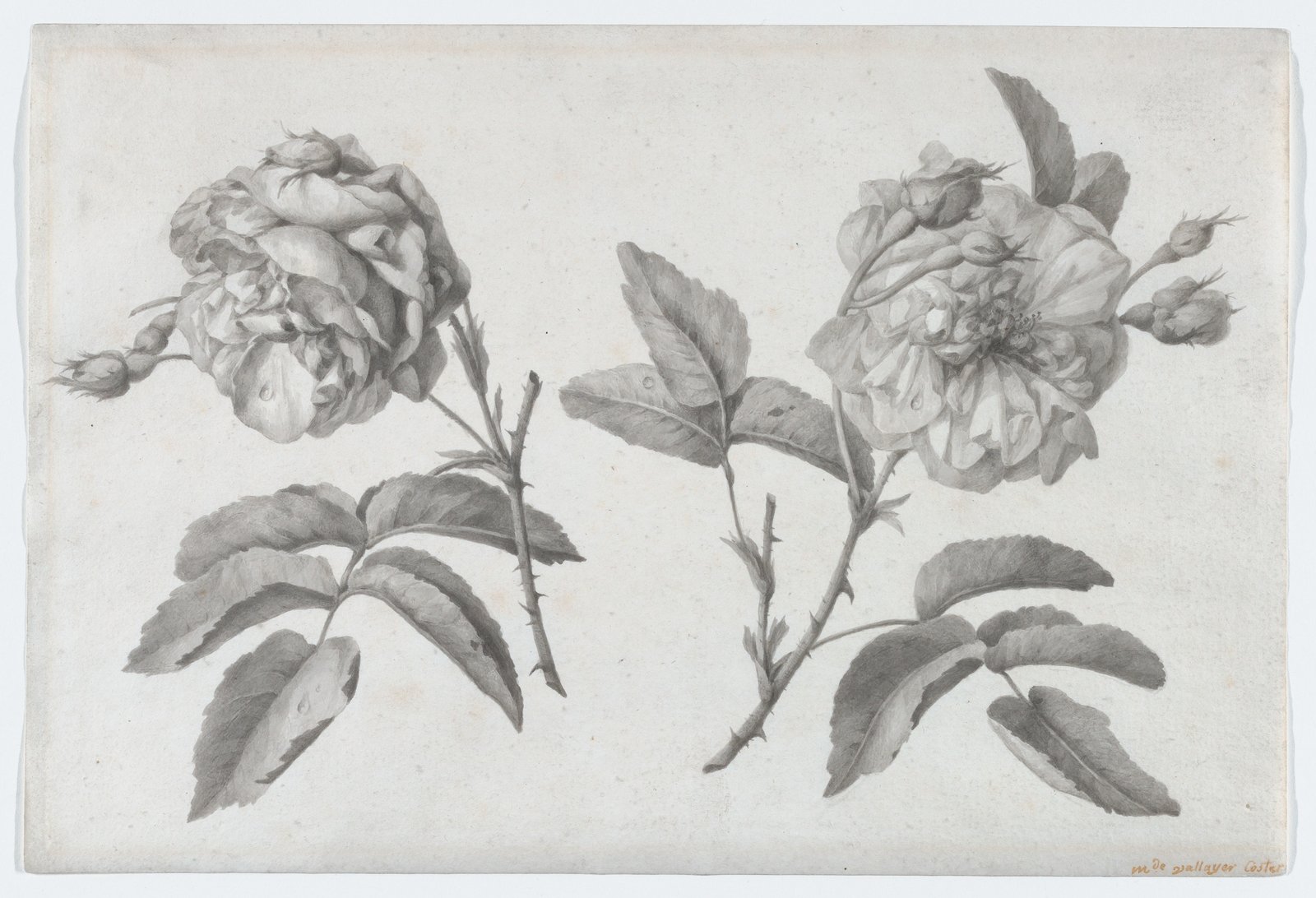
Two late drawings at the Met, Three Peonies and Two Roses, both dated about 1810, show her working method without colour. Each is in pen and grey ink with brush and grey wash over black chalk, on a sheet of 21 by 33.5 cm. The flowers are spaced across the page like specimens, each with its own stem and leaves, and modelled entirely in tone.
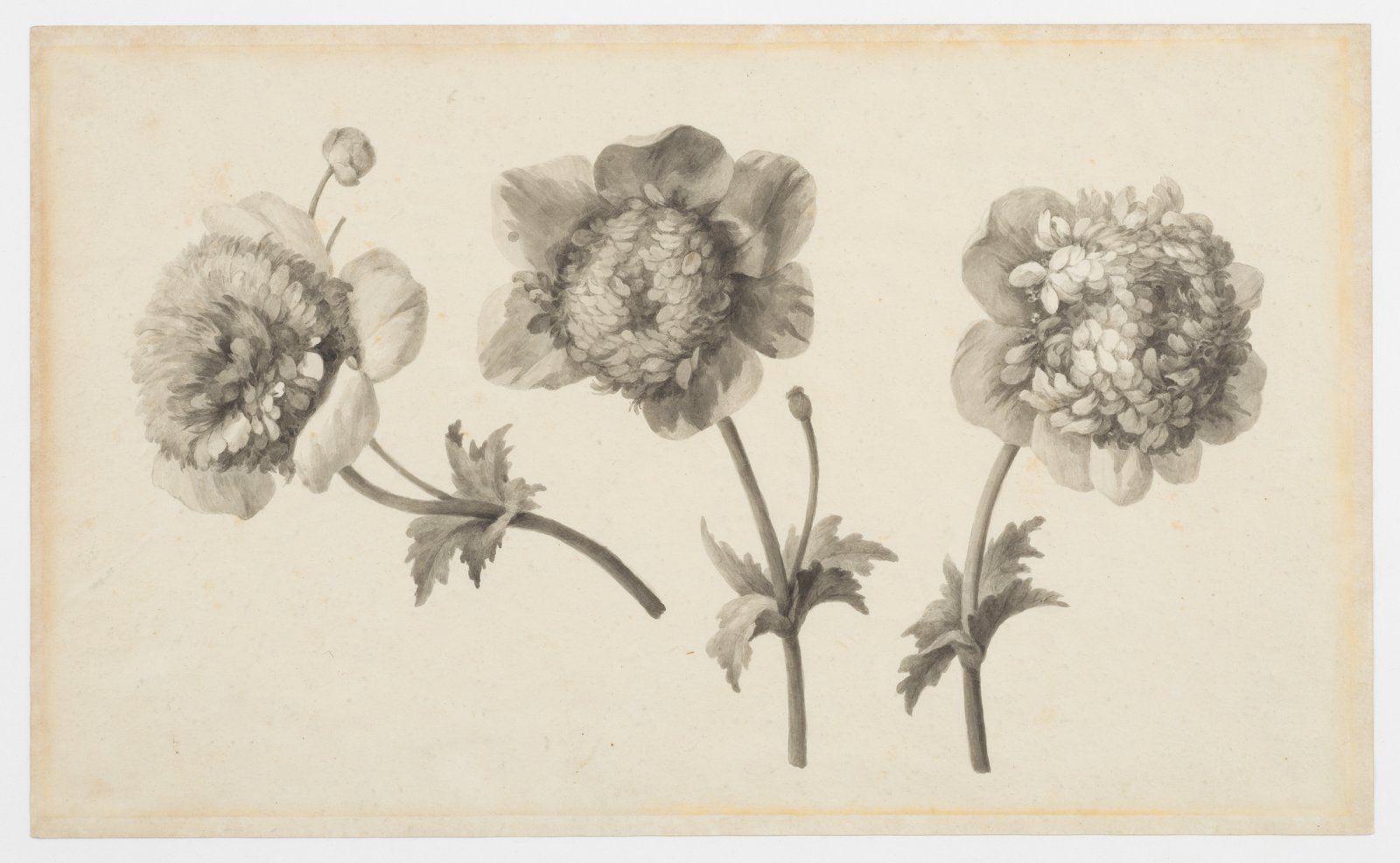
These sheets sit close to the tradition of botanical illustration: an even, unlit background, a consistent light direction, and blooms shown at a slight turn so that petals overlap.
How the artist presented herself
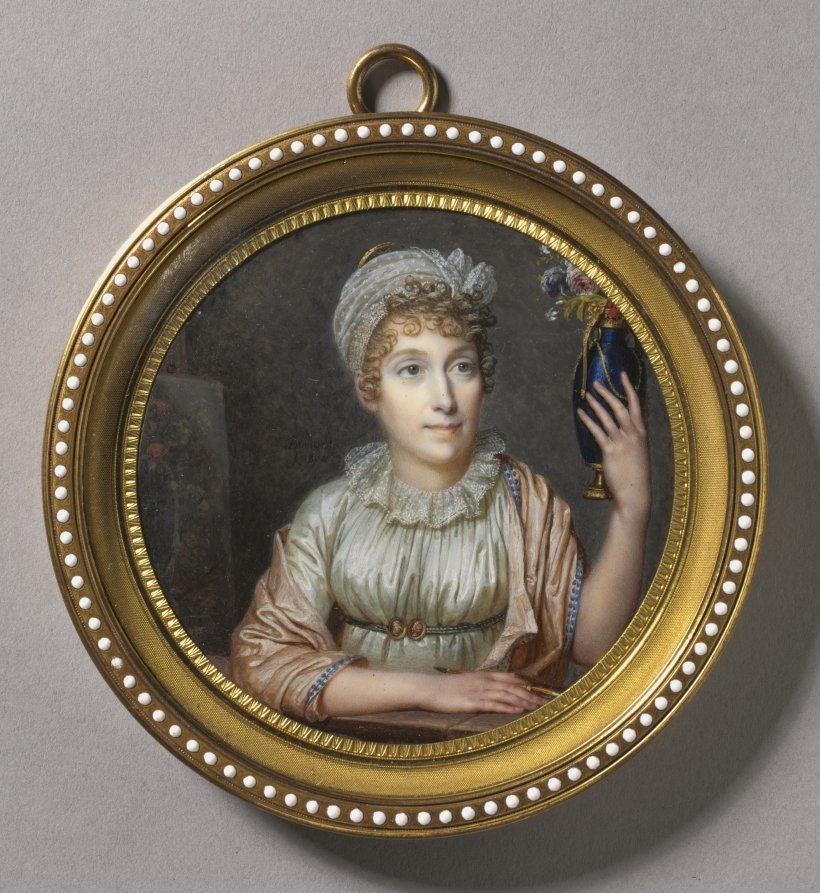
In 1804 the miniaturist François Dumont painted her in watercolour on ivory, a portrait now in Cleveland. The museum notes that she holds a brush in one hand and a vase of flowers in the other, alluding to her skill as a still-life painter, and suggests the miniature may have been meant to reassert that status. Cleveland records that Diderot had praised her Salon debut decades earlier, and the Ministry of Culture also notes his enthusiasm. A practitioner’s portrait that shows the tools and the product is still a sound approach to a personal brand. Her near-contemporary in portraiture is covered in our guide to Élisabeth Vigée Le Brun, whose name the Louvre gives to the gallery where Instruments de musique now hangs.
How designers can borrow from Anne Vallayer-Coster
- Use one surface and one wall. A single horizontal ledge and a dark, plain backdrop is a template for product photography, menu covers and packaging hero shots.
- Ration your accent colour. Keep most of the frame in near-neutral browns and let one saturated hue, a plum red or a deep blue, carry the image.
- Break the edge once. Let one element hang over the shelf line, as her loose basket strand does, to make a flat layout feel three-dimensional.
- Crop to an oval. Her oval canvases and tapestry darken the corners and focus the eye; an oval mask does the same for labels and social posts.
- Test in greyscale. Her grey-wash flower drawings are a reminder to check that an illustration works in value before adding colour.
Frequently asked questions
Who was Anne Vallayer-Coster?
A French painter, born in Paris in 1744 and died there in 1818, known for still lifes of flowers, fruit, shells and objects. She was admitted to the Académie royale in 1770 and later worked under the patronage of Marie-Antoinette.
What were her reception pieces for the Académie?
Two still lifes presented in 1770, titled by the Cleveland Museum of Art as The Attributes of Painting, Sculpture, and Architecture and The Attributes of Music. The Louvre holds the music picture as Instruments de musique, INV 8260.
Did Anne Vallayer-Coster design tapestries?
The Met catalogues her as the designer of a small oval tapestry, Flowers in a Vase and Two Plums, designed in 1781 and woven in wool and silk between 1800 and 1804.
Where can I see her work?
The Louvre holds her 1770 reception piece. The Metropolitan Museum of Art holds paintings, drawings and a tapestry, the Cleveland Museum of Art holds Basket of Plums, and the National Museum of Women in the Arts holds a 1785 portrait of the singer Madame de Saint-Huberty.