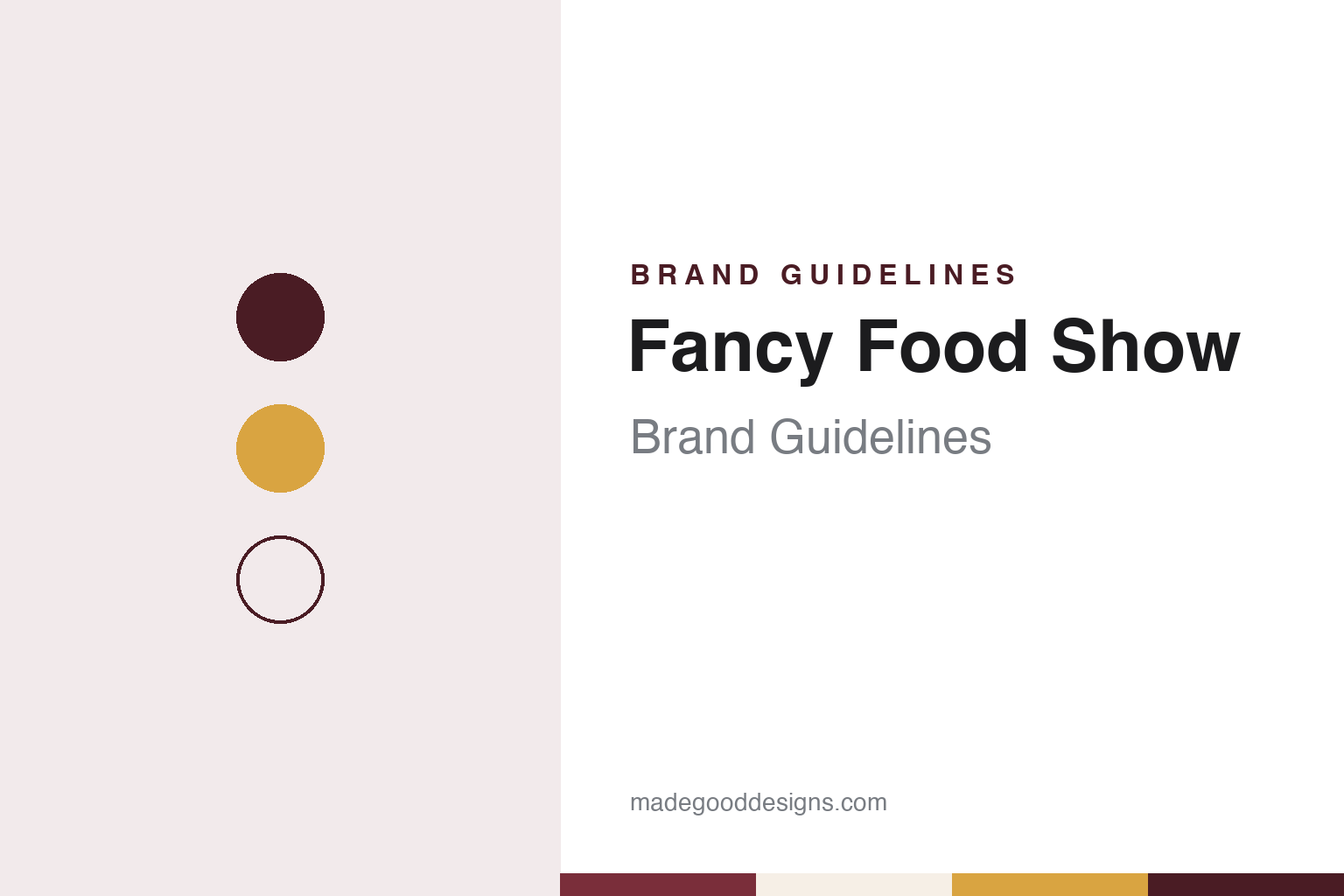
Fancy Food Show Brand Guidelines
The specialty food trade show that opened in New York in 1955.
Aa
Two constants: a red, plum and honey palette and a display serif register. Abstract homage — not a Fancy Food Show or Specialty Food Association mark; no logo or signage is reproduced.
The Sheraton-Astor
A food and confection show in a New York hotel, 1955.
The Fancy Food Show began in New York in 1955. On 30 August 1955 The New York Times reported that the first Annual National Fancy Food and Confection Show had opened on the Sunday at the Sheraton-Astor Hotel, with 125 foreign and American exhibitors and more than 12,000 buyers through the doors by the evening of its second day. The paper described buying as brisk, with many orders placed for delivery by October. The report is quoted on the food-etymology site of the researcher Barry Popik.
The show belongs to a trade association. The National Association for the Specialty Food Trade, known as NASFT, was set up in New York in 1952 as a not-for-profit body for specialty food makers, importers, distributors and retailers, according to its own 2005 description and to English Wikipedia. In that 2005 text the association said it had founded and sponsored the Fancy Food Shows since 1954, while also describing the Summer show as an annual event since 1955; the 1955 date is the one the Times report supports.
Membership has grown alongside the shows. The association put its membership at more than 2,100 companies in the United States and overseas in 2005, and at more than 3,000 members in 2013, when it described itself as the operator of the Summer and Winter Fancy Food Shows.
In March 2013 NASFT changed its name to the Specialty Food Association, as the cheese magazine culture noted on 2 March 2013. The shows kept their names. The association said in November 2013 that the rename was the first step of a wider rebranding developed with Roth Partners, a New York brand advisory firm. English Wikipedia names Bill Lynch as the association’s president from November 2020; the association’s president in 2013 was Ann Daw.
Colour
Summer in New York, winter in the West.
For most of its history the show has run as a pair, and at times as a trio. The association’s 2005 website, as quoted by Popik, described the Summer Fancy Food Show as held annually on the East Coast, the Winter Fancy Food Show on the West Coast and a Spring show at McCormick Place in Chicago, with an International Wine & Spirits Pavilion at all three; it put attendance at between 15,000 and 30,000 per show. It listed the 51st Summer show for 10 to 12 July 2005 at the Jacob K. Javits Center in New York.
The Javits Center has remained the summer venue. English Wikipedia describes the Summer show as traditionally held at the end of June at the Javits Center, and Trade Show Executive reported in January 2025 that the Summer Fancy Food Show would stay there, running that year from 29 June to 1 July. The association’s website described the Summer show in 2026 as “now in its 70th year.”
The winter show has moved more often. English Wikipedia gives its traditional home as the Moscone Center in San Francisco in January, and the association said the 2014 Winter Fancy Food Show was held there from 19 to 21 January. By the mid-2020s it had moved to Las Vegas: Trade Show Executive reported on 23 January 2025 that the Winter Fancy Food Show in Las Vegas had just closed on 21 January, and that the association was ending that show and replacing it with a new winter event called Winter FancyFaire. Bill Lynch, the association’s president, told the magazine that members valued the chance to explore different cities as part of a trade show.
The association’s website styles the name with an asterisk, as Winter FancyFaire*.
Typography
Design and documentation.
Food and wine trade fairs tend to present themselves through a short name. Some are acronyms built from a longer title, such as SIAL, from the French Salon International de l’Alimentation, or Anuga, from the German words for a general food and luxury-goods exhibition. Others pair a word with a country or a city, as FOODEX JAPAN does, and many editions are announced simply as the name followed by the year.
Most of these fairs are business events rather than public shows. Their halls are aimed at producers, importers, wholesalers, retail buyers and caterers, and admission usually depends on trade registration. German Wikipedia says Anuga dropped its last public day in 1975, and FOODEX JAPAN’s organiser says entry is limited to people from the trade.
Behind each fair stands an organiser of a particular kind: an exhibition company, a trade association, a group of producer or hospitality bodies, or a fair company owned by a city or region. Halls are often arranged in two ways at once, by product area and by country, with national pavilions placed beside sector halls for drinks, dairy, frozen food or fine food. Some fairs have grown into networks of sister events abroad under the same name.
The visual side usually follows the same pattern. A wordmark is kept from one edition to the next, while the key visual, the poster image and the colour of the year can change with each edition. For a design guide, that combination of a steady name and a changing seasonal look offers a clear pattern to study, and the colours and type in these guides are our own interpretation rather than official assets.
Aa
A high-contrast display serif for a pantry-label register. (Specimen set in Playfair Display, a serif STAND-IN; NOT the Fancy Food Show logo.)
Fancy Food Show
A name kept through a rebrand.
The show’s name is older than its organiser’s. In 1955 it was the National Fancy Food and Confection Show; by 2005 the association was using the trademarked form “International Fancy Food & Confection Shows” alongside “Summer NASFT Fancy Food Show” and “Winter NASFT Fancy Food Show,” according to the text Popik quotes. Today the association uses the plain seasonal forms, Summer Fancy Food Show and, for the winter event, Winter FancyFaire*.
The clearest documented change to the show’s look came in 2013. The association said in November that year that the 2013 Summer Fancy Food Show had launched its new brand, “Specialty Food. Craft. Care. Joy.”, and that it appeared in the halls as bold graphics and giant portraits of members on banners and signs, putting the people behind small specialty food businesses on show. It said the 2014 Winter show in San Francisco would carry the same look on the West Coast.
The association’s own description of its members, in 2013, was food artisans, importers and entrepreneurs, and the portrait approach put those people, rather than packshots, at the centre of the halls. The word “fancy” has stayed in the show’s title since 1955, while the association around it changed its name.
For a design guide, the Fancy Food Show shows how a trade-show name can outlast a rebrand of the body that runs it, with a season and a city doing the rest of the work. Compare Gulfood and SIAL Paris, two other international food trade fairs. For this guide we use a preserve red, plum and honey gold with a serif, an unofficial interpretation; no product or logo is reproduced.
Explore & save
Keep Fancy Food Show’s identity on hand — save it to a board in the Made Good inspiration library.
Fancy Food Show identity set
Pin the Fancy Food Show red, plum and honey palette and the display serif register to your own board.
Source & notes
Frequently Asked Questions
What font can I use to match the Fancy Food Show look?
This guide describes Fancy Food Show’s type as “A high-contrast display serif for a pantry-label register”. Its type specimen is set in Playfair Display from Google Fonts as a stand-in; Playfair Display is not Fancy Food Show’s own lettering.
What colours are in the Fancy Food Show palette?
This guide’s Fancy Food Show palette is Preserve red #7A2E3A, Cellar plum #4A1C24, Honey gold #D9A441, Linen #F6EFE6 and Counter white #FBF9F6. The tones are the guide’s own unofficial interpretation, not official Fancy Food Show hex codes.