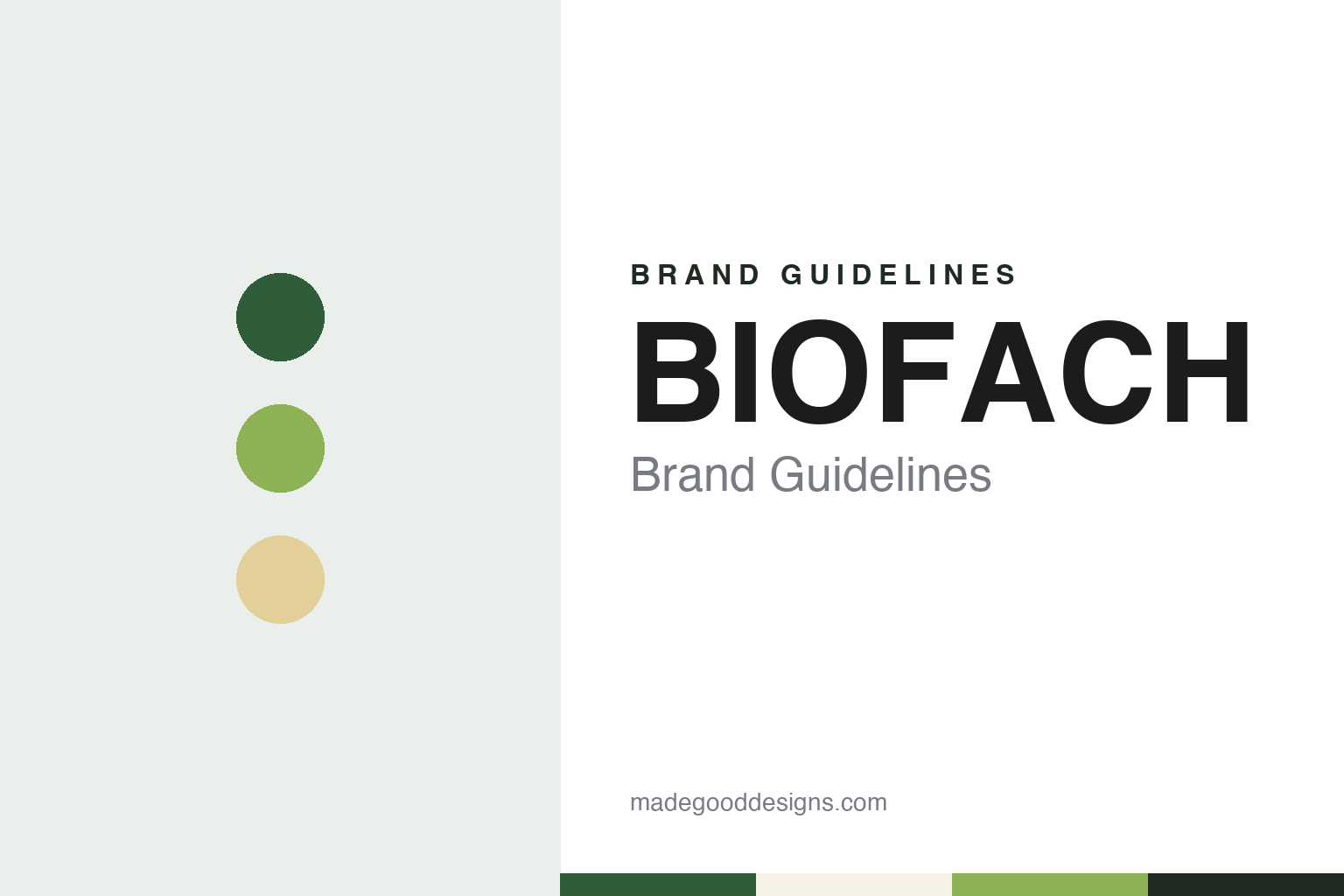
BIOFACH Brand Guidelines
The organic trade fair that began in Ludwigshafen in 1990.
Aa
Two constants: a leaf green, wheat and cream palette and a plain capital sans register. Abstract homage — not a BIOFACH logo, key visual or mark; nothing of the fair’s own design is reproduced.
Ludwigshafen, 1990
Three fair organisers and a city hall on the Rhine.
BIOFACH began in 1990, and not in Nuremberg but in Ludwigshafen, on the Rhine. According to the organiser’s own history, the fair was founded by the trade-fair organisers Hubert Rottner, Hagen Sunder and Jürgen Ries, and it opened with 197 exhibitors in the Ludwigshafen Stadthalle. The organiser puts attendance at that opening edition at about 2,500 visitors; English Wikipedia gives a figure of over 2,000. German Wikipedia describes those early visitors as people from the organic trades, in food and in cosmetics, which set the pattern of a fair aimed at the trade rather than the general public.
The fair moved to Nuremberg in 1999. The organiser says that the 1999 edition, its debut in the city, brought together 1,276 exhibitors and more than 15,384 visitors, and German Wikipedia says it has been held there every year since. In 2001 the founders handed the running of the fair to NürnbergMesse, the exhibition company of the Nuremberg Exhibition Centre, which has organised it ever since, the organiser says; English Wikipedia gives the same year for the handover.
The fair also has an institutional patron. German Wikipedia names IFOAM – Organics International, the international umbrella federation of organic farming movements, as the fair’s patron, and BIOFACH’s own partner page lists IFOAM as international patron alongside a national supporting organisation, the German organic food-industry association BÖLW. Both bodies sit on the fair’s advisory board, with retailers and importers from the organic trade, the partner page shows.
The dated record shows the fair’s growth after the move. The German trade weekly Lebensmittel Zeitung reported on 23 February 2006 that the fair had closed in Nuremberg with around 37,000 trade visitors, a rise of 12 percent on the year before.
Colour
Organic food, drinks and natural cosmetics.
BIOFACH is held once a year in February at the Nuremberg Exhibition Centre and is open to trade visitors. German Wikipedia notes that its four days have run from Tuesday to Friday since 2022, after earlier patterns of Wednesday to Saturday from 2010 to 2020 and Thursday to Sunday up to 2009. It also records two breaks in that rhythm: the 2021 fair was held online only, and the 2022 edition was moved from February to July. The 2026 fair ran from 10 to 13 February in Nuremberg, the trade title Food Ingredients First reported on 9 February 2026.
The product range is organised by category. German Wikipedia lists fresh, frozen and dry goods, the last including cooking and baking, snacks and sweets, and drinks, alongside non-food items, technology and equipment, and media and services. The organiser sets a rule for what may be shown: all organic products on display must meet the requirements of the EU Organic Regulation or the international IFOAM guidelines and be certified accordingly, it says.
Natural cosmetics have moved in and out of the fair. In 2007, the organiser says, the natural cosmetics segment was separated out and run as its own International Trade Fair for Natural Cosmetics and Personal Care, VIVANESS, held in parallel with BIOFACH for 17 years. German Wikipedia says the two fairs were brought back together in 2025, and the current BIOFACH site lists natural cosmetics among the fair’s product categories, next to organic food, organic drinks and organic non-food products.
A congress runs alongside the halls. The organiser says more than 6,400 participants attended 171 congress sessions in 2025. For 2026 it chose the theme “Growing Tomorrow: Young Voices, Bold Visions!” and named India as country of the year, with 95 exhibitors on a joint stand of the Indian agricultural export body APEDA. In its closing report of 13 February 2026, NürnbergMesse said around 2,200 exhibitors from almost 90 countries and just under 32,000 trade visitors had taken part, half of them from abroad.
Typography
How food and wine fairs present themselves.
Food and wine trade fairs tend to present themselves through a short name. Some are acronyms built from a longer title, such as SIAL, from the French Salon International de l’Alimentation, or Anuga, from the German words for a general food and luxury-goods exhibition. Others pair a word with a country or a city, as FOODEX JAPAN does, and many editions are announced simply as the name followed by the year.
Most of these fairs are business events rather than public shows. Their halls are aimed at producers, importers, wholesalers, retail buyers and caterers, and admission usually depends on trade registration. German Wikipedia says Anuga dropped its last public day in 1975, and FOODEX JAPAN’s organiser says entry is limited to people from the trade.
Behind each fair stands an organiser of a particular kind: an exhibition company, a trade association, a group of producer or hospitality bodies, or a fair company owned by a city or region. Halls are often arranged in two ways at once, by product area and by country, with national pavilions placed beside sector halls for drinks, dairy, frozen food or fine food. Some fairs have grown into networks of sister events abroad under the same name.
The visual side usually follows the same pattern. A wordmark is kept from one edition to the next, while the key visual, the poster image and the colour of the year can change with each edition. For a design guide, that combination of a steady name and a changing seasonal look offers a clear pattern to study, and the colours and type in these guides are our own interpretation rather than official assets.
Aa
A plain capital sans for a name the organiser writes in capitals. (Specimen set in Figtree, a sans STAND-IN; NOT the BIOFACH logo.)
BIOFACH World
One capitalised name, several continents.
The organiser writes the name in capitals, BIOFACH, and German Wikipedia records that as the fair’s own styling. The current website pairs the name with the short line “into organic” beside the dates of the next edition. In running text the trade press is less consistent: Food Ingredients First writes “Biofach”, and English Wikipedia uses “BioFach”. This guide follows the organiser’s capitals throughout.
The name has also travelled. NürnbergMesse groups its organic fairs abroad as BIOFACH World. Its site lists BIOFACH CHINA in Shanghai, BIOFACH INDIA in the Delhi region, BIOFACH AMERICA LATINA, held together with the Bio Brazil Fair in São Paulo, and BIOFACH SOUTH EAST ASIA. German Wikipedia records a wider set in 2014, including editions in the United States and in Japan, so the line-up has changed over the years. Each one keeps the capitalised BIOFACH name and adds a region, in the same way that the parallel natural cosmetics fair once carried its own name, VIVANESS, while sharing the Nuremberg halls.
The fair is also a media event for its trade. The organiser says more than 400 media representatives from 22 countries report on it, and its closing report put half of the 2026 trade visitors as coming from abroad. The same report describes a new-products stand showing 480 products and an Innovation Stage on which 31 start-ups, creative companies and innovators presented their work.
For a design guide, BIOFACH shows how a trade fair can keep one capitalised name steady while it changes city, organiser and format, and then lend that name to sister fairs abroad. Compare FOODEX JAPAN, the food and drink trade fair in Tokyo, and SIAL Paris. For this guide we use a leaf green, a fresh sprout green, wheat and oat cream with a sans, an unofficial interpretation; no product or logo is reproduced.
Explore & save
Keep BIOFACH’s identity on hand — save it to a board in the Made Good inspiration library.
BIOFACH identity set
Pin the BIOFACH leaf green, wheat and cream palette and the plain capital sans register to your own board.
Source & notes
Frequently Asked Questions
What font can I use to match the BIOFACH look?
This guide describes BIOFACH’s type as “A plain capital sans for a name the organiser writes in capitals”. Its type specimen is set in Figtree from Google Fonts as a stand-in; Figtree is not BIOFACH’s own lettering.
What colours are in the BIOFACH palette?
This guide’s BIOFACH palette is Leaf green #2F5D3A, Ink #1F2A22, Sprout #8DB255, Wheat #E3CF9A and Oat cream #F6F2E6. The tones are the guide’s own unofficial interpretation, not official BIOFACH hex codes.
When was BIOFACH founded?
BIOFACH was founded in 1990, in Ludwigshafen, Germany.
Who founded BIOFACH?
BIOFACH was founded by Hubert Rottner, Hagen Sunder and Jürgen Ries in 1990.