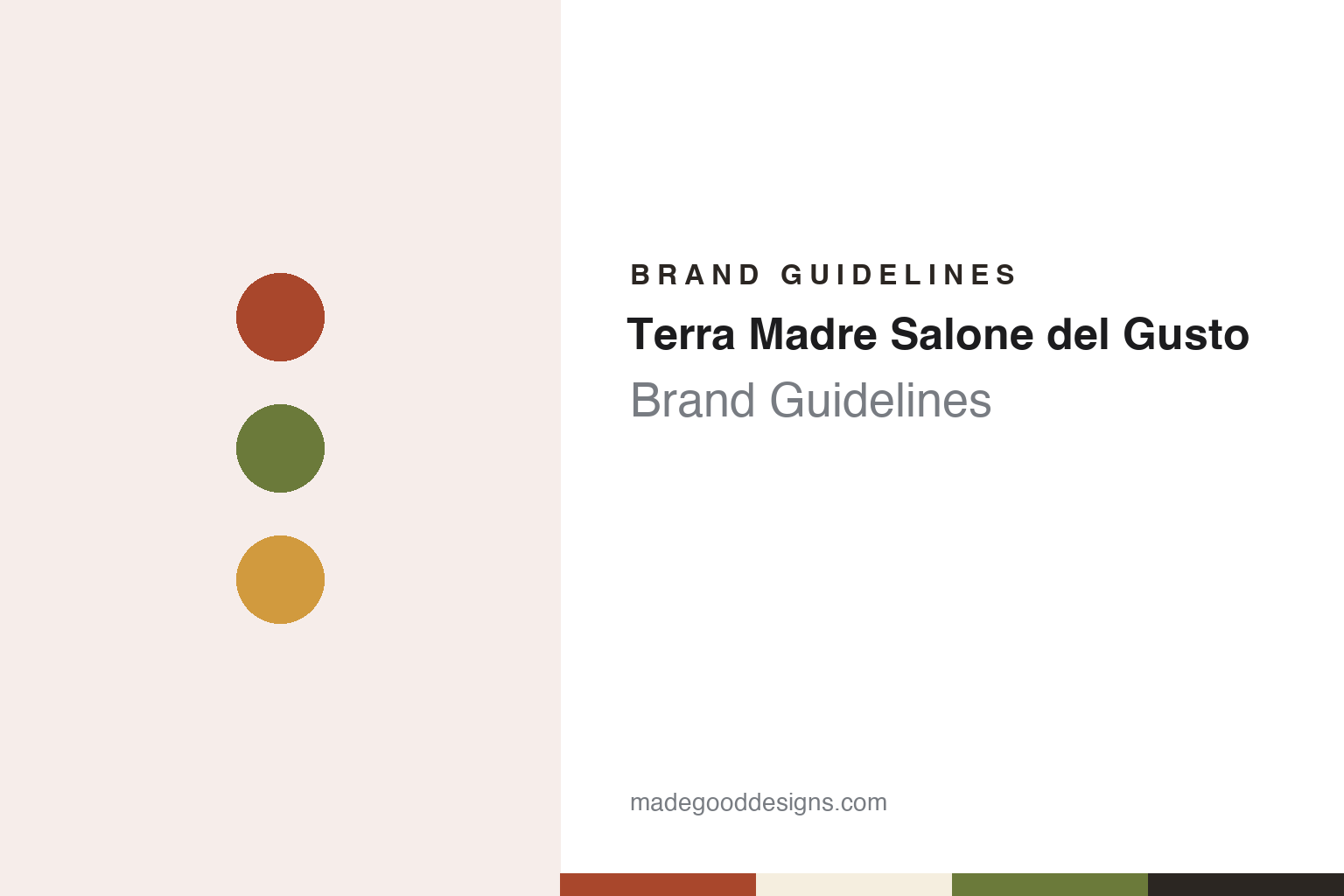
Terra Madre Salone del Gusto Brand Guidelines
Slow Food’s biennial food fair in Turin.
Aa
Two constants: a terracotta, olive and ochre palette and a warm editorial serif register. Abstract homage — not a Terra Madre Salone del Gusto or Slow Food logo, key visual or mark; nothing of the event’s own design is reproduced.
Salone del Gusto
A Slow Food fair and a world meeting, joined.
Terra Madre Salone del Gusto grew out of two events in Turin. Italian Wikipedia, citing a 2004 book by Slow Food’s founder Carlo Petrini, dates the opening Salone del Gusto, then called the Salone Internazionale del Gusto, to 1996. It was the fair of Slow Food, the association whose Italian story began in 1986; Il Sole 24 Ore marked forty years since Slow Food’s founding in September 2026. For most of its history the Salone was held at the Lingotto exhibition halls: Dissapore recalled in July 2020 a Lingotto Fiere filled with delegates, and Italian Wikipedia calls the Lingotto the event’s historic home.
In 2004 Slow Food added Terra Madre, a world meeting of what it calls food communities: small-scale farmers, breeders, fishers and food artisans. English Wikipedia says the opening Terra Madre meeting in Turin that year drew about 5,000 delegates from more than 130 countries, and that the meeting was held every two years in the autumn. Italian Wikipedia says the 2008 meeting ran from 23 to 27 October, alongside the Salone del Gusto. English Wikipedia lists the founding members of a Terra Madre Foundation set up to organise the gatherings, among them the Piedmont Region, the City of Turin and Slow Food.
The two events then became one. Italian Wikipedia says the Salone del Gusto and Terra Madre merged into a single event in 2012, and that in 2016 it took the name Terra Madre Salone del Gusto and left the Lingotto, spreading across the city to the Parco del Valentino, the Borgo Medioevale, the Palazzo Reale and other sites, citing reports in Corriere della Sera and La Stampa from September 2016.
Colour
Biennial, and always in Turin.
The event is held every two years, at the end of summer or in the autumn, and is organised by Slow Food, the Piedmont Region and the City of Turin, according to the official site. At its centre is a market of producers, surrounded by conferences, forums, Taste Workshops, guided tastings and cooking classes, Italian Wikipedia says.
Recent editions show how freely the format moves. The 13th edition, the food magazine Dissapore reported on 22 July 2020, was largely digital: it opened on 8 October 2020 with Taste Workshops at a site in the Lingotto district and ran as a six-month programme on the theme “Our Food, Our Planet, Our Future” until a Slow Food congress on 21 April 2021. Italian Wikipedia, citing la Repubblica, says the 2022 and 2024 editions were held at the Parco Dora. The organiser’s recap of the 15th edition, in 2024, gives its theme as “We Are Nature” and counts 700 exhibitors, 180 of them Slow Food Presidia.
The 16th edition, from 24 to 27 September 2026, moved into the historic centre. The Piedmont Region said on 8 July 2026 that it was the event’s debut in the heart of the old city, and that it marked thirty years of the Salone del Gusto and forty years of Slow Food Italy. The official site lists Piazza San Carlo, Piazza Castello, Piazzetta Reale, Piazza Carlo Alberto, Piazza CLN, Via Roma and Piazza Vittorio among the sites, with a market of more than 700 producers, the organiser says. Dissapore described on 8 July 2026 a route from Via Roma up to Piazza Castello and on to Piazza Vittorio Veneto, with the market arranged by Italian region. On the opening day Il Sole 24 Ore reported more than 1,000 events on the programme and quoted Serena Milano, Slow Food’s director, on the aim of an edition that was “intimate and walkable”.
The event also reaches beyond its four days. The official site describes a Road to Terra Madre programme from 1 May to 20 September 2026, in Italy and abroad, and eight days of Terra Madre Off events in Turin and Piedmont from 21 to 28 September.
Typography
How food and wine fairs present themselves.
Food and wine trade fairs tend to present themselves through a short name. Some are acronyms built from a longer title, such as SIAL, from the French Salon International de l’Alimentation, or Anuga, from the German words for a general food and luxury-goods exhibition. Others pair a word with a country or a city, as FOODEX JAPAN does, and many editions are announced simply as the name followed by the year.
Most of these fairs are business events rather than public shows. Their halls are aimed at producers, importers, wholesalers, retail buyers and caterers, and admission usually depends on trade registration. German Wikipedia says Anuga dropped its last public day in 1975, and FOODEX JAPAN’s organiser says entry is limited to people from the trade.
Behind each fair stands an organiser of a particular kind: an exhibition company, a trade association, a group of producer or hospitality bodies, or a fair company owned by a city or region. Halls are often arranged in two ways at once, by product area and by country, with national pavilions placed beside sector halls for drinks, dairy, frozen food or fine food. Some fairs have grown into networks of sister events abroad under the same name.
The visual side usually follows the same pattern. A wordmark is kept from one edition to the next, while the key visual, the poster image and the colour of the year can change with each edition. For a design guide, that combination of a steady name and a changing seasonal look offers a clear pattern to study, and the colours and type in these guides are our own interpretation rather than official assets.
Aa
A warm editorial serif for a long, two-part name. (Specimen set in Fraunces, a serif STAND-IN; NOT the Terra Madre Salone del Gusto or Slow Food logo.)
Biodiversity – Be Diversity
A campaign built from producers’ faces.
Each edition carries a theme and a campaign of its own. For 2026 the slogan was “Biodiversity – Be Diversity”, as Il Sole 24 Ore and Dissapore both reported. The official graphics page says the visuals were created by the creative agency Undesign and feature photographs of Slow Food Presidia and of products from the Ark of Taste, together with the faces of the people who look after them. The organiser offers the graphics as a downloadable kit, with guidelines included, for anyone to share under the hashtag #TerraMadre2026.
The name is long, and it carries the event’s history in its two halves: “Terra Madre”, Italian for Mother Earth, from the 2004 world meeting, placed before “Salone del Gusto”, the Salon of Taste of 1996. The organiser’s own hashtag shortens it to Terra Madre, and so do many press reports.
Unlike a fair housed in one exhibition centre, the event has changed its setting several times: the Lingotto halls, then the Parco del Valentino and other city sites in 2016, the Parco Dora in 2022 and 2024, and the squares of the old centre in 2026. The constants have been the three organisers, the Turin base, the two-year rhythm and the market of producers at the centre of the programme.
For a design guide, Terra Madre Salone del Gusto shows how an event identity can rest on a long, two-part name and a campaign of real producers’ faces while its venue changes from edition to edition. Compare Vinitaly, the Italian wine fair in Verona, and BIOFACH. For this guide we use a terracotta, an olive green and an ochre on cream with a serif, an unofficial interpretation; no product or logo is reproduced.
Explore & save
Keep Terra Madre Salone del Gusto’s identity on hand — save it to a board in the Made Good inspiration library.
Terra Madre Salone del Gusto identity set
Pin the Terra Madre Salone del Gusto terracotta, olive and ochre palette and the warm editorial serif register to your own board.
Source & notes
Frequently Asked Questions
What font can I use to match the Terra Madre Salone del Gusto look?
This guide describes Terra Madre Salone del Gusto’s type as “A warm editorial serif for a long, two-part name”. Its type specimen is set in Fraunces from Google Fonts as a stand-in; Fraunces is not Terra Madre Salone del Gusto’s own lettering.
What colours are in the Terra Madre Salone del Gusto palette?
This guide’s Terra Madre Salone del Gusto palette is Terracotta #A9472C, Charcoal #2B2622, Olive #6B7A3A, Ochre #D19A3E and Cream #F5EEDF. The tones are the guide’s own unofficial interpretation, not official Terra Madre Salone del Gusto hex codes.