London International Awards Brand Guidelines
Founded in London, judged in Las Vegas.
Aa
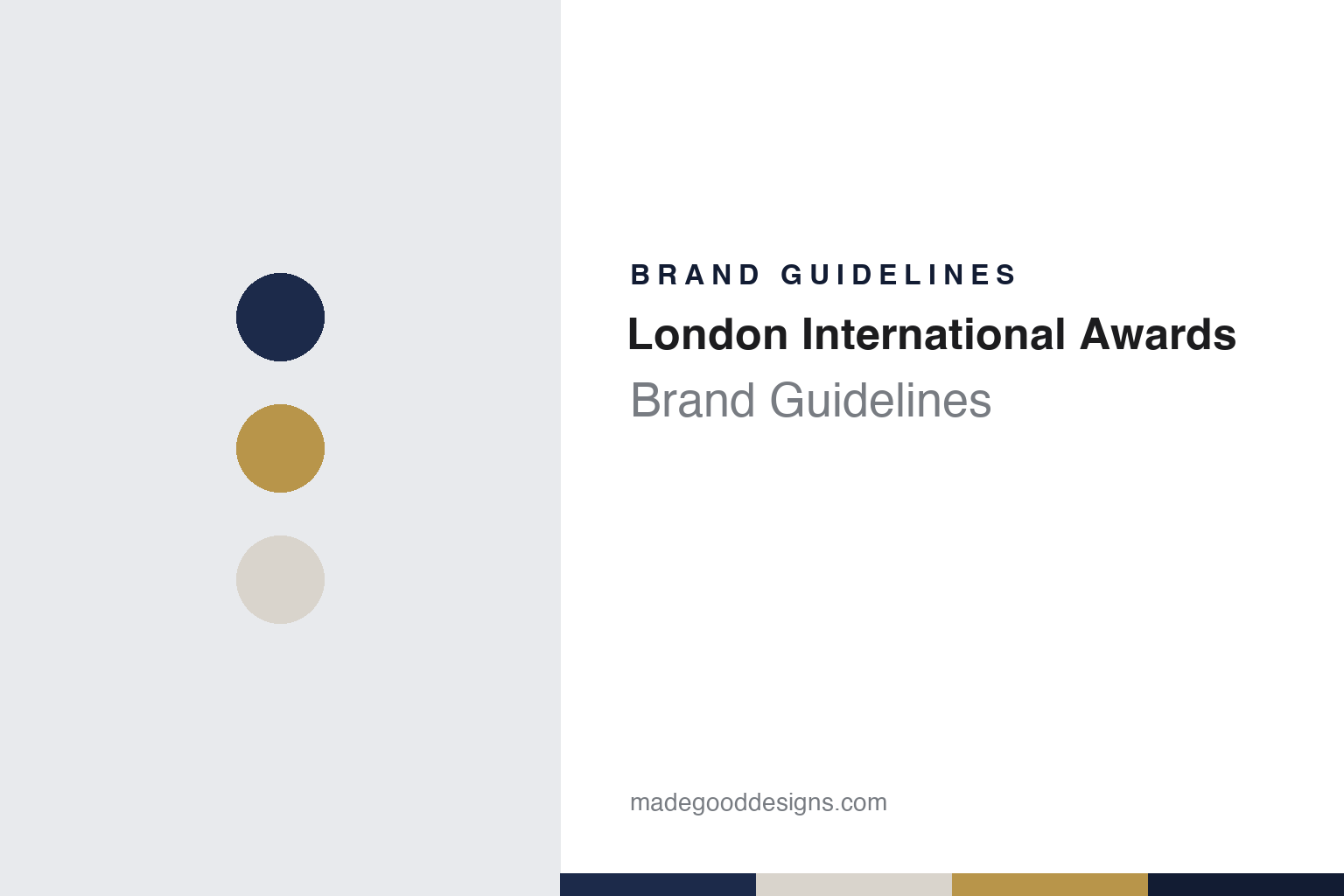
Two constants: a navy, gold and warm grey palette and a bookish serif register. Abstract homage — not a London International Awards statue or mark; no trophy, logo or key visual is reproduced.
A London show
Founded in London in 1986.
The London International Awards were founded in London in 1986 by Barbara Levy, who remains the programme’s founder and president. The German trade weekly Horizont reported on 6 August 2025 that Levy had worked at the Clio Awards in New York from 1979, rising to international director, before a group of British creatives asked her to set up a global awards show covering every kind of media. The same report says she has run the competition as its independent owner since 1999.
In an interview with the Philippine trade magazine adobo on 10 October 2025, Levy recalled that the creative community had asked her to take their local show and make it international. The show began by recognising outdoor, television, cinema and radio advertising; by 2025 it covered 29 categories, according to adobo, while Horizont counted 30, including TV & Cinema, Print, Audio and Design. The programme uses its initials, LIA, as its short name and in the name of its top prize.
For more than two decades the show ended with an awards ceremony in London. In 2011, after 26 years of London ceremonies, adobo reported, it dropped the traditional gala and launched Creative LIAisons, a programme for young creatives aged 21 to 30 that runs alongside the judging, with seminars, workshops and access to the judging rooms. A virtual strand was added in 2021, and adobo put the number of young creatives mentored at more than 400 a year. The 40th edition was marked in 2025.
Colour
Statues in gold, silver and bronze.
Judging moved to Las Vegas in 2010, and since then every round has been held on site, adobo reported; Horizont names the venue as the Encore at Wynn Las Vegas. There is no pre-judging, adobo reported, and no separate shortlist jury: every juror in a competition votes on every entry in that competition from start to finish.
LIA’s own account of the process, published by the Australian trade site Campaign Brief on 1 August 2022, describes 16 judging panels and three rounds. In the first, “In or Out,” every juror votes on every entry, and work voted in by a majority, or by an even split, goes forward. In the second, jurors score the remaining work from one to ten, and entries averaging seven or more go to a third round, the “Statue Discussion,” in which the jury reviews the work in order of score and decides the Gold, Silver and Bronze statues and the finalists. There is no minimum or maximum number of statues, and each juror may ask for up to two pieces that missed the cut to be brought back for discussion.
The last question is whether any gold should become a Grand LIA, the programme’s top award. The jury does not have to give one, and the decision needs a majority vote rather than a unanimous one. The jury president and the jury then check all the results together, and the jurors know every result when they leave the room.
Observers sit in. LIA admits young creatives, its excellence managers and the press to the judging rooms to watch the statue discussions, according to the 2022 account, and Levy told Horizont in 2025 that no juror may vote on their own work. Entries must have been published commercially with the client’s approval, the same interview says, and the organiser can ask an entrant for proof that a piece actually ran.
The panels themselves are curated, the 2022 account says, so that each is represented across regions, company types, networks and holding companies; the jury president sets the tone and guides the room, but every juror has an equal voice, and votes are cast on tablets. Levy told Horizont that all jurors are working, award-winning creatives, that juries are chosen to be culturally varied and international, and that entrants are asked to supply cultural context so that each piece can be judged fairly.
Typography
Awards, juries and festivals.
Advertising and creative awards tend to present themselves through very few elements. The name is usually short: a set of initials, a club’s name, or the city where the festival takes place. Next to it sits a trophy with a name and a shape of its own, such as a lion, a pencil, a statuette, a cube or an eye, and that object often does the work of a logo, lending its name to the levels of award and to the everyday talk around them.
The organisations behind these programmes vary. Some are associations or clubs formed by working designers, art directors and copywriters; some are registered charities or non-profits; others are run by publishers or events companies, and a few have changed owners as those companies were bought and sold. Where a programme has a parent company, the festival name usually stays in front and the owner appears in the small print.
Most follow a yearly cycle. Entries open months ahead, juries of practitioners meet in rounds, a shortlist is published, and the awards are given at a ceremony or during a festival week, often with talks, workshops and student competitions alongside. Award levels are typically graded, from a shortlist through bronze, silver and gold or their equivalents, with a top prize that juries may decide not to give.
The visual identity has two speeds. A steady wordmark and trophy carry over from year to year, while a key visual is refreshed for each edition, and the selected work is kept in an annual book or an online archive. This guide describes those elements as the organisers and dated sources set them out, and the colours and type shown here are an unofficial interpretation.
Aa
A bookish serif for a name that keeps its city. (Specimen set in Libre Baskerville, a serif STAND-IN; NOT the London International Awards logo.)
LIA
Four words, three letters.
The yearly cycle is built around the judging week rather than a gala. adobo described the 2025 anniversary week in Las Vegas as a gathering for judging, mentorship and talks, without the red carpets of a traditional ceremony, and placed it at the Encore Wynn, where the juries, mentors and young creatives meet at the same time. Levy told Horizont that the programme’s motto is “Created for Creatives” and that jurors are gathered in one place so that no judging happens off site.
The name still points to London, where the show was founded and where its ceremonies were held until 2011, while its judging and its young-creatives programme now take place in Las Vegas. Horizont and adobo both describe LIA as owned and run by women, with Levy as owner and president.
The list of competitions changes with the industry. Levy told adobo that new categories, such as transformative business or sports marketing, are often co-curated with the people who propose them, and that Creative LIAisons is paid for by LIA, covering participants’ travel, accommodation and mentoring.
For a design guide, London International Awards shows how a programme can keep a city in its name after moving its judging elsewhere, with three initials doing the work of a short mark and naming its top prize, the Grand LIA. Compare Clio Awards, where Levy worked before founding LIA, and D&AD, the London awards body. For this guide we use a deep navy, a soft gold and a warm grey with a serif, an unofficial interpretation; no product or logo is reproduced.
Explore & save
Keep London International Awards’s identity on hand — save it to a board in the Made Good inspiration library.
London International Awards identity set
Pin the London International Awards navy, gold and warm grey palette and the bookish serif register to your own board.
Source & notes
Frequently Asked Questions
What font can I use to match the London International Awards look?
This guide describes London International Awards’ type as “A bookish serif for a name that keeps its city”. Its type specimen is set in Libre Baskerville from Google Fonts as a stand-in; Libre Baskerville is not London International Awards’ own lettering.
What colours are in the London International Awards palette?
This guide’s London International Awards palette is Deep navy #1C2A4A, Midnight #121C33, Soft gold #B8954A, Warm grey #D9D4CC and Paper #F7F5F0. The tones are the guide’s own unofficial interpretation, not official London International Awards hex codes.
When was London International Awards founded?
London International Awards was founded in 1986, in London, UK.
Who founded London International Awards?
London International Awards was founded by Barbara Levy in 1986.