Peabody Awards Brand Guidelines
The University of Georgia’s broadcasting prize, first issued in 1941.
Aa
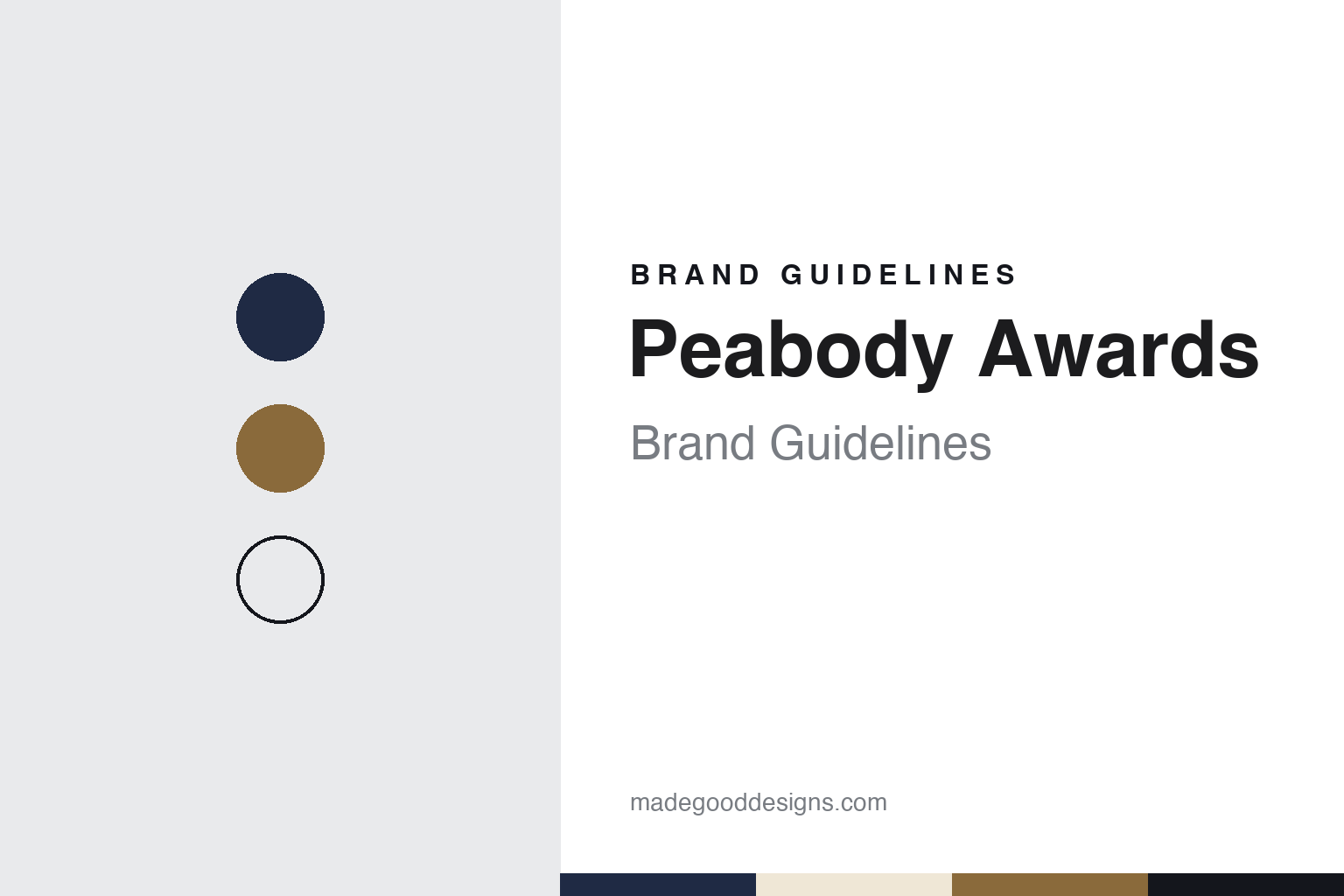
Two constants: a deep navy, bronze and parchment palette and a bookish serif register. Abstract homage — not a Peabody Awards medallion or mark; no trophy, logo or seal is reproduced.
Athens, Georgia
A broadcasters’ committee and a journalism school.
The Peabody Awards are run from the University of Georgia in Athens, where the programme is based at the Grady College of Journalism and Mass Communication. Their full name is the George Foster Peabody Awards, often shortened to “the Peabodys.” The organiser describes them as awards for television, podcast and radio, and streaming and digital media, chosen each year by a board of jurors through a unanimous vote.
The idea came from radio. According to the programme’s own history, the National Association of Broadcasters formed a committee in the late 1930s to set up an award for excellence in broadcasting, along the lines of the Pulitzer Prize; English Wikipedia dates that committee to 1938. Lambdin Kay, the manager of WSB Radio in Atlanta, asked the dean of the University of Georgia’s journalism school to sponsor the awards, on the recommendation of a graduate who worked at the station. English Wikipedia says the award was established in 1940 with the Grady College as its permanent home, and the organiser says the first awards were issued in 1941, for radio programmes broadcast during 1940.
The awards are named for George Foster Peabody (1852–1938), a Georgia-born investment banker. The organiser makes two points about the name. The awards were not set up through an endowment or through his will; they were named after him posthumously, in recognition of his contributions to the University of Georgia. And he is not the same person as George Peabody (1795–1869), the earlier banker and philanthropist with whom he is sometimes confused.
For their first years the awards covered radio alone. Television awards followed in 1948, and English Wikipedia says categories for work distributed on the World Wide Web were added in the late 1990s. Material made only for theatrical film release is not eligible, it adds.
Colour
Eight categories and a unanimous board.
Today the programme gives awards in eight categories: entertainment, documentary, news, podcast and radio, arts, children’s and youth, interactive and immersive media, and public service, as listed in the organiser’s announcement of November 2025 and in Variety’s report of January 2025. The organiser’s FAQ says that each year 30 Peabody Awards are given across the main categories, with special awards for individuals’ career achievement and for institutions with a long-standing body of work. Interactive work joined the programme more recently: the organiser says a separate jury for interactive and immersive media was formed in 2020, and that from 2022 the categories were widened to areas such as gaming, virtual and augmented reality, social video and interactive documentary.
Selection rests with the Board of Jurors. The organiser says its boards are made up of media professionals, scholars, critics and journalists, and it now runs a Broadcast Board and an Interactive Board. TheWrap reported in January 2025 that jurors serve six-year terms and that every winning programme must receive a unanimous vote, and the organiser’s release of November 2025 says the same applies to nominations. English Wikipedia describes the process in more detail: since 2015 a preliminary round has been judged by faculty members at research universities across the United States, and the board then meets at the University of Georgia in early April for final screenings and deliberations. It adds that from 2016 the programme settled on a field of 60 nominees and 30 winners. The organiser’s FAQ says there are no set criteria for judging.
The cycle runs across two calendar years. For television, streaming, podcast and radio, entries for work made in a given year are accepted in the autumn, typically from October to December; nominations and winners are announced the following spring, and the ceremony takes place in May or June, typically in New York or Los Angeles, the organiser says.
The prize itself is a medallion. The organiser says it was commissioned by Peabody’s family and designed by the sculptor Evelyn Beatrice Longman. People credited on a winning programme, and executives at the company, station or network behind it, may order a statuette engraved with their name and title, and certificates are offered to those credited on nominated programmes.
Typography
Prizes, juries and ceremonies.
Music, screen and media awards usually carry the name of the body behind them. Some are run by a television network, which both organises the night and broadcasts it; others by a trade association, an academy, a guild of performers, a critics’ association or a university. That organiser sets the rules, the eligibility period and the voting method, and its name or initials often become the programme’s nickname — CMAs, VMAs, AMAs — long before anyone reads the full title.
Most programmes follow a yearly cycle. Work released within a fixed window, sometimes twelve months that do not match the calendar year, becomes eligible; a first ballot or submission round produces nominees; and a later vote or jury decision picks the winners in each category. Depending on the programme, the voters may be the organiser’s professional members in several rounds, a voting academy of industry and media figures, a panel or jury, or the public through fan votes.
The ceremony itself is usually built for television or streaming. Many awards keep a regular month and a regular venue for years at a time, and some of the categories are presented on air while others are handed out separately or announced in advance. Special honours, such as lifetime achievement awards, sit alongside the competitive categories.
The most constant visual element is often the object handed to winners. A named statuette, a sculpted star or a crystal trophy can outlast every change of logo, host city or broadcaster, and organisers often tell the story of its shape, material and maker. The guides in this group describe those programmes plainly: who runs them, how their categories and voting work, and how their trophies and names present them, without listing winners.
Aa
A bookish serif for a university-based prize. (Specimen set in Libre Caslon Text, a serif STAND-IN; NOT the Peabody Awards logo.)
The Peabodys
From a New York luncheon to Beverly Hills.
For many years the awards were presented at a luncheon in New York City, English Wikipedia says, and the presentation became an evening red-carpet event in May 2015. From 2014 to 2016 the ceremony was shown on a tape-delayed basis on the cable channel Pivot, and in June 2017 a television special of the 76th awards aired on PBS and Fusion. The organiser says the celebration of winners was held online from 2020 to 2022.
The ceremony has since moved west. The organiser says the awards were held in Los Angeles for the first time in 2024, at the Beverly Wilshire Hotel. Variety and TheWrap reported in January 2025 that the 85th ceremony would return there on 1 June 2025, and the organiser’s release of November 2025 describes that ceremony as held at the Beverly Wilshire in Beverly Hills and announced the 86th for 31 May 2026 at the same hotel.
An archive stands behind the awards. The organiser says the Peabody Awards Collection holds more than 90,000 titles, with radio programmes from 1940 and television from 1948, on formats from transcription discs and 16mm kinescopes to two-inch video reels and cassettes. It is managed by the university’s Walter J. Brown Media Archives & Peabody Awards Collection, while press kits, scripts and correspondence sent with entries are kept in the Hargrett Rare Book and Manuscript Library. English Wikipedia says the archive is housed in the Richard B. Russell Building on the university’s north campus.
The programme’s executive director, in post since 2013, also holds the Lambdin Kay Chair for the Peabodys, the organiser says. It adds that under the current director the programme formed boards of directors on the East and West Coasts, drawn from media executives, journalists, documentary makers, public-media leaders and foundation executives.
For a design guide, the Peabody Awards show how a prize can be presented through an institution and an object: a university home, a namesake’s full name and a sculpted medallion. Compare the Brit Awards, whose statuette is redesigned for each year’s ceremony, and the Critics Choice Awards, another American awards programme for screen media. For this guide we use deep navy, antique bronze and parchment with a serif, an unofficial interpretation; no product or logo is reproduced.
Explore & save
Keep Peabody Awards’s identity on hand — save it to a board in the Made Good inspiration library.
Peabody Awards identity set
Pin the deep navy, bronze and parchment palette and the bookish serif register to your own board.
Source & notes
Frequently Asked Questions
What font can I use to match the Peabody Awards look?
This guide describes Peabody Awards’ type as “A bookish serif for a university-based prize”. Its type specimen is set in Libre Caslon Text from Google Fonts as a stand-in; Libre Caslon Text is not Peabody Awards’ own lettering.
What colours are in the Peabody Awards palette?
This guide’s Peabody Awards palette is Deep navy #1F2A44, Ink #14161C, Parchment #EFE7D6, Antique bronze #8A6A3B and Paper #FAF7F0. The tones are the guide’s own unofficial interpretation, not official Peabody Awards hex codes.
When was Peabody Awards founded?
Peabody Awards was founded in 1941 (first awards), in Athens, Georgia, USA.