Carolus-Duran built portraits out of very few moves: a near-black background, a face or a dress caught in strong light, and broad strokes of paint that describe fabric without fussing over it. Born Charles-Auguste-Émile Durand in Lille, he took the Latinised name Carolus-Duran and became a sought-after society portraitist in Paris. Designers will recognise the method in every editorial portrait shot against a dark backdrop, and in packaging that sets one luminous product on a deep field.
This guide uses four works that the Metropolitan Museum of Art and the Cleveland Museum of Art flag as public domain or CC0: two oil portraits, a small chalk drawing and an etching.
What to look at in Carolus-Duran’s portraits
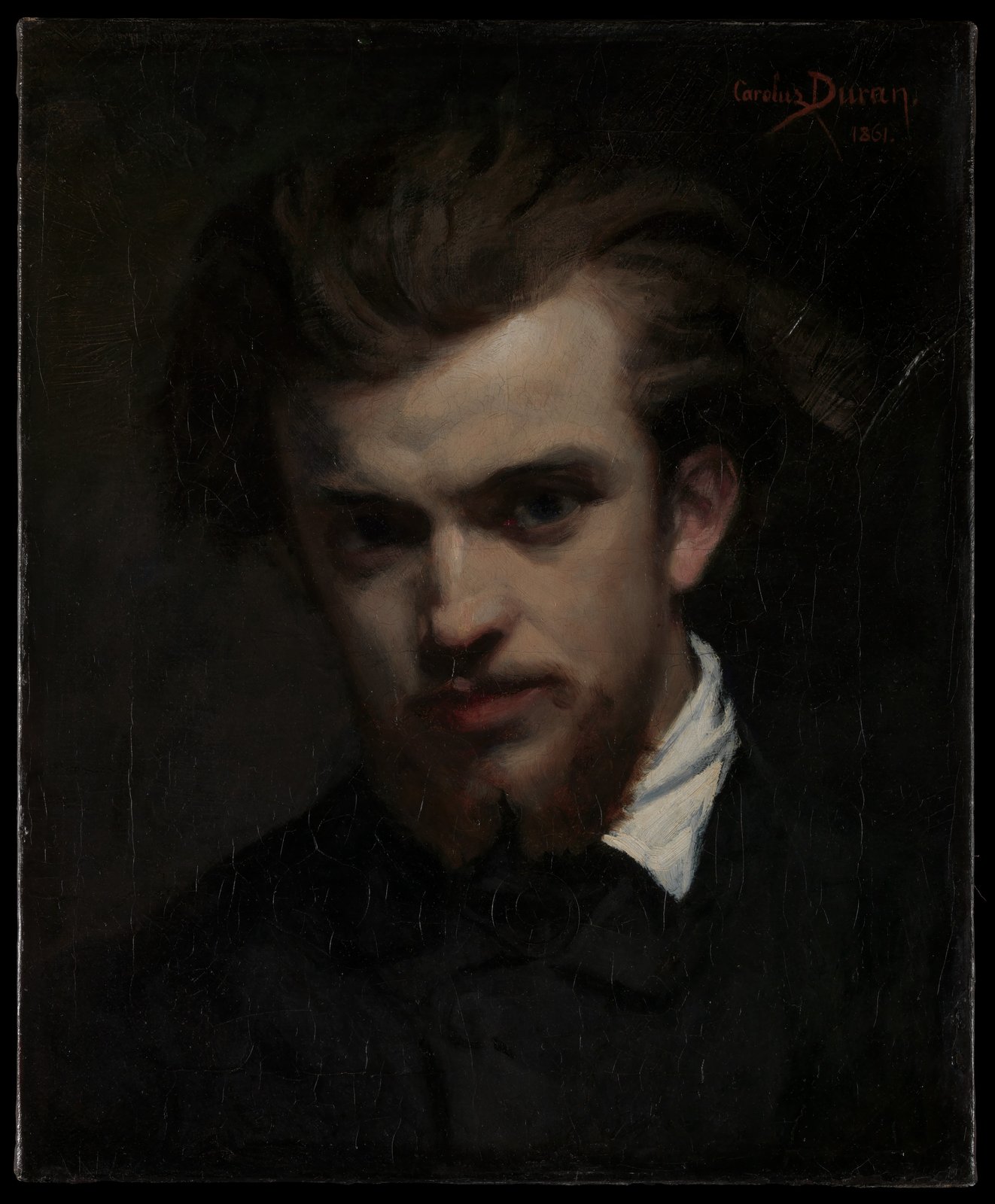
The ground. In his 1861 portrait of his friend, the painter Henri Fantin-Latour, now at the Met, almost everything is dark. Measured from the museum’s scan, the background and coat sit between #080806 and #12100c, values so close that the jacket barely separates from the wall. Against that, the lit side of the face reads around #836d58, and a scrap of white collar at #a29b8c is the brightest note in the picture. The face looks bright only because the ground is so low.
The light. Light falls from the upper left and leaves half the face in shadow. One eye is clear, the other sinks into the dark. That asymmetry gives a small canvas (47.6 by 38.1 cm, according to the Met) the intensity of a close-up.
The edge. Hair dissolves into the background in loose strokes, while the collar has a crisp edge. Hard and soft edges in one image tell the viewer where to look first.
The signature. At top right he signed and dated the canvas in thin red paint, the only warm colour outside the face. It balances the lit cheek on the opposite diagonal: a small typographic element doing compositional work.
A short career outline
According to the Villa Medici, which lists him among the directors of the French Academy in Rome, and the University of Glasgow’s Whistler etchings project, he was born in Lille on 4 July 1837; the Smithsonian American Art Museum gives 1838. He studied drawing at the Lille academy with the sculptor Augustin-Phidias Cadet de Beaupré and painting with François Souchon, a pupil of Jacques-Louis David. He moved to Paris in 1853, copied in the Louvre and met Fantin-Latour; the Villa Medici adds Gustave Courbet and Édouard Manet. Both sources date his Salon debut to 1859.
From 1862 to 1866 he was in Rome, and in 1866 he went to Spain. Glasgow’s biography says he stayed there until 1868 and that his work of the period shows subdued colour and heavy impasto. The Villa Medici and the Smithsonian both describe a turn from Courbet’s realism toward Diego Velázquez. The Palais des Beaux-Arts in Lille holds The Kiss (1868), which the museum describes as a restrained composition in a limited palette, a woman in white emerging from a dark ground.
His breakthrough as a portraitist was La Dame au gant (The Lady with the Glove), a full-length portrait of his wife, the pastellist and miniaturist Pauline Croizette. The Lille museum, which notes that it is now in the Musée d’Orsay, calls it the perfect example of the society portrait.
The Villa Medici dates the opening of his Paris studio to 1870; Glasgow gives 1872. Glasgow also records Mlle Croizette on Horseback (1873) in the museum at Tourcoing and a commission of 1878 for a ceiling in the Palais du Luxembourg, The Glorification of Marie de’ Medici, now in the Louvre. He helped found the Société Nationale des Beaux-Arts in 1890, according to Glasgow and the Smithsonian, and Glasgow records his election as its president in 1900. He was elected to the Académie des Beaux-Arts in 1904 and, according to the Villa Medici, directed the French Academy in Rome from 1905 to 1913. He died in Paris in February 1917: the Villa Medici gives the 17th, Glasgow the 18th.
Technique: painting straight in
The Villa Medici and the Smithsonian both point to Velázquez as a lasting influence after his years in Spain; the Smithsonian notes that the Spanish painter’s realistic, often sombre portraits shaped his own.
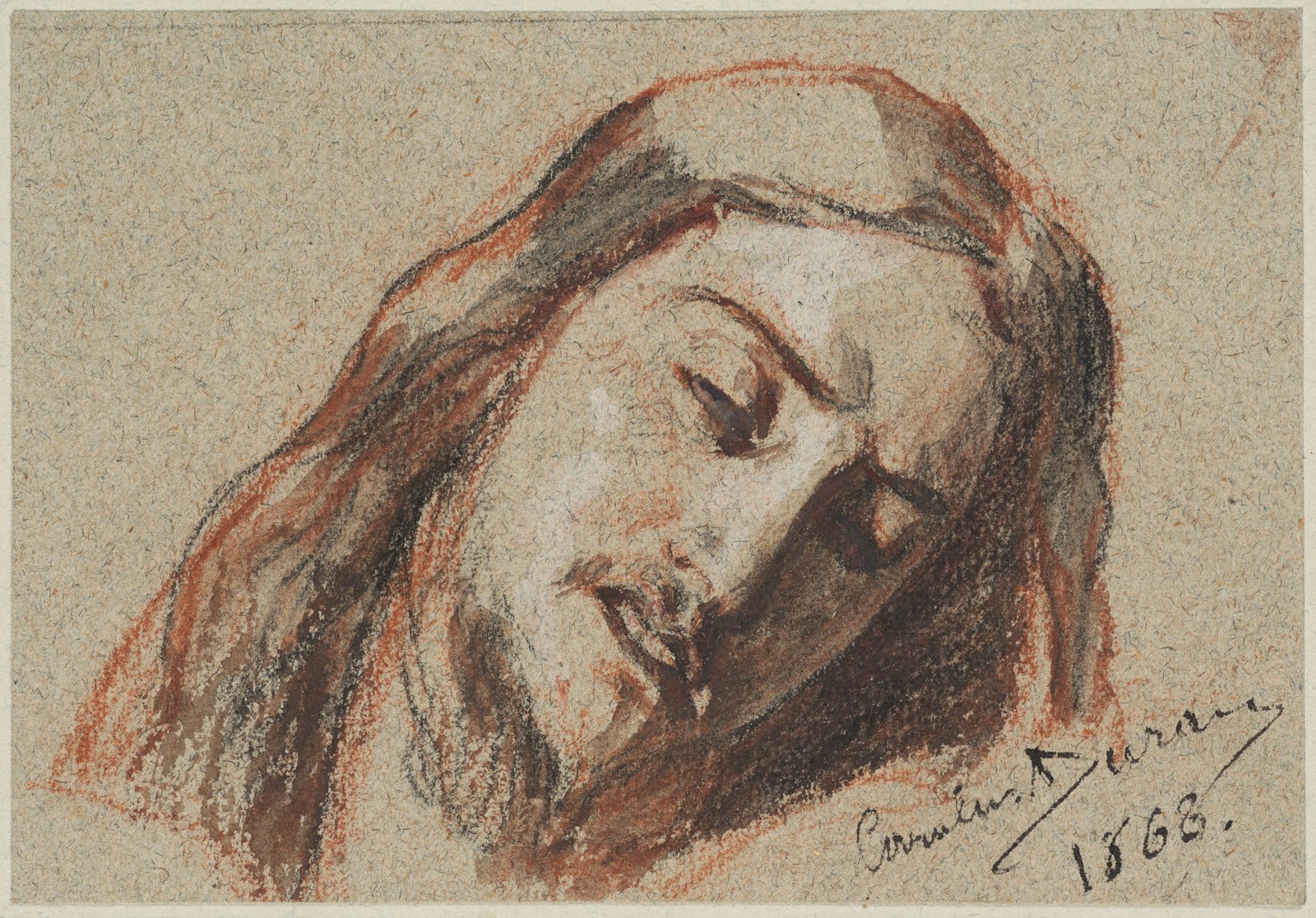
The small Head of Christ of 1868, at the Met, shows the same habit on paper. The Met lists black chalk, red and black washes, red chalk and white gouache on a sheet just 8.6 by 12.5 cm. Red chalk lines rough out the contour of the hair, black wash lays in the shadow side of the face in one pass, and touches of white gouache pick out the brow and nose. Measured from the museum’s scan, the paper reads about #b5a78e and the darkest wash about #644c3e: a narrow, warm range that a designer could use directly for a muted two-colour print.
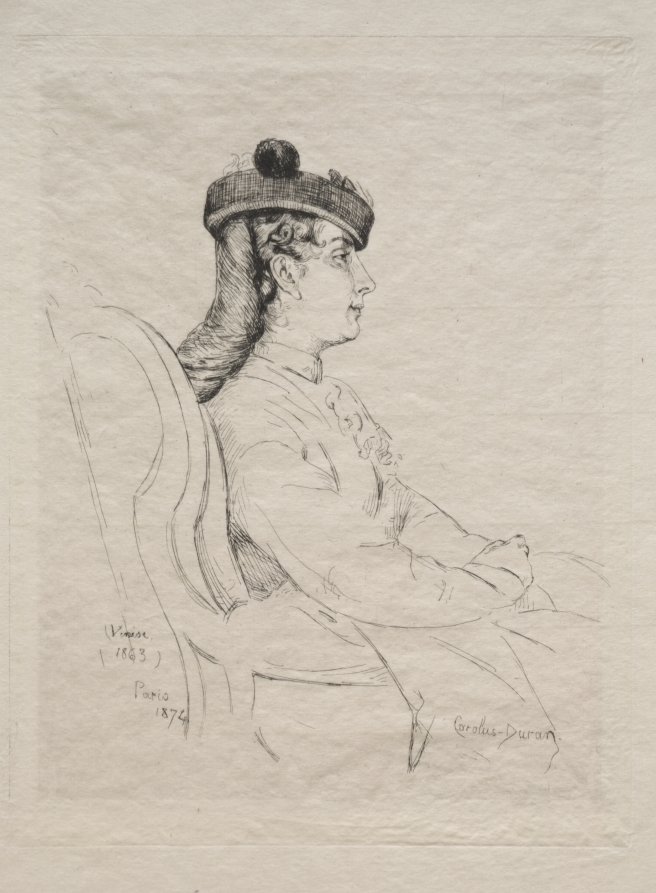
He also made etchings. In Souvenir de Voyage, which the Cleveland Museum of Art dates to 1874, a seated woman in a plaid cap is drawn in profile with economical lines. Dense cross-hatching is reserved for the cap and the coil of hair; the chair and skirt are left as open contour. The plate is inscribed “Venise (1863)” and “Paris 1874” at left, which suggests a sketch from his years in Italy and etched a decade later.
The studio and John Singer Sargent
Glasgow’s Whistler etchings project and the Smithsonian both name the young American John Singer Sargent among the students of his Paris studio. Our guide to John Singer Sargent follows what the student did with the lessons: the dark grounds, the loaded brush and the full-length society portrait.
For designers, the takeaway is less the lineage than the teaching itself: start with tone, not outline.
Black silk and full-length format
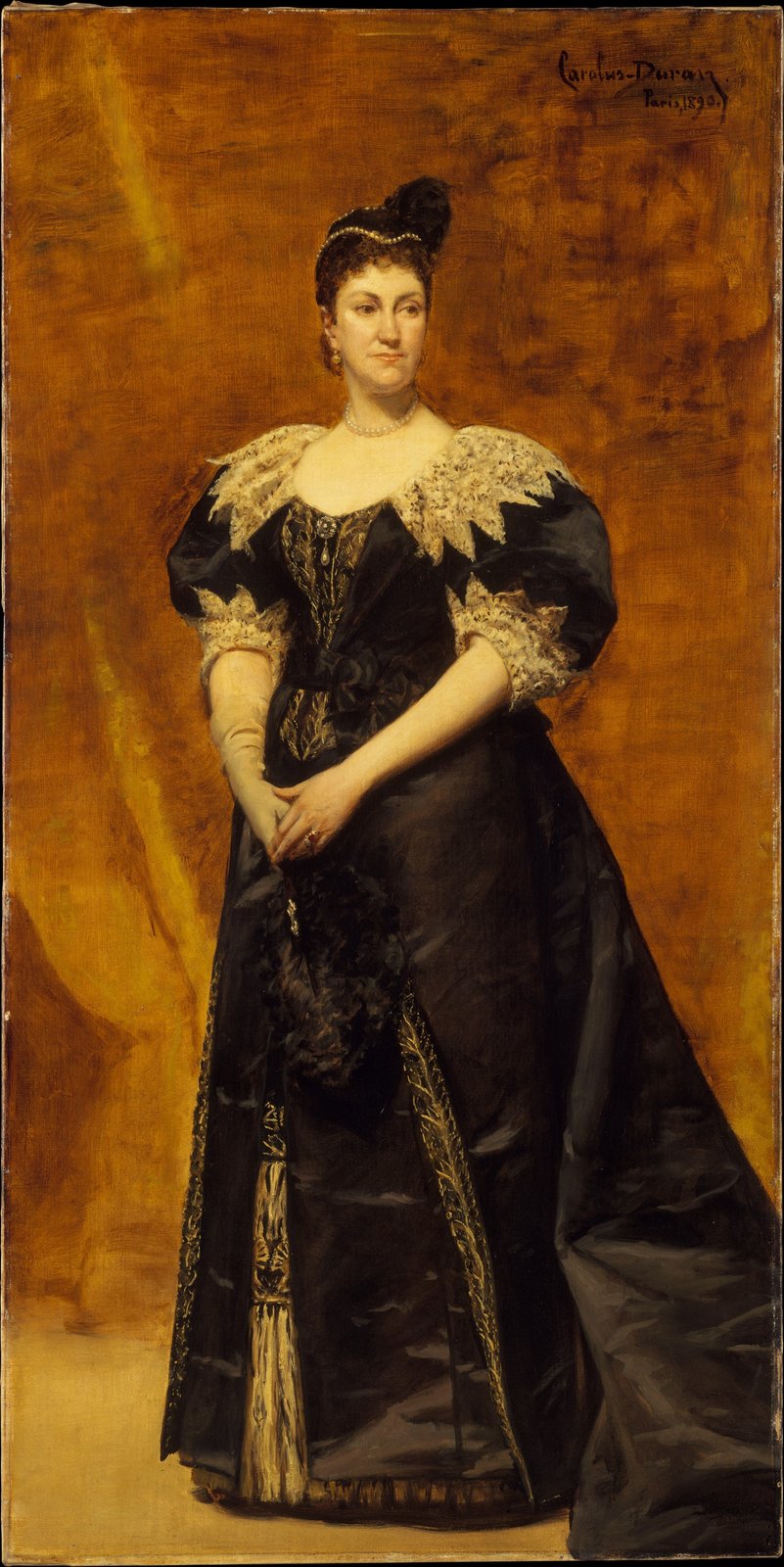
The Met’s Mrs. William Astor (1890) is over two metres tall (212.1 by 107.3 cm). Caroline Webster Schermerhorn Astor stands in a black dress against a curtain-like backdrop of burnt orange. Measured from the museum’s scan, the dress sits near #180e0c, the backdrop moves between #8d4608 and #985811, and the gold lace on the shoulders peaks around #e4bd68. That is three bands of value: a dark figure, a mid-toned ground and a few bright accents at the face, shoulders and hands.
Look at how the black is handled. The skirt is a run of long, glossy strokes that catch light along the folds, so the silk reads as material, not shape. The figure stands slightly off-centre, with the train spilling to the right, which keeps a tall, narrow format from feeling static. The signature and date at upper right echo the placement in the Fantin-Latour portrait thirty years earlier.
How designers can borrow from Carolus-Duran
Lower the ground, not the subject. Rather than brightening a product or face, darken everything around it. A background within a few steps of black, like the #080806 to #12100c range in the Fantin-Latour portrait, makes a modest midtone look lit. Sample your own photographs with the image color picker to check how close your values sit.
Build in three value bands. The Astor portrait works as dark figure, mid ground, bright accents. Try the same structure on a poster or a landing page: one deep block, one warm mid-tone field, and highlights only where the eye should land.
Show the stroke. His fabric is described in broad, visible marks. In illustration and texture work, a few confident strokes can suggest satin or lace better than detailed rendering.
Treat the signature as type. His signatures sit at a corner, sized and coloured to balance the composition. A logo, date line or credit can do the same job in a layout if you place it as an element rather than an afterthought.
For the wider context of the period, read our guide to realism in art, and compare his society sitters with the small, highly finished fashion scenes of Auguste Toulmouche. More public-domain portraits are in the MGD museum collection.
Frequently asked questions
Who was Carolus-Duran?
He was a French painter (1837–1917), born Charles-Auguste-Émile Durand in Lille, known for society portraits and for a Paris teaching studio. He later directed the French Academy in Rome at the Villa Medici.
Was Carolus-Duran John Singer Sargent’s teacher?
Yes. The University of Glasgow’s Whistler etchings project and the Smithsonian American Art Museum both record Sargent as a student in his Paris studio.
Which Carolus-Duran painting should designers know?
The Lady with the Glove, a full-length portrait of his wife Pauline Croizette, is now at the Musée d’Orsay. The Palais des Beaux-Arts in Lille calls it the perfect example of the society portrait.
Where can I see his work in the United States?
The Metropolitan Museum of Art holds his portraits of Henri Fantin-Latour (1861) and Mrs. William Astor (1890) and a 1868 chalk drawing, and the Cleveland Museum of Art holds his 1874 etching Souvenir de Voyage.