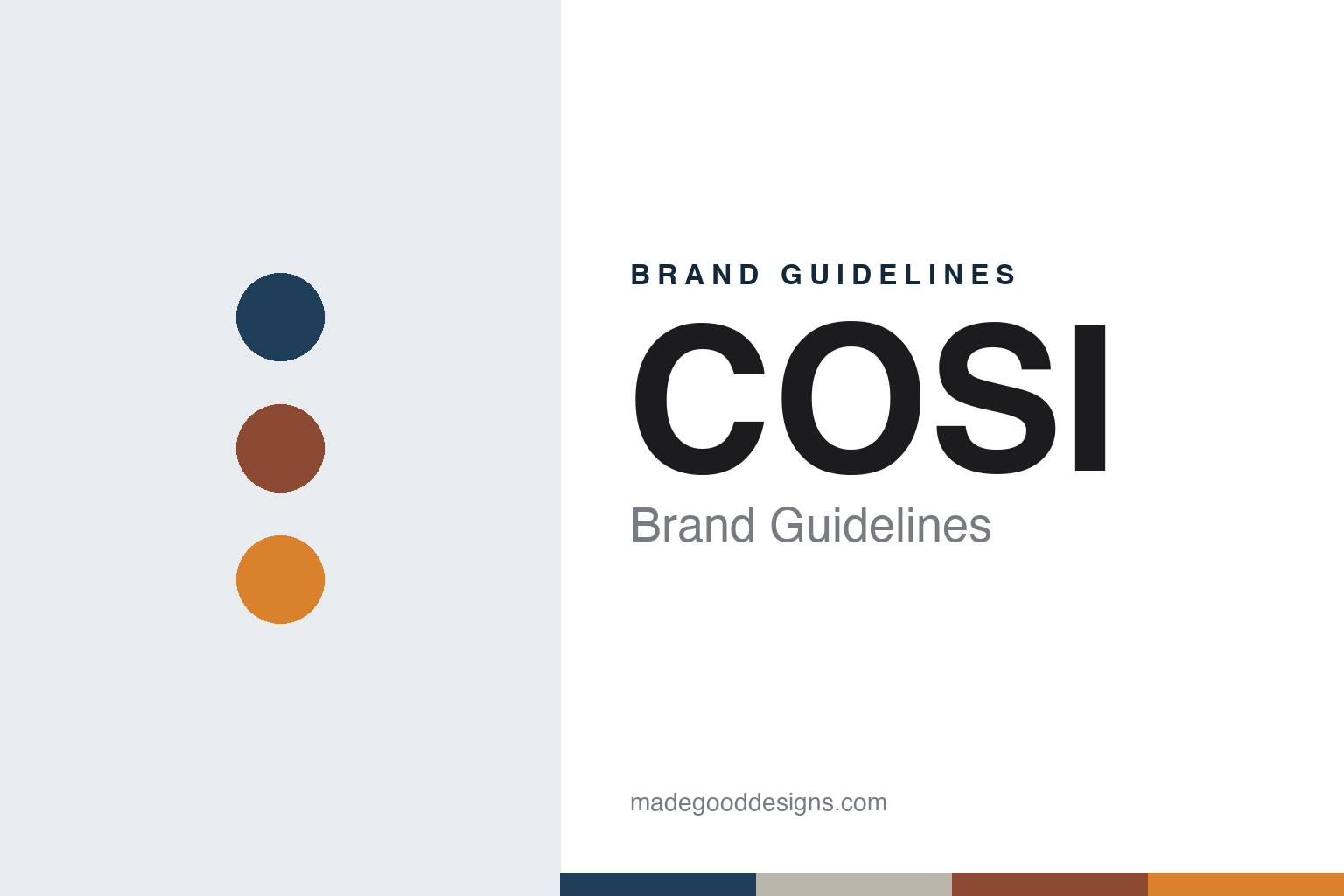
Maryland Science Center Brand Guidelines
An academy from 1797 that opened the Inner Harbor’s new waterfront in 1976.
Aa
Two constants: a harbour navy, brick red and brass palette and a grotesque sans register. Abstract homage — not a Maryland Science Center asset; no logo, sign or building image is reproduced.
An academy finds a home
From 1797 to a harbour site in 1976.
The Maryland Science Center grew out of an older society. The centre traces itself to the Maryland Academy of Sciences, which it dates to 1797, and the Baltimore news site Baltimore Fishbowl described the centre in June 2026 as the academy’s permanent home, adding that the land and building are owned by the Maryland Academy of Sciences. The centre’s 50th-anniversary press release quotes the academy’s aim to be “a focal point for scientific activities” and to extend its work in public education and civic service.
The building came out of Baltimore’s plans for its old waterfront. The centre says that in 1961 the Greater Baltimore Committee proposed a permanent location for the academy, and that in 1966 city voters approved a site on the Inner Harbor; its press release places that site at the southwest corner of the harbour, on the grounds of a former fish oil refinery. Ground was broken at the corner of Light Street and Key Highway on 9 September 1971, the centre says, using a lunar drill built to probe the surface of the moon.
The centre opened to the public on Sunday, 13 June 1976. Baltimore Fishbowl, reporting on the 50th-anniversary celebration in June 2026, wrote that it was the first major building to open in the city’s redevelopment of the Inner Harbor, before the World Trade Center Baltimore in 1977, the Baltimore Convention Center in 1979, Harborplace in 1980 and the National Aquarium in 1981. Civic leaders at the anniversary said that starting with a public attraction rather than a private building set the tone for the waterfront, the site reported.
The early years leaned on schools and volunteers. The centre’s own history says it hosted school field trips from the start, sent a Traveling Science Program around the state, and greeted visitors with two flat, puppet-like mascots called Mort and Myrt. In the 1980s an Alvan Clark and Sons telescope, previously at the Enoch Pratt Library, moved to the rooftop observatory; an exhibit called Energy opened as a continuous exhibit; and an overnight programme for scouts, Camp-In, began.
Colour
Planetarium, IMAX, dinosaurs and a demo stage.
The building has been reshaped several times. Baltimore Fishbowl reported that the original main entrance on Key Highway was turned to face the Inner Harbor in the 1980s. An IMAX theatre followed in 1987; the centre’s press release describes 400 seats and a screen 75 feet wide and 55 feet tall, and the theatre now carries the name St. John Properties IMAX Theater. The centre says the theatre was later renovated to show 3D films and, in the 2010s, moved to digital projection.
In 2004 a new wing opened. English Wikipedia dates the addition to May 2004, the centre’s press release describes about 40,000 square feet with a glass atrium and an exhibit hall of life-size dinosaurs, and Baltimore Fishbowl credits the dinosaur wing to the Baltimore practice Design Collective. The centre’s history adds the Kids Room to the same decade, along with Dinosaur Mysteries and Newton’s Alley.
The exhibits today are hands-on and organised by subject. English Wikipedia and the centre list Dinosaur Mysteries, with full-size models of Astrodon, Maryland’s state dinosaur, and Acrocanthosaurus, replica skeletons and a mock dig; Newton’s Alley, with physics demonstrations; Space; and You – The Inside Story, on the human body. Others include Science & Main, Science Aglow on light and optics, Power Up on electricity, Math in Nature and SciLab, where visitors carry out experiments such as DNA extraction. The centre says the Space exhibit and Make, a do-it-yourself workshop, opened in December 2025, alongside a larger Demo Stage on the third floor and Design Build Test, an engineering space for early learners in the Kids Room.
The sky is a fixed part of the visit. The Harvey M. Meyerhoff Digital Planetarium, which English Wikipedia says seats up to 140, runs live and recorded shows of 30 to 40 minutes, and the centre says it was upgraded to a laser projection system in the 2020s. The rooftop observatory keeps the Alvan Clark and Sons telescope.
Programmes reach well beyond the building. The centre describes field trips, school assemblies and classroom labs, summer camps, scout and homeschool programmes, and an evening Family Science Night, and says its outreach educators travel to schools and libraries across the Mid-Atlantic region. It also runs adult evenings such as Science Uncorked and Music Under the Dome, and gives annual awards to Maryland residents, among them an Outstanding Young Scientist Award and an Outstanding STEM Educator Award. Baltimore Fishbowl put attendance at 400,000 visitors a year in June 2026, and the centre says more than 15 million people have visited since 1976.
Typography
Design and documentation.
Science centres and planetariums tend to present themselves through a small set of parts. Many trace their origins to a founding body: a learned society or academy, a city, a state agency or a non-profit formed to build a museum. That origin often stays in the name, in words such as “academy,” “institute” or “center,” even when the institution itself has changed a great deal since its founding.
The building often carries much of the identity. A geodesic dome, a tower, a set of arches or a planted roof can become the outline by which a centre is recognised in photographs, on signs and in its own publicity. A dome that began as a film theatre may later become a digital planetarium without any change to its shape, so the silhouette outlasts the technology inside it.
Inside, the offer is broadly similar from one centre to the next: hands-on galleries arranged by theme, a planetarium or dome theatre, and sometimes an aquarium, live animals or a living collection of plants. Around these sit programmes for schools and families, such as field trips, workshops, summer camps and training for teachers, along with evening events for adults. An institution that also does research, such as a natural history academy, adds collections and laboratories that visitors rarely see.
A name may change with a new building, a merger or a sponsor, and an older name may later return. For a designer, the useful constants are the founding story, the shape of the building and the plain description of what visitors find inside; the palettes and typefaces in these guides are our own unofficial interpretations, not the institutions’ own.
Aa
A sturdy grotesque sans for a brick building of few windows. (Specimen set in Archivo, a sans STAND-IN; NOT the Maryland Science Center logo or lettering.)
A brick octagon
Edward Durell Stone’s building on the harbour.
The centre’s look began with its architect. Its anniversary press release describes the 1976 building as an octagonal, windowless structure in the Brutalist style, designed by Edward Durell Stone, the architect of the Kennedy Center in Washington, in partnership with Charles M. Nes, Jr. of the Baltimore firm Nes, Campbell and Partners. It held three storeys, two of them for exhibits, and a planetarium.
Baltimore Fishbowl added detail in June 2026. It described the original three-storey building as austere, windowless and fortress-like, and reported that Stone had first wanted a reinforced concrete exterior until the city’s Architectural Review Board pressed for brick. The few openings reflected Stone’s view that museum visitors should not be drawn to the view outside, the site was told by a former marketing director of the centre, and the centre’s release states the same philosophy. The building, the site wrote, started with three levels above ground, including the planetarium and the observatory.
Later changes softened that first face. The entrance turned toward the harbour in the 1980s, the IMAX theatre was added in 1987, and the 2004 wing brought a glass atrium to a building that had been almost all brick. The anniversary year was marked with a timeline exhibit of archival photographs, videos and a year-by-year account of how the building and its exhibits changed after 1976, the centre says.
For a design guide, the Maryland Science Center shows how a science museum can grow from an austere civic building into a softer, more open one. Compare The Franklin Institute, another East Coast science museum with a planetarium, and Griffith Observatory, a public observatory and planetarium. For this guide we use a harbour navy, a brick red and an observatory brass with a sans, an unofficial interpretation; no product or logo is reproduced.
Explore & save
Keep Maryland Science Center’s identity on hand — save it to a board in the Made Good inspiration library.
Maryland Science Center identity set
Pin the harbour navy, brick red and brass palette and the grotesque sans register to your own board.
Source & notes
Frequently Asked Questions
What font can I use to match the Maryland Science Center look?
This guide describes Maryland Science Center’s type as “A sturdy grotesque sans for a brick building of few windows”. Its type specimen is set in Archivo from Google Fonts as a stand-in; Archivo is not Maryland Science Center’s own lettering.
What colours are in the Maryland Science Center palette?
This guide’s Maryland Science Center palette is Harbour navy #1F3A5C, Brick red #A5472F, Observatory brass #D9A441, Night ink #15202B and Paper #F7F5F0. The tones are the guide’s own unofficial interpretation, not official Maryland Science Center hex codes.
When did Maryland Science Center open?
Maryland Science Center opened on 13 June 1976, in Inner Harbor, Baltimore, Maryland, USA.