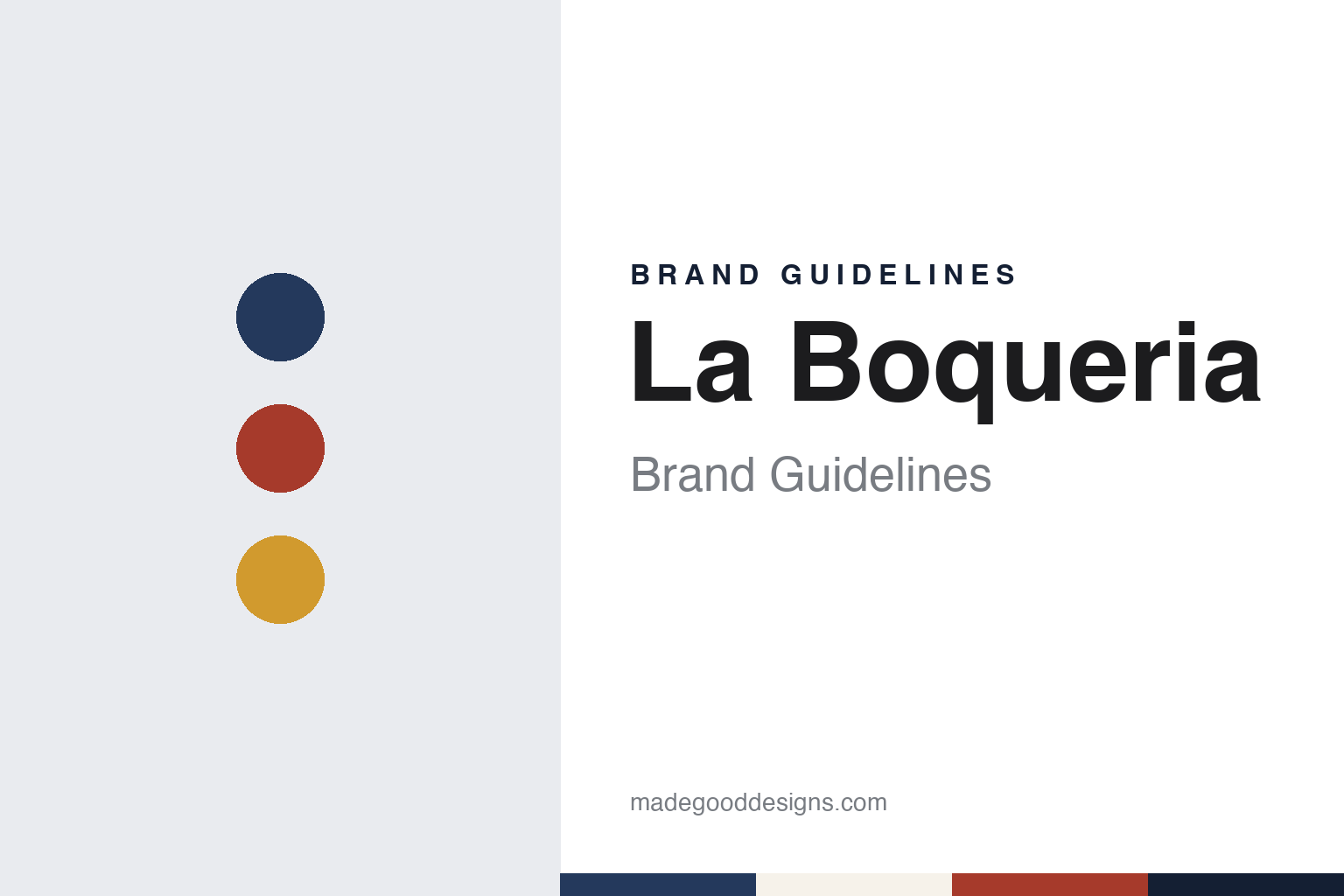
La Boqueria Brand Guidelines
An open-air market at a city gate, a porticoed square of 1840 and an iron roof of 1914.
Aa
Two constants: a deep blue, glass red and ochre palette and a Market-hall grotesque sans register. Abstract homage — not a La Boqueria asset or mark; no logo, coat of arms, sign or photograph is reproduced.
A gate, a convent and a square
Medieval stalls outside the walls, then a square for Saint Joseph.
La Boqueria is the name most people use for the Mercat de Sant Josep de la Boqueria (the Saint Joseph Market of the Boqueria), a covered food market on La Rambla in Barcelona’s Ciutat Vella district, not far from the Liceu opera house. Spanish Wikipedia describes it as a municipal market. Catalan Wikipedia says it fills the porticoed Plaça de Sant Josep, which is catalogued as a cultural asset of local interest, and gives it an area of 2,583 square metres with more than 300 stalls.
Its origins are older than its square. Catalan Wikipedia says that from at least the 13th century there was an open-air market on the open ground in front of the Boqueria gate in the city wall, where farmers from the surrounding market gardens and villages sold their produce outside the walls to avoid the tax on goods brought into the city. English Wikipedia dates the earliest mention to 1217, when tables were set up near the old gate to sell meat, records a pig market there from 1470 and says the market was known until 1794 as the Mercat de la Palla, the straw market. The same article says the name Boqueria is believed to come from the Catalan boc, a goat, so that a boqueria was a place where goat meat was sold. The Government of Catalonia’s cultural heritage portal dates the site’s commercial use back to the 12th century.
The present square stands on the site of a convent. Catalan and Spanish Wikipedia both say that Discalced Carmelite friars, known locally as “els josepets” for their devotion to Saint Joseph, founded a convent on the Rambla in 1586. The heritage portal says the convent was demolished in 1835 and a large porticoed square planned in its place, and that the market, moved onto the site as a temporary measure, stayed for good. A 2016 article in ElNacional.cat, reviewing a history of the city’s markets produced with Barcelona City Council and Mercats de Barcelona, places the Boqueria on the former Carmelite convent and counts it among twelve Barcelona markets opened in the 19th century.
Sources give different opening dates. Catalan Wikipedia, citing a 1990 study published by the city’s history institute, says a porticoed square designed by the municipal architect Josep Mas i Vila was approved in January 1840 and that its first stone was laid on 19 March 1840, Saint Joseph’s day; the plan gained an extra storey in 1846. English Wikipedia gives the same start, says the market opened that year and dates the inauguration of the structure to 1853. The Government of Catalonia’s heritage portal and Spain’s tourism website, spain.info, both give 1836.
Colour
Ionic columns, an iron roof and an arch of coloured glass.
The square began as an open porticoed space. Catalan Wikipedia describes the buildings around it as having a ground floor, a mezzanine, a principal floor and two further storeys, with large lintelled doorways on the Rambla, long balconies on stone brackets and richly worked wrought-iron railings. The porticoes are covered by shallow vaults on giant Ionic columns that carry a moulded entablature and terracotta balustrades. The Ruta del Modernisme, Barcelona’s city-run route of modernista buildings, describes the 1840 market as a large porticoed square with Ionic columns under which traders offered their goods.
Stallholders soon asked for a roof. Catalan Wikipedia says that around 1850, with the portico still unfinished, they were calling for a covered hall, and that the most complete of several schemes was a metal structure drawn up in 1864 by the engineer Miquel de Bergue. English Wikipedia records a new fish market in 1911. The metal roof that defines the market came in 1914. Catalan Wikipedia, citing the 1990 study, credits it to the Barcelona engineering firm La Maquinista Terrestre i Marítima and describes cast-iron pillars and lattice beams with Polonceau trusses forming five parallel naves; the Ruta del Modernisme credits the design of the 1914 roof to de Bergue. The heritage portal says the market was enclosed that year in response to the demands of vendors and shoppers, which sets it apart from Barcelona markets built from new as covered halls, such as Sant Antoni of 1882. Spanish Wikipedia records a later architectural refurbishment in 2000.
The entrance from the Rambla was given a monumental treatment. Catalan Wikipedia says the end of the central nave facing the Rambla was given a monumental iron arch with coloured stained glass, set on masonry bases faced with trencadís, the broken-tile mosaic of Catalan modernisme, built in 1913 by the architect Antoni de Falguera. Wrought-iron garlands of flowers hold up an old coat of arms of Barcelona inside a circle, also of coloured glass. The Ruta del Modernisme lists the restoration of the archway among the works of the city’s “Barcelona, posa’t guapa” (Barcelona, get pretty) programme. Spanish Wikipedia notes that the heraldry on the entrance shield is original while its inscription dates from the 1980s, and that the market was inaugurated under the name “San José.”
Typography
Food markets and market halls in Europe.
Europe’s food markets present themselves through a few recurring elements. Behind the name there is usually a public or charitable body rather than a single trader: a city council or its markets office, a charitable trust with volunteer trustees, or a company that runs a food hall inside an older building. Most give a founding date, and many separate the market’s origins, sometimes recorded centuries earlier in charters, acts of parliament or town records, from the date of the building that houses it today.
The buildings carry much of the identity. Many halls of the 19th and early 20th centuries are iron-and-glass structures: cast-iron columns, lattice beams and glazed roofs over open naves, sometimes added over an older open square when stallholders asked for cover. Entrances are often treated as set pieces, with iron arches, coloured glass, a city coat of arms or the market’s name in large lettering, and some markets have taken in parts of other buildings. Halls of the 21st century have tried other forms, such as a single arched shell or pavilions of glass.
Inside, the layout is usually described in general terms: fresh-produce stalls, fishmongers, butchers and delicatessens in rows or aisles, and, more and more, food counters with seating or a street-food area grouped in one section. Signs, clocks and painted lettering on stall fronts and gateways help visitors find their way, and often date from different periods of the same market.
Many of these markets have changed their role. Some began as, or grew into, wholesale markets supplying greengrocers and restaurants, and turned toward retail when that trade declined or moved to sites on the edge of the city. The guides in this series set out each market’s owner, buildings and dates as dated sources give them, and treat colours and type as an unofficial interpretation.
Aa
A market-hall grotesque sans, for iron, glass and tile. (Specimen set in Archivo, a sans STAND-IN; NOT the La Boqueria logo.)
La Boqueria today
Stalls under five naves, in the middle of the Rambla.
Inside, the market is laid out as rows of stalls under the naves. Spain’s tourism website describes walking between stalls of fruit and vegetables, fish and meat, with bars and restaurants among them, and Catalan Wikipedia says the stalls sell local and imported products both to households and to the city’s restaurants. ElNacional.cat wrote in July 2023 that the Boqueria is one of about twenty fresh-produce markets spread across Barcelona, that more than 200 merchants sell there, and that it also has a few bars and restaurants. Catalan Wikipedia describes the market as a place of work for generations of women, who have run many of its stalls as fishmongers, butchers, fruit sellers, bakers, florists and herbalists.
The market sits on the middle stretch of the Rambla, the Rambla de les Flors, which the Ruta del Modernisme says takes its name from the flower stalls that have stood there all year round since 1853. Spanish Wikipedia links the florists to the market itself, recalling that many vendors once gave a flower with a purchase of food. The Ruta del Modernisme adds that the market and its surroundings have been restored in recent years to their early 20th-century appearance, and that some stalls were adapted as information points.
The market’s visual character comes from its architecture rather than from any single mark: the Ionic columns of the 1840 square, the five iron naves of 1914 and the 1913 arch on the Rambla, with its coloured glass, trencadís bases and the old coat of arms of Barcelona held in a ring of wrought-iron flowers, as Catalan Wikipedia describes them.
For a design guide, La Boqueria shows how a market can be read through its buildings: an 1840 porticoed square, a 1914 iron roof and an arch of iron and coloured glass facing the street. Compare Mercado de San Miguel, a market in Madrid, and Primavera Sound, another Barcelona name. For this guide we use a deep blue, a glass red and an ochre with a sans, an unofficial interpretation; no product or logo is reproduced.
Explore & save
Keep La Boqueria’s identity on hand — save it to a board in the Made Good inspiration library.
La Boqueria identity set
Pin the La Boqueria blue, red and ochre palette and the market-hall grotesque sans register to your own board.
Source & notes
Frequently Asked Questions
What font can I use to match the La Boqueria look?
This guide describes La Boqueria’s type as “A market-hall grotesque sans, for iron, glass and tile”. Its type specimen is set in Archivo from Google Fonts as a stand-in; Archivo is not La Boqueria’s own lettering.
What colours are in the La Boqueria palette?
This guide’s La Boqueria palette is Rambla Blue #24395C, Glass Red #A63A2B, Ochre Tile #D19A2E, Ironwork Night #141F33 and Paper #F6F2EA. The tones are the guide’s own unofficial interpretation, not official La Boqueria hex codes.