Louis Valtat painted with heightened colour a decade before the word “Fauve” existed, and spent the rest of his career being filed next to a movement he never quite joined. That in-between position is what makes Louis Valtat useful to designers: his paintings sit on the line where decorative flat colour, broken Neo-Impressionist touch and outline drawing meet, and you can see each ingredient working separately.
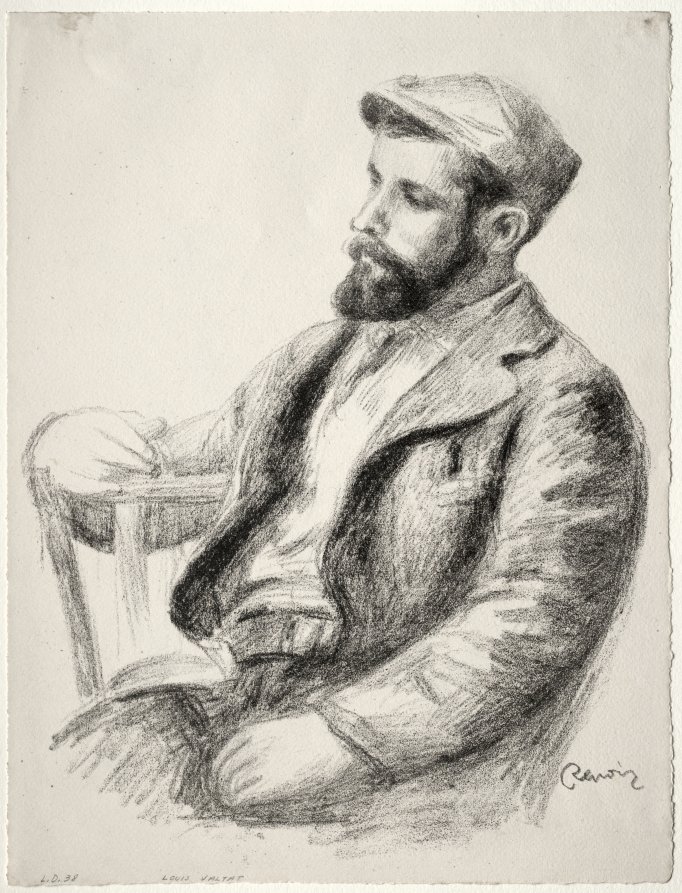
Valtat died in 1952, and none of his own works in the Met, Art Institute of Chicago or Cleveland Museum of Art databases is flagged public domain, so they are described in text only. The image below is Renoir’s portrait of him, released by Cleveland under CC0. For public-domain works you can download and study, browse the MGD museum inspiration collection.
Who was Louis Valtat?
Valtat was born in Dieppe in 1869 and died in Paris in 1952, as both the Met’s collection records and the Museo Nacional Thyssen-Bornemisza in Madrid state. The Thyssen gives his birth date as 8 August 1869 and records that his parents moved to Versailles in 1880, where he received a classical schooling.
According to the Thyssen, he was admitted to the École des Beaux-Arts in Paris in 1887, at seventeen, and also enrolled at the Académie Julian, where he met Pierre Bonnard and Albert André. John Elderfield’s catalogue The “Wild Beasts”: Fauvism and Its Affinities (Museum of Modern Art, 1976) also places Valtat and André together at the Académie Julian and describes a close friendship between them.
The Thyssen says he showed regularly at the Salon des Indépendants from 1893, and that studies made at Arcachon and shown there in 1896 caught the attention of the critic Thadée Natanson. Studies from Agay followed at the Galerie Durand-Ruel in 1899. Elderfield discusses the same 1899 Durand-Ruel exhibition, where a group of younger colourists gathered around Odilon Redon.
The Thyssen records a contract with the dealer Ambroise Vollard from 1900 to 1912, which paid for travel to Italy in 1902 and Algeria in 1903. Valtat built a house at Anthéor, near Agay on the Mediterranean coast, which the Thyssen says he named “Roucas Rou” (the red rocks) and where he spent winters until 1914. From there he visited Pierre-Auguste Renoir at Cagnes-sur-Mer and Paul Signac at Saint-Tropez. Renoir’s lithograph portrait of him, dated 1904 by Cleveland and about 1904 by the Art Institute of Chicago, is a record of that friendship.
In 1914 he gave up the south and moved to a new studio in Paris; in 1924 he bought a house at Choisel. The Thyssen states that he lost his sight to glaucoma in 1948 and died in Paris on 2 January 1952.
Louis Valtat and the Fauves
At the Salon d’Automne of 1905, Valtat showed six paintings, according to the Thyssen. One of his sea views was reproduced in L’Illustration on 4 November 1905, alongside work by Matisse, Henri Manguin, André Derain, Georges Rouault and Jean Puy. Both the Thyssen and Elderfield identify that magazine page as the reason he is so often counted among the Fauves.
Elderfield argues that the label is misleading. He notes that Valtat hung in a different room from the Matisse group that year, alongside Alexej von Jawlensky and Wassily Kandinsky, and that the critic Louis Vauxcelles, reviewing the 1906 Salon, grouped Valtat and André separately from Matisse and the Fauves. In Elderfield’s reading, Valtat belonged to a loosely knit circle that sat stylistically between the Fauves and the Nabis, “closer to the Nabis,” and whose shared trait was a heightened palette drawn from several Post-Impressionist sources. He also suggests that after 1905 the more conservative Fauves, such as Henri Manguin, Charles Camoin and Puy, could as well be called friends of Valtat as the other way round.
Key works to know
Water Carriers at Arcachon, 1897
Elderfield reproduces this oil, then in a private collection in Geneva, as an example of “bright, flat color contained within a complex linear draftsmanship,” with a subject he compares to the Pont-Aven painters around Gauguin. He says the style persisted into the Fauve years. What to look at: colour areas that stay flat, held in place by drawing rather than by modelling.
Skaters in Winter, about 1900
The Thyssen collection holds this picture of skaters, titled in its record as a view of the garden of the Petit Trianon at Versailles, the town where Valtat grew up. Its online record marks the title with a question mark, so the identification of the place is not certain.
Woman on the Seashore, 1902
The Met’s Robert Lehman Collection records this oil on canvas, about 81 by 100 centimetres, under the French title Jeune Femme sur les rochers à Anthéor. Anthéor is where Valtat had his winter house. It is not flagged public domain.
Woman with a Cat, 1903
Also in the Lehman Collection, this oil on canvas is about 94 by 73 centimetres. The Met dates it to 1903, the year the Thyssen says Vollard’s contract took him to Algeria. It is not flagged public domain.
Paul Cézanne, about 1905
Valtat also sculpted. The Met holds his bronze head of Cézanne, dated about 1905, with a dark brown patina, about 26 centimetres high.
Prints: woodcuts in the 1890s
The Art Institute of Chicago holds Valtat woodcuts from the mid-1890s. Its records list The Lunch, dated 1894/95, a woodcut on tan wove paper, and In Llansa (Spain), about 1895, a woodcut combined with colour monotype on ivory laid paper. Neither is flagged public domain.
The second print pairs a woodcut’s fixed, repeatable black structure with monotype colour that is painted onto a plate and printed once, so each impression differs. That is Valtat’s method in miniature: a firm drawn armature with free colour laid over it. Elderfield also notes that Valtat was among the painters, with Matisse, Derain, Rouault, Puy, Kees van Dongen and Maurice de Vlaminck, who made ceramics shown in 1907, another medium where flat colour sits inside a drawn line. For the craft behind relief prints, see our guide to woodblock printing.
Technique, line and palette
Elderfield describes Valtat working “across the stylistic axis” laid out by the Neo-Impressionists and the Nabis: some works close to the dotted, divided touch of Signac, some close to Toulouse-Lautrec, many following the Nabis’ flat, decorative pattern. He adds that bright colour alone does not make a painting Fauve, quoting Matisse on the Fauves’ rejection of imitative colour.
That gives three tools to study:
- Contour first. A drawn outline that holds each colour area, as Elderfield describes in Water Carriers at Arcachon.
- Divided touch. Short strokes of separate colour, borrowed from Neo-Impressionism, used for sea and light.
- Flat decorative fields. Large unmodelled areas that read as pattern, in the Nabis manner.
No public-domain Valtat scan is embedded here, so this guide gives no hex codes for his paintings. The tones that can be measured come from Renoir’s portrait of him above. Measured from the museum’s scan of this impression, the paper reads as a warm off-white, about #e8e3d7, the mid-tone hatching about #959187, and the darkest crayon passages about #524f48. They make a quiet, warm neutral base for testing brighter colour. Test schemes against such a base in the colour palette generator.
How designers can borrow from Louis Valtat
- Let line carry the structure. If a palette is loud, hold it with a consistent outline. In illustration and icon sets, a fixed stroke weight lets you push colour much further without the image falling apart.
- Mix one fixed layer with one free layer. The woodcut-plus-monotype idea translates directly to risograph, screen print or digital work: keep a locked black key and vary the colour layer from piece to piece.
- Use a place as a palette. Valtat named his house after the red rocks of the coast and painted figures against them. A palette anchored to one real landscape, red stone, blue sea, pale sky, is easier to keep coherent across a series than an abstract set of brights.
- Watch how grouping labels work. One magazine page fixed Valtat’s reputation. How work is grouped and captioned in a layout shapes how it is read.
Frequently asked questions
Was Louis Valtat a Fauve?
He is often grouped with the Fauves because one of his sea views was reproduced in L’Illustration in November 1905 beside works by Matisse and Derain. John Elderfield’s 1976 MoMA catalogue argues that he belonged instead to a circle of colourists between the Nabis and the Fauves.
When and where did Louis Valtat live?
He was born in Dieppe in 1869 and died in Paris in 1952, according to the Met and the Thyssen. He grew up in Versailles, trained in Paris and spent winters at Anthéor on the Mediterranean until 1914.
Did Valtat make prints?
Yes. The Art Institute of Chicago holds his woodcuts The Lunch (1894/95) and In Llansa (Spain) (about 1895), the latter combined with colour monotype.
Are Louis Valtat’s works public domain?
None of his works in the Met, Art Institute of Chicago or Cleveland databases is flagged public domain, so check each museum record before reusing an image. Renoir’s 1904 lithograph portrait of Valtat is released by Cleveland under CC0.