Arnolfo di Cambio worked at the point where sculpture and architecture were still one job. He carved figures, designed the stone frames that held them, and in Florence planned buildings at the scale of a city. For designers, Arnolfo di Cambio shows how a frame and a limited set of parts can hold a whole composition together.
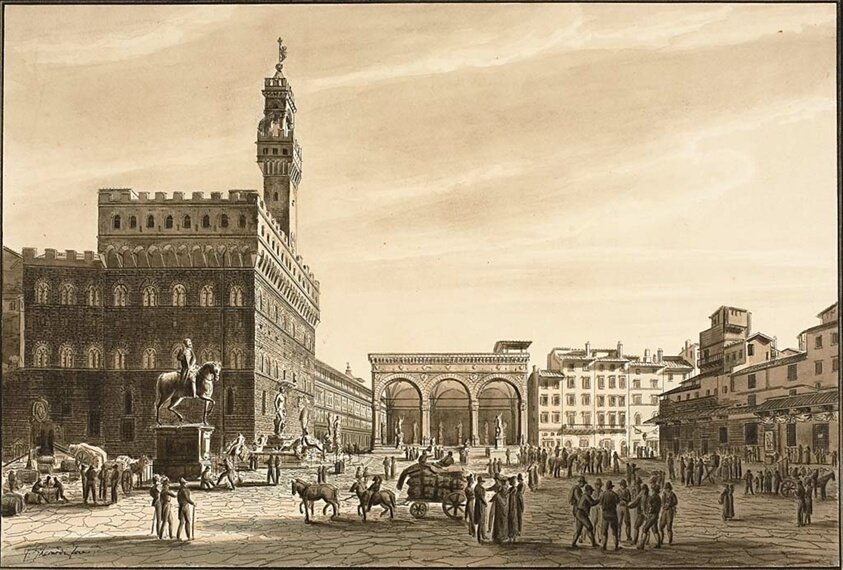
This guide looks at what to study in his work and how to borrow it. No museum open-access collection holds a public-domain image of an object by Arnolfo himself, so the pictures here are later prints and drawings of the Florentine square his town hall faces, all flagged public domain by the Art Institute of Chicago. For more public-domain prints, ornament and architecture, browse the MGD museum inspiration collection.
Who was Arnolfo di Cambio?
He was born around 1245 in Colle di Val d’Elsa in Tuscany, the son of Cambio, according to Treccani’s Dizionario Biografico degli Italiani and the Web Gallery of Art; the Oxford entry reproduced on Encyclopedia.com also gives about 1245. His death date is less certain. The Gale biography on Encyclopedia.com gives 8 March 1302 in Florence, while the Web Gallery of Art gives about 1310 and Treccani says only that he died in Florence before 1310.
He trained in the workshop of the sculptor Nicola Pisano. Treccani records that Nicola contracted for the marble pulpit of Siena Cathedral in 1265 and that Arnolfo had to be summoned to the work in 1266; Encyclopedia.com dates his part in the pulpit to 1265–68, and EBSCO calls him Nicola’s chief assistant from 1266 to 1268. The Web Gallery of Art and Treccani also connect him with the workshop’s shrine of Saint Dominic in Bologna. For the master behind that training, see our guide to Nicola Pisano.
By 1277 he was in Rome working as both sculptor and architect, according to Treccani, and the Web Gallery of Art says he went there that year in the service of Charles of Anjou. In the 1290s he returned to Florence. Encyclopedia.com cites a document of 1 April 1300 naming him capomastro of the cathedral, and EBSCO records that the Florentines declared him exempt from taxes in 1300.
Arnolfo di Cambio’s key works
Charles of Anjou, Rome
Encyclopedia.com and the Web Gallery of Art both describe a seated portrait of Charles of Anjou, now in the Capitoline Museums in Rome. The Web Gallery of Art calls it one of the earliest portrait statues since the ancient world. Encyclopedia.com characterises his early style as blocky and still, with drapery cut deep into regular V-shaped folds.
Tomb of Cardinal de Braye, Orvieto
The wall tomb of Cardinal Guillaume de Braye, who died in 1282, stands in San Domenico in Orvieto. Encyclopedia.com describes it as signed and notes that its canopy is lost, and EBSCO and Treccani also date it to the 1280s. The Web Gallery of Art says it set the type of the Italian wall tomb for more than a century, and Encyclopedia.com names Tino di Camaino among the sculptors who followed its pattern.
Altar canopies in Rome, 1285 and 1293
Two ciboria, or canopies over an altar, anchor his Roman career: San Paolo fuori le Mura, dated 1285, and Santa Cecilia in Trastevere, dated 1293, as Encyclopedia.com and Treccani both record. Treccani notes that the inscription on the San Paolo canopy names Arnolfo together with an associate called Pietro. Encyclopedia.com describes both as Gothic structures with triangular gables, crockets, pinnacles and figure sculpture.
Bronze Saint Peter, Vatican
The seated bronze Saint Peter in St Peter’s Basilica is attributed to Arnolfo by Encyclopedia.com and the Web Gallery of Art. Treccani records that the attribution has been questioned in favour of a late-antique date and later reaffirmed, so it remains an attribution rather than a documented work.
Florence Cathedral facade, from the 1290s
Arnolfo began the new cathedral of Florence. Encyclopedia.com gives 1296 for the start of his design, citing Oxford for 1294–96, and Treccani says he was recalled to Florence for the cathedral in 1294. His facade was never finished and was dismantled in the sixteenth century, as The Art Newspaper and Treccani both record. Statues from it, including an enthroned Virgin and an enthroned Boniface VIII, are now in the Museo dell’Opera del Duomo, according to Encyclopedia.com.
Santa Croce and the Palazzo Vecchio
The Franciscan church of Santa Croce and the town hall now called the Palazzo Vecchio are traditionally given to Arnolfo, largely on the authority of Giorgio Vasari’s sixteenth-century Lives. The Web Gallery of Art says that no other buildings besides the cathedral are documented as his, and Encyclopedia.com and Treccani both present these attributions as coming from Vasari. EBSCO credits him with designing Santa Croce.
Technique: carving, framing and colour
Arnolfo worked mainly in marble, with the bronze Saint Peter as the notable exception if the attribution holds. His Roman monuments drew on the local Cosmati tradition of geometric inlay in coloured stone and glass: Encyclopedia.com records that he made the tomb of Pope Adrian V in Viterbo with a Cosmati master, and Treccani connects his Roman tombs to Cosmatesque forms and workshops.
Treccani also notes colour and gilding on the carved marble of the Santa Cecilia canopy. On a larger scale, EBSCO describes coloured marble outlining geometric panels on the cathedral’s exterior. In each case the colour sits inside a carved or built frame, never loose on the surface.
EBSCO also notes strong horizontals that calm the vertical push of Gothic forms in the Braye tomb and the San Paolo canopy.
What to look at: frame, block and grid
The frame does the composing. In the canopies and the Braye tomb the architecture is the layout. Gables, columns and cornices set the zones where figures, inscriptions and inlay go, much as a page grid sets columns and margins.
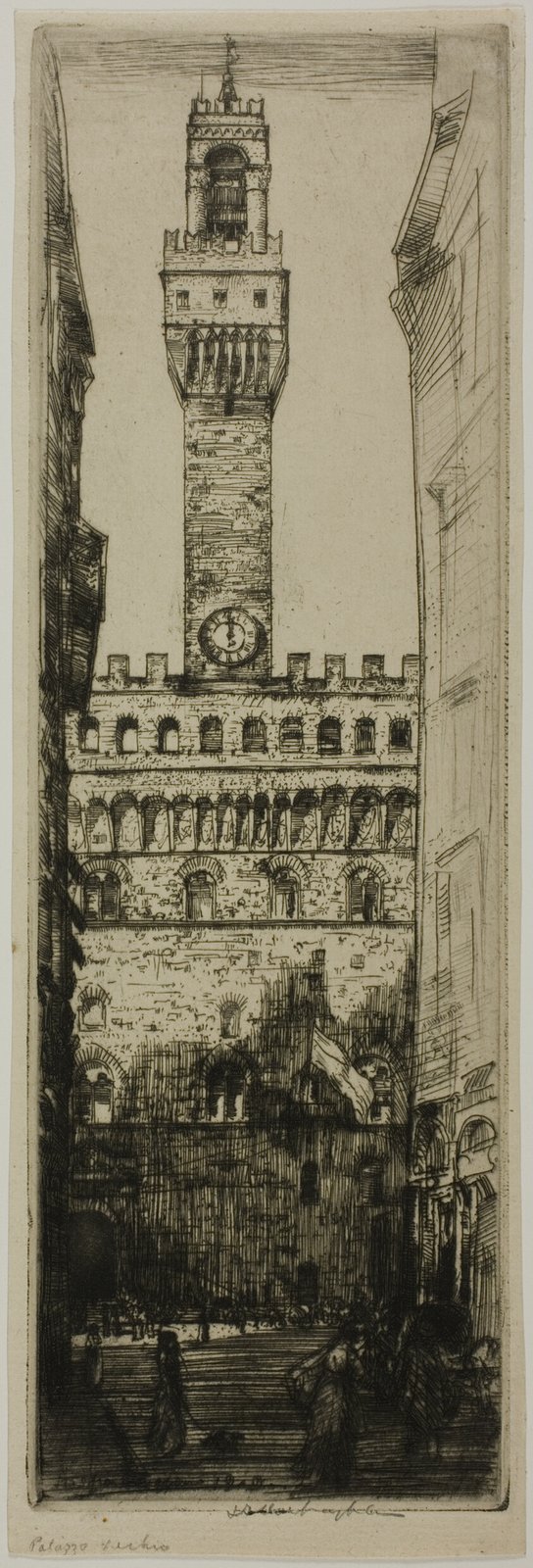
The block. The Palazzo Vecchio, as MacLaughlan’s narrow 1909 etching shows, reads as one rugged mass with a crenellated top and a single offset tower. The tower breaks the symmetry and gives the block a recognisable profile from a distance. In this scan the darkest stone tones measure near #2E2B1B and the mid-tones near #665F46, measured from the museum’s scan of this impression.
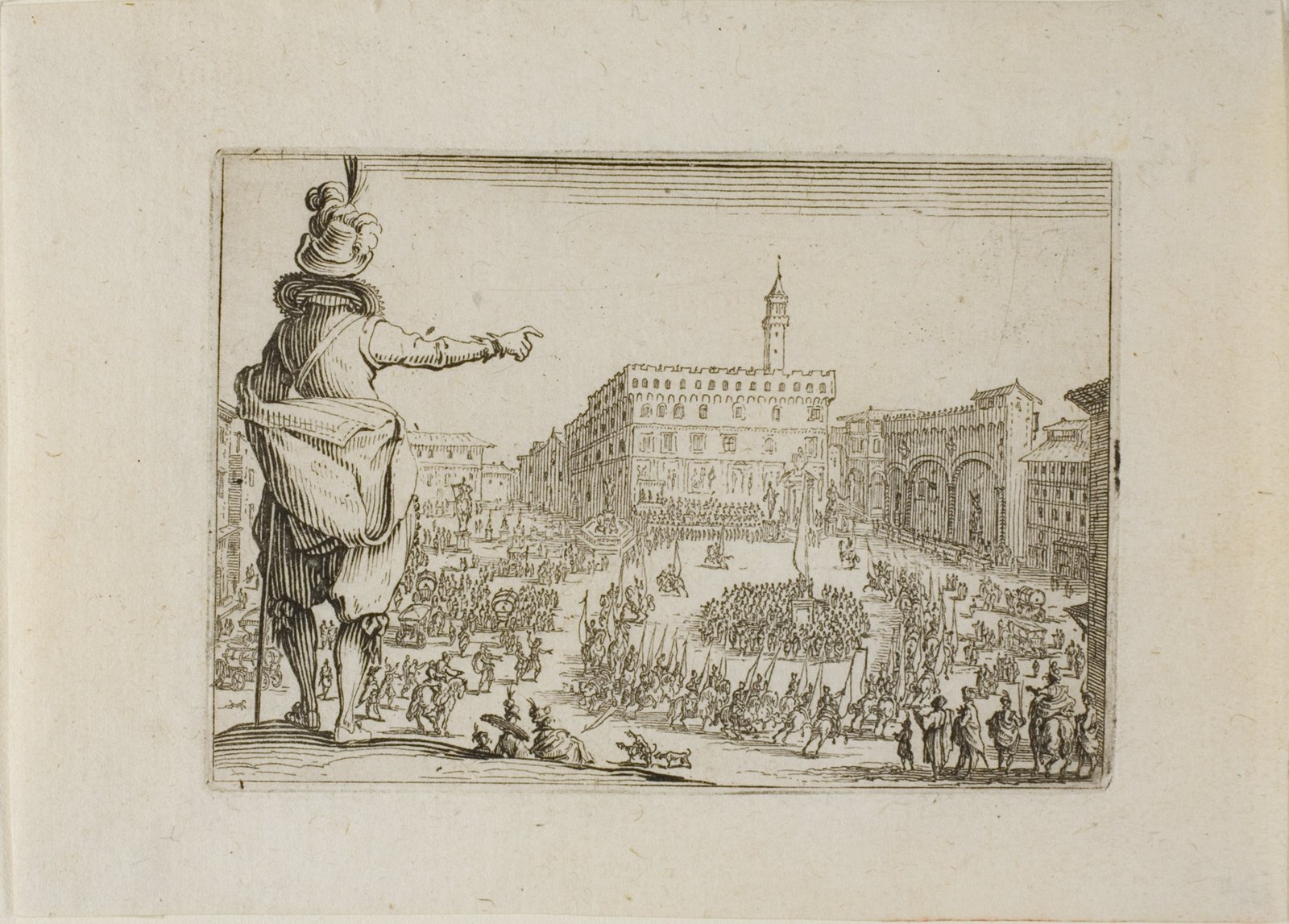
A building as a civic sign. Callot’s tiny etching, made about three centuries later, shows how the palace and its tower anchor the whole square. Even at postage-stamp size the battlements and tower stay legible, as a strong mark should. The paper tone here measures around #C9C1B0, with the ink lines near #70664D, measured from the museum’s scan of this impression.
Rhythm. Gherardi’s drawing shows the same block in context: a band of identical arched windows across the facade, a heavier band of battlements above, and the open arches of the loggia across the square. The light ground of this sheet measures near #E9D5B3 and the shadowed stone near #5D4E37, measured from the museum’s scan of this drawing.
How designers can borrow from Arnolfo di Cambio
- Design the frame first. Before placing images or type, build the container: margins, gables, panels. Arnolfo’s canopies show how a strong frame makes varied contents look like one family.
- Keep colour inside structure. Use inlay logic for UI and packaging: colour fills defined panels and borders rather than floating freely. It reads as rich but stays orderly.
- Let horizontals calm a tall layout. On posters or long scrolling pages, a few firm horizontal bands stop a vertical composition from feeling unstable.
- Give a block one exception. A logo, building icon or product silhouette becomes memorable when a single element, like the offset tower, breaks a regular mass.
- Sample stone and paper tones. Pull a warm, restrained palette from public-domain scans with the image colour picker.
For the wider style he worked in, see our guide to Gothic art. The dome that finally crowned his cathedral more than a century later is covered in our guide to Filippo Brunelleschi.
Where to see his work
In Rome, the canopies remain in San Paolo fuori le Mura and Santa Cecilia in Trastevere, and the seated Charles of Anjou is in the Capitoline Museums. The Braye tomb is in San Domenico, Orvieto. In Florence, the Museo dell’Opera del Duomo reopened in 2015 with a full-scale reconstruction of the cathedral’s medieval facade, holding original sculptures and copies, as The Art Newspaper reported; the museum’s researchers worked from a 1672 copy by Alessandro Nani of a lost drawing by Bernardino Poccetti.
Frequently asked questions
What is Arnolfo di Cambio known for?
He is known for the tomb of Cardinal de Braye in Orvieto, the altar canopies of San Paolo fuori le Mura (1285) and Santa Cecilia in Trastevere (1293) in Rome, and for beginning Florence Cathedral and carving sculpture for its facade.
Did Arnolfo di Cambio design the Palazzo Vecchio?
It is traditionally attributed to him, mainly on the word of Giorgio Vasari. The Web Gallery of Art notes that only the cathedral is documented as his among Florentine buildings, so the Palazzo Vecchio is described here as attributed.
Who trained Arnolfo di Cambio?
He trained in the workshop of Nicola Pisano and worked on the marble pulpit of Siena Cathedral in the later 1260s, according to Treccani, Encyclopedia.com and EBSCO.
Are the images in this guide public domain?
Yes. The three prints and drawings shown are flagged public domain by the Art Institute of Chicago. They are later views of Florence, not works by Arnolfo; check each museum’s terms before using other photographs.