iRobot Brand Guidelines
From bomb-disposal robots to the round vacuum that created a category — a green wordmark and a bumpy road.
Aa
Two constants: a green palette and a clean sans. Abstract homage — not the iRobot wordmark.
From bomb disposal to the living room
iRobot created the robot-vacuum category.
iRobot is a lesson in a category-defining product — and the perils that follow. It was founded in 1990 by three MIT roboticists — Colin Angle, Helen Greiner and Rodney Brooks — in Bedford, Massachusetts, initially building practical robots for space, military and industrial use. (A nice detail: the name is a deliberate allusion to Isaac Asimov’s 1950 story collection I, Robot — but it’s not connected to the 2004 Will Smith movie, which came later.) (Honest caveats: no official brand hex was found, so the green below is approximate, and the wordmark typeface is undocumented.)
Before the living room came the battlefield: iRobot built the PackBot, a tracked bomb-disposal and reconnaissance robot — thousands served with US forces in Iraq and Afghanistan clearing IEDs, and PackBots were among the first robots to enter the damaged Fukushima reactors after the 2011 disaster. Then, in 2002, iRobot introduced the Roomba — the disc-shaped autonomous vacuum that created and defined the entire robot-vacuum category and became the product iRobot is famous for (joined later by the Braava mopping robot).
The recent chapter is harder. Amazon agreed to acquire iRobot (announced 2022 at ~$1.7B, later ~$1.4B), but the deal was terminated in January 2024 after EU regulators opposed it — and iRobot then cut roughly a third of its staff, with co-founder Colin Angle departing, followed by deep financial strain. The identity through it all is friendly and simple: the lowercase-leaning “iRobot” wordmark (lowercase “i,” capital “R”) in a signature green. A pioneer that invented a category, then hit turbulence.
Colour
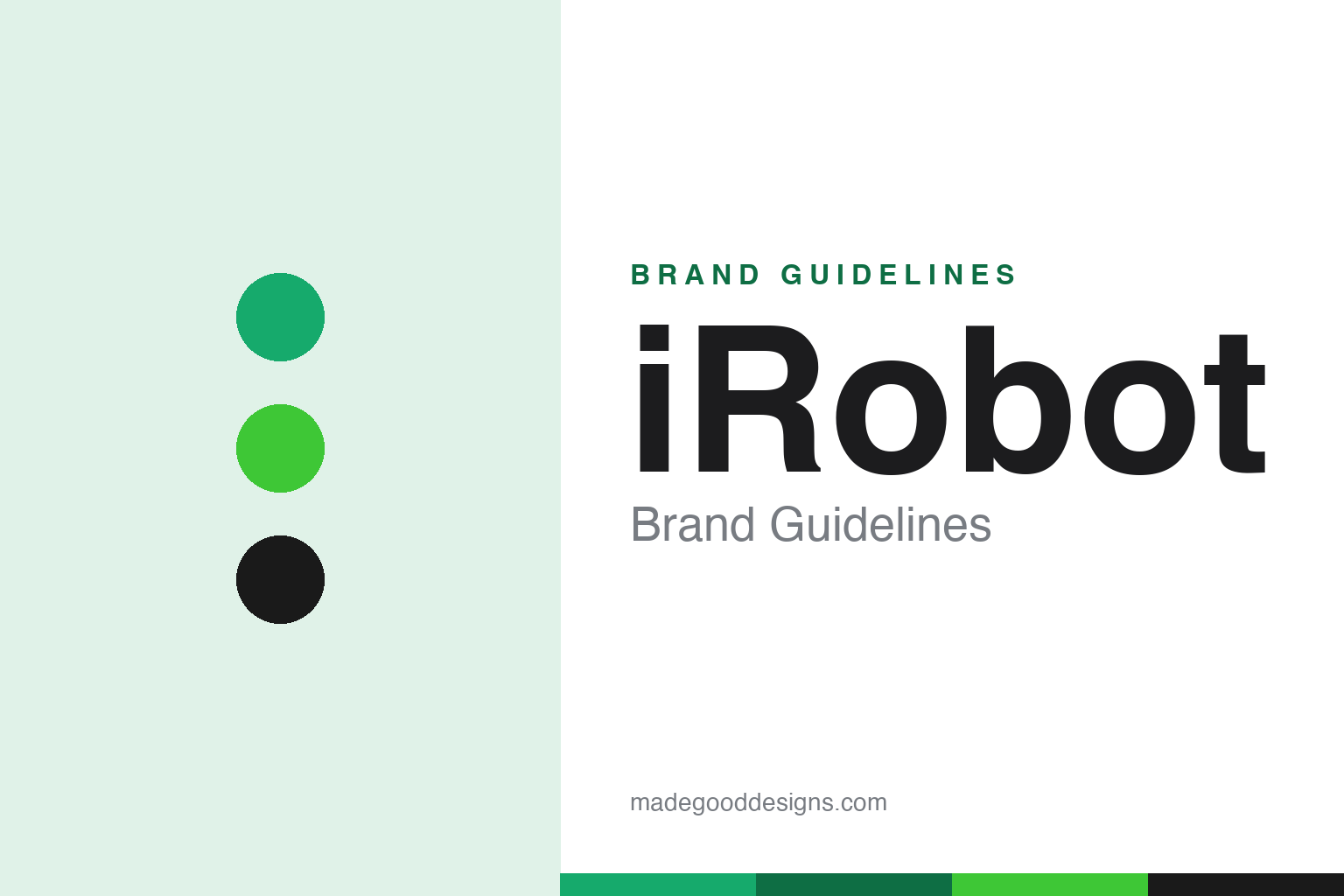
iRobot lives in green. Click a swatch to copy the hex.
iRobot’s palette is anchored by a friendly green, with ink and white. The green reads as approachable, clean and reassuring — an important tone for a robot you invite into your home to roam around your floors autonomously — softening the “robot” idea into something helpful and unthreatening. It stands apart from the cold blues and greys of much technology, signalling a domestic, everyday helpfulness rather than industrial machinery. It’s a warm, approachable scheme that makes household robotics feel friendly. The honest caveat: no official iRobot brand hex was found — the green here is an observed approximation (third-party swatches vary), not a confirmed value.
The lesson is a friendly colour to humanise a robot. iRobot’s green makes an autonomous machine feel approachable and domestic. For designers, it’s a reminder that colour can soften an intimidating concept (a home robot) into something welcoming. The takeaways: choose a warm, approachable colour to humanise technology (the green); keep the identity friendly and simple for a consumer robot; and treat specific hexes as approximate when no official spec is published.
Typography
The wordmark is a clean sans — friendly and approachable.
iRobot’s clean sans wordmark — “iRobot,” with a lowercase “i” and capital “R,” in green — is friendly and approachable. The simple, even letterforms read as modern, helpful and unintimidating, matching a brand whose robots live in your home, and the lowercase “i” (echoing the Apple-era i-naming) gives it an approachable, consumer-friendly feel. In the signature green, the type feels domestic and warm rather than industrial or menacing — exactly the “helpful household robot” personality iRobot wants. It’s straightforward and welcoming rather than techy or cold. (Because the exact face is undocumented, the honest description is “a clean sans,” not a named font.) The type behaves like the brand: friendly, approachable and helpful.
Aa
A clean sans — friendly and approachable. (Specimen set in Figtree, a clean sans in the spirit of the iRobot wordmark; the real face is undocumented.)
Inventing a category isn’t enough
iRobot pioneered, then faced hard times.
iRobot is a lesson in the difference between inventing a category and keeping it. iRobot literally created the robot-vacuum market with the Roomba, and “Roomba” became a near-generic word for the whole product type — an enviable position. But a first-mover advantage isn’t permanent: a flood of capable, cheaper rivals, a blocked Amazon acquisition, and financial strain showed that pioneering a category doesn’t guarantee you’ll dominate it forever. The brand’s friendly green identity and the beloved Roomba name remain strong assets, but the story is a sober reminder that innovation must be matched by ongoing competitiveness and sound strategy. Being first is powerful; staying ahead is the harder part.
For designers and brand-builders, iRobot offers a clear takeaway: creating a category earns huge brand equity, but that equity must be defended with continued competitiveness. The lessons: a category-defining product and a near-generic name are enormous assets (Roomba); a friendly identity helps a novel product feel safe (the green, the lowercase “i”); but first-mover status alone doesn’t guarantee lasting dominance. It’s also a reminder to keep the facts precise — iRobot was founded in 1990 by three MIT roboticists (Angle, Greiner, Brooks), built the military PackBot, launched the category-defining Roomba in 2002, saw its Amazon acquisition terminated in January 2024 over EU regulatory opposition, and uses a green “iRobot” wordmark (a name alluding to Asimov, not the 2004 film). iRobot invented a category — proof that pioneering earns equity, but keeping the lead is the harder task.
Explore & save
Keep iRobot’s identity on hand — save it to a board in the Made Good inspiration library.
iRobot identity set
Pin the green palette and the clean-sans spirit to your own board.