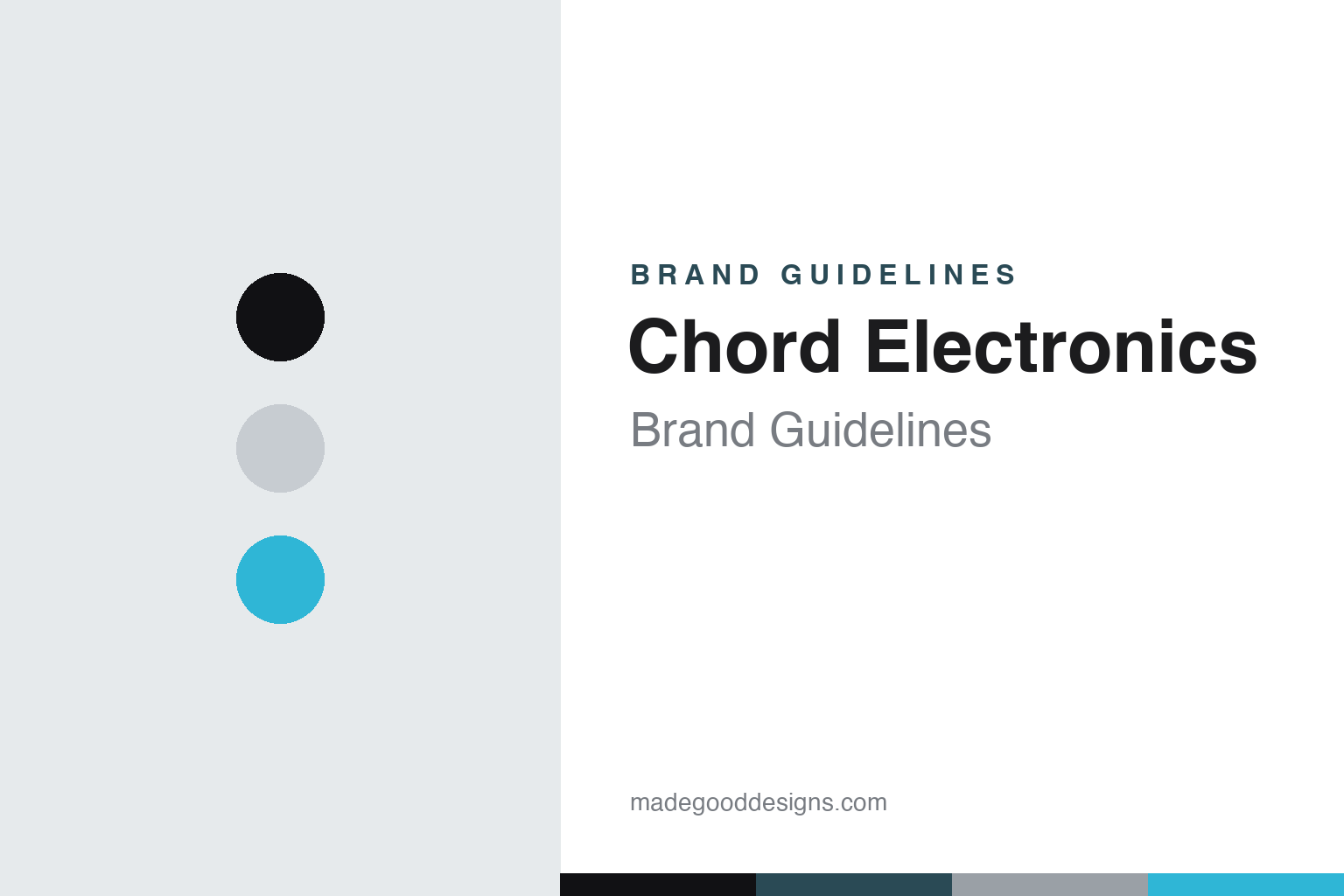
Chord Electronics Brand Guidelines
British DACs machined like aircraft parts — portholes, marble buttons, coloured LEDs, and FPGA engineering.
Aa
Two constants: a silver-and-black palette (with a coloured-LED accent) and a techy sans. Abstract homage — not the Chord wordmark.
Engineering from the air
Chord builds DACs like aircraft parts.
Chord Electronics is a lesson in engineering pedigree expressed as design. It was founded in 1989 in England (Kent) by John Franks, an engineer with an aviation/aerospace power-supply background — and that origin is real, not marketing gloss: Chord’s amplifiers grew out of high-frequency switch-mode power-supply technology from the aviation field, and the company still cites “engineering without limits” from that world. Everything is designed, engineered and manufactured in Great Britain. (An essential myth to correct up front: Chord Electronics is NOT “The Chord Company.” Caveats: no official brand hex is published — the tones below are observed — and the wordmark typeface is undocumented.)
Chord earned early credibility supplying amplifiers to the BBC, and later to studios including Abbey Road, Sony Music New York and the Royal Opera House. But its modern fame rests on FPGA-based DACs: rather than off-the-shelf DAC chips, Chord runs custom digital code on FPGAs — an architecture associated with Rob Watts, a long-time independent design consultant (not a staff engineer), whose WTA filtering and pulse-array conversion power icons like the Hugo, Mojo, DAVE, Qutest and Poly.
The most recognisable thing about Chord is the industrial design: chassis machined from aircraft-grade aluminium, with portholes / viewing windows that expose the internals, spherical, marble-like control buttons, and coloured LED lighting used functionally (to indicate volume and sample rate). The palette is silver/natural aluminium and black, with multi-colour LED accents as the signature pop, under the line “pure audio.” Chord is privately owned by founder John Franks. Engineering, made visible.
Colour
Chord lives in silver and black. Click a swatch to copy the hex.
Chord’s identity comes from its materials: natural machined aluminium/silver with black, and a signature pop of multi-colour LED lighting. The silver reads as precise, industrial and premium — the colour of machined aircraft-grade metal — while the black grounds it, and the functional coloured LEDs (indicating volume or sample rate) give Chord an instantly recognisable, almost sci-fi glow. It’s a distinctive, ownable look that ties the brand straight to its sculptural hardware, where the coloured light isn’t decoration but information. The palette feels like a precision instrument. The honest caveat: Chord publishes no official brand hex — the aluminium silver, black and the LED accent here are observed approximations, not first-party values.
The lesson is let precision materials and functional light define the look. Chord’s silver-and-black comes from machined aluminium; the coloured LEDs are both signature and functional. For designers, it’s a reminder that a distinctive material and a purposeful accent can be a brand’s identity. The takeaways: draw the palette from real materials (machined aluminium); make an accent both ownable and functional (the coloured LEDs); and treat specific hexes as approximate when no official spec is published.
Typography
The wordmark is a techy sans — precise and engineered.
Chord’s clean, techy sans wordmark — “CHORD,” often with “Electronics” — is precise and engineered. The even, slightly futuristic letterforms read as technical, high-end and machined, matching a brand whose DACs are built like aircraft components and whose look is unmistakably sculptural, and the restraint keeps the focus on the hardware. Set in silver and black with coloured-LED accents, the type feels like part of a precision instrument — exactly the “pure audio,” engineering-first personality Chord cultivates. It’s clean and technical rather than decorative, mirroring the aircraft-grade aluminium and functional lighting. Because the exact face is undocumented, the honest description is “a techy sans,” not a named font. The type behaves like the brand: precise, engineered and futuristic.
Aa
A techy sans — precise and engineered. (Specimen set in Jura, a techy sans in the spirit of the Chord wordmark; the real face is undocumented.)
Design that shows the engineering
Chord makes the tech visible.
Chord Electronics is a lesson in industrial design that dramatises the engineering. Most audio gear hides its internals in a black box; Chord does the opposite — portholes and viewing windows expose the circuitry, the aluminium is machined like an aircraft part, the buttons are marble-like spheres, and coloured LEDs glow with functional meaning. That sculptural, “look inside the machine” design isn’t vanity: it visually communicates Chord’s genuinely unusual engineering (custom FPGA DAC code, aviation-derived power supplies) and makes every unit instantly recognisable. It’s a powerful lesson — when your engineering is real and differentiated, letting the design show it turns technical substance into desirability and brand identity at once. Chord’s aviation roots, FPGA DACs and made-in-Britain build are all made tangible in objects that look like precision instruments. Show the engineering, and the design becomes the brand.
For designers and brand-builders, Chord offers a clear takeaway: industrial design that reveals and dramatises real engineering can be a brand’s most powerful identity. The lessons: express genuine engineering through the design (portholes, machined aluminium, functional LEDs); make the look ownable and instantly recognisable; and back it with real substance (aviation-derived tech, FPGA DACs, made in Britain). It’s also a reminder to keep the facts precise — Chord Electronics was founded in 1989 in England by John Franks (with aviation engineering roots), makes FPGA-based DACs (Hugo, Mojo, DAVE) with a sculptural aluminium-and-LED design, and is a separate company from The Chord Company (cables). Chord shows its engineering — proof that design revealing real substance is a durable brand.
Explore & save
Keep Chord Electronics’s identity on hand — save it to a board in the Made Good inspiration library.
Chord Electronics identity set
Pin the silver-and-black palette and the tech-sans spirit to your own board.