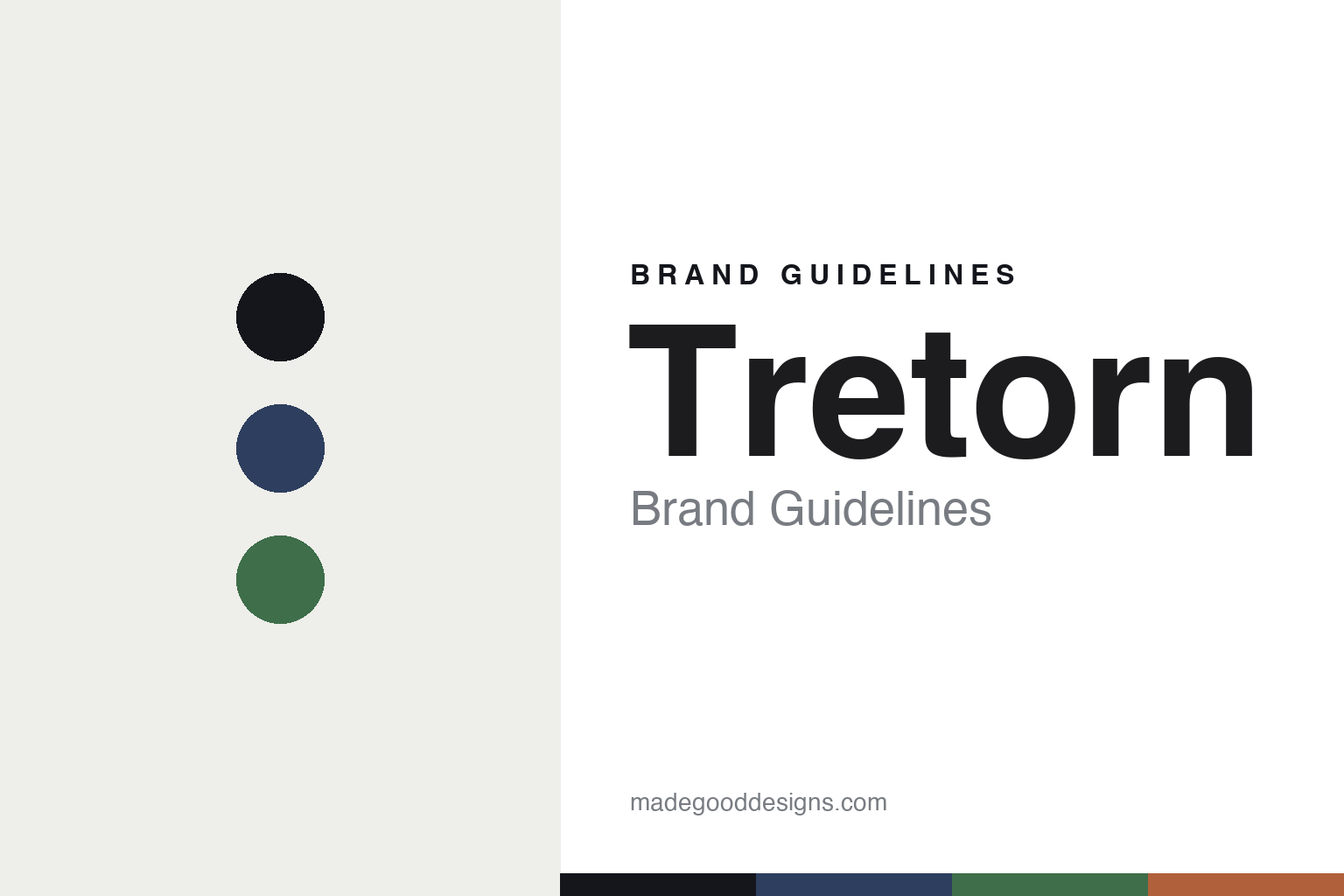
Tretorn Brand Guidelines
The Nylite.
Aa
Two constants: a court-navy-and-green palette and a preppy sans register. Abstract homage — not the Tretorn footwear.
The Nylite
Tretorn turned Swedish rubber heritage into a preppy tennis icon.
Tretorn is a lesson in a sneaker as identity. Founded in 1891 in Helsingborg, Sweden, as a rubber factory (the Dunker family’s Helsingborgs Gummifabriks), it made galoshes and rubber boots — and even patented the pressureless tennis ball in 1955. The name means “three towers” in Swedish.
Its most citable design signature is the Nylite canvas tennis sneaker (1967), which Tretorn bills as the world’s first luxury tennis sneaker. Worn by Björn Borg and Martina Navratilova and named a must-have in the 1980 Official Preppy Handbook, it is a preppy icon. Behind it sits the Swedish rubber heritage — galoshes, the first rubber boot (1903), the “Strong” rubber boot — and a modern Eco Essentials sustainability line.
(Honest notes: Tretorn isn’t independent — it’s owned by the US brand-management group Authentic Brands Group (since 2015), after Puma owned it in the 2000s, so it’s an ABG-managed heritage licence. It’s a Swedish heritage brand but not Swedish-made — Helsingborg manufacturing ended in 1980. And “Wings” is a 1969 sailing line, not the rubber rain boot (that’s the “Strong”). There’s no official brand hex, so these tones are an unofficial interpretation.)
Colour
Tretorn lives in a court-navy-and-green palette. Click a swatch to copy the hex.
Tretorn’s identity is preppy, sporty and heritage — an ink, a court navy, a court green, a clay court, and a chalk. The palette pairs a court navy with a court green — the register of a tennis-and-rubber brand. It signals the court and heritage rather than the mountain. The honest caveat: with no published brand hex, these tones are an original, unofficial interpretation, not first-party values.
The lesson is a court navy with a court green signals a preppy tennis heritage. Tretorn’s world is a canvas tennis sneaker and a rubber boot. For designers, it is a reminder that a navy-and-green court palette reads as preppy and sporty — right for a tennis-icon brand. The takeaways: source the palette from the court (navy, green, clay); keep it preppy and sporty; lead with the icon (the Nylite); and treat any single hex as unofficial.
Typography
The register is a preppy sans — sporty, clean, heritage.
Tretorn’s identity carries a sporty, clean, heritage spirit — a tennis sneaker and a rubber past. A preppy sans captures the mood: it is neat and collegiate, the register of the tennis club. Set in a court-navy-and-green palette, the preppy sans feels sporty and clean — exactly the personality Tretorn carries. It is heritage rather than loud, mirroring a canvas sneaker. (Tretorn’s real footwear is work we describe but do not reproduce, and the exact typeface is not ours to use.) Because it is not ours to use, the honest description is “a preppy sans spirit,” shown here in a stand-in. The type behaves like the brand: sporty, clean and heritage.
Aa
A preppy sans spirit — sporty and clean. (Specimen set in Manrope, a clean sans STAND-IN; NOT the Tretorn footwear.)
A sneaker as identity
Tretorn stands for a tennis sneaker with rubber roots.
Tretorn is a lesson in making a sneaker the identity. A court-navy-and-green palette, a preppy sans and a canvas tennis sneaker make a preppy icon the whole brand — sporty, clean, heritage. The sneaker is the differentiator. The differentiator is a Nylite, tennis-and-rubber identity.
For designers and brand-builders, Tretorn offers a clear takeaway: let one icon carry a deep heritage. The lessons: build a cultural icon (the Nylite); keep the origin story (rubber, galoshes, tennis balls); modernise honestly (Eco Essentials); and be clear about ownership and origin. It is also a reminder to stay accurate: it’s ABG-owned, not Swedish-made, and the palette here is an unofficial interpretation. Tretorn made a sneaker the brand — proof that one icon can be the difference.
Explore & save
Keep Tretorn’s identity on hand — save it to a board in the Made Good inspiration library.
Tretorn identity set
Pin the court-navy-and-green palette and the preppy-sans register to your own board.