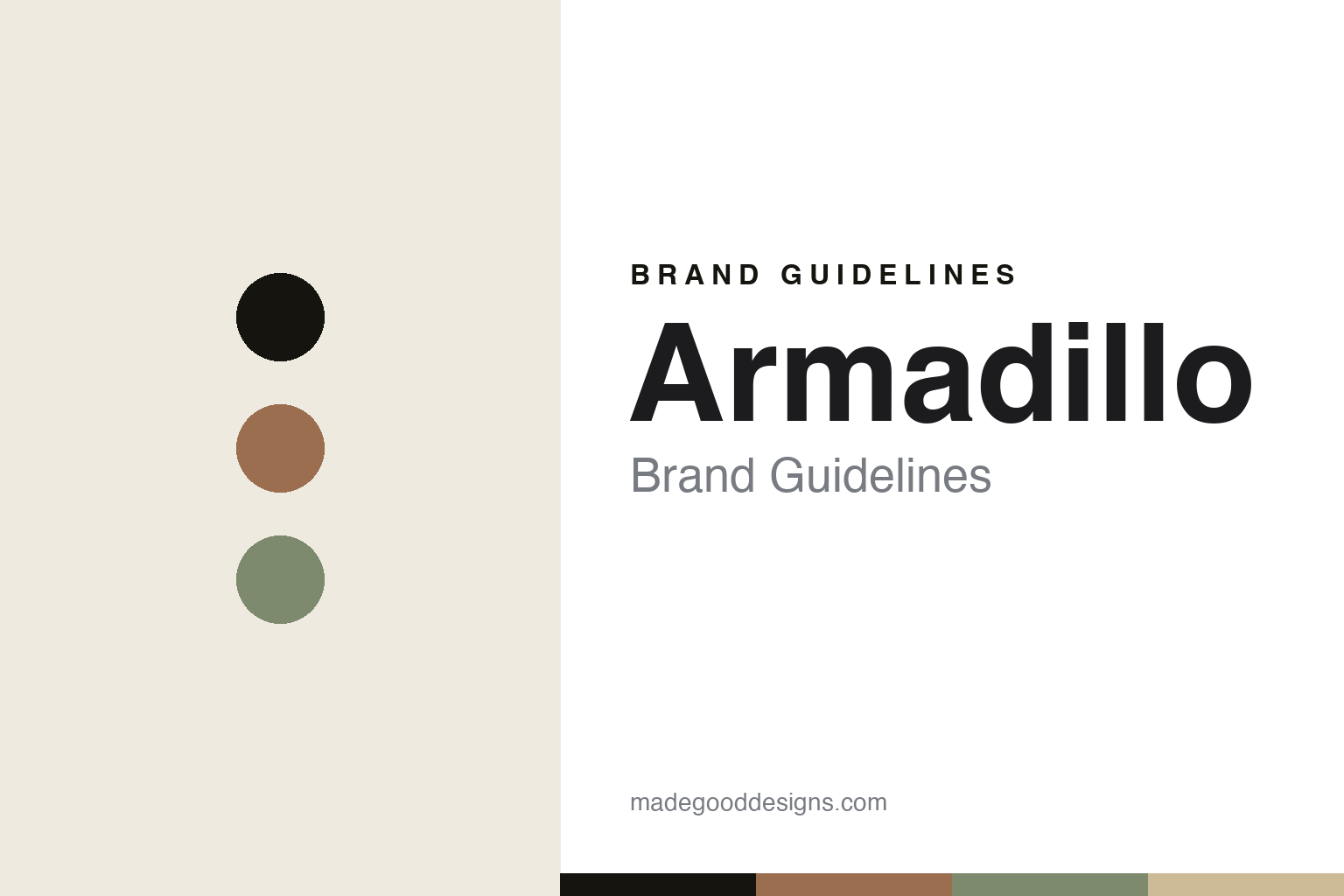
Armadillo Brand Guidelines
The natural rug.
Aa
Two constants: a jute-and-olive palette and a natural sans register. Abstract homage — not the Armadillo rugs, pattern or packaging.
The natural rug
Armadillo weaves rugs that lie lightly on the earth.
Armadillo is a lesson in ethics as the identity. Founded in 2009 in Australia — co-founded by Jodie Fried — it set out to make floor rugs that are as responsible as they are beautiful.
Its identity is natural-fibre rugs. Armadillo’s rugs are handmade by artisan partners, with its community programmes centred in India, on a natural, understated aesthetic — “our rugs lie lightly on this earth.” It is a certified B Corp — the first Australian and American rug brand to earn the mark — and runs the Armadillo Foundation, funded by 10% of net profit, with programmes across India, Nepal, Australia and the USA. A rug, made responsibly.
(Honest notes: 2009 and Jodie Fried as co-founder are confirmed; a second co-founder (reported as Sally Pottharst) we treat as reported, and we say “founded in Australia” without pinning a city. India production is strongly indicated by its foundation footprint, so we frame it as “handmade by artisan partners, with community programmes centred in India,” and treat the specific natural fibres as reported. The B Corp certification and Armadillo Foundation (10% of net profit) are on record; we don’t claim GoodWeave, carbon-neutrality or “1% for the Planet,” which we couldn’t verify — and the 10% model is distinct from 1% for the Planet. There’s no official brand hex, and we reproduce no actual rug design — these tones are an unofficial interpretation. This is design commentary and does not promote any product.)
Colour
Armadillo lives in a jute-and-olive palette. Click a swatch to copy the hex.
Armadillo’s identity is natural, ethical and understated — a jute, an ink, an olive, a sand, and a chalk. The palette pairs a jute with an olive — the register of natural-fibre rugs. It signals responsibility and calm rather than novelty. The honest caveat: with no published brand hex, these tones are an original, unofficial interpretation, not first-party values.
The lesson is a jute with an olive signals a natural-fibre house. Armadillo’s world is a calm, natural rug. For designers, it is a reminder that ethics and material — natural fibres, responsible making — can be the whole identity. The takeaways: make ethics the identity; keep the fibres natural; give back (the foundation); and treat any single hex as unofficial.
Typography
The register is a natural sans — natural, ethical, calm.
Armadillo’s identity carries a natural, ethical, calm spirit — an understated natural rug. A soft humanist sans captures the mood: it is warm and grounded, the register of a responsible maker. Set in a jute-and-olive palette, the natural sans feels natural and calm — exactly the personality Armadillo carries. It is understated rather than loud, mirroring natural-fibre rugs. (Armadillo’s real rugs, patterns and wordmark are works we describe but do not reproduce, and the exact typeface is not ours to use.) Because it is not ours to use, the honest description is “a natural sans spirit,” shown here in a stand-in. The type behaves like the brand: natural, ethical and calm.
Aa
A natural sans spirit — natural and calm. (Specimen set in Figtree, a soft humanist sans STAND-IN; NOT the Armadillo packaging.)
Ethics as the identity
Armadillo stands for natural-fibre rugs.
Armadillo is a lesson in making ethics the identity. A jute-and-olive palette, a natural sans and a calm, natural rug make responsible making the whole brand — natural, ethical, calm. The ethics is the differentiator. The differentiator is a natural-fibre rug made by a B Corp that gives back.
For designers and brand-builders, Armadillo offers a clear takeaway: make responsibility the product. The lessons: make ethics the identity; keep the fibres natural; give back; and be honest about the story. It is also a reminder to stay accurate: it was founded in 2009 in Australia by Jodie Fried, it’s a B Corp with a foundation funded by 10% of net profit, and its making is centred in India — the palette here is an unofficial interpretation. Armadillo made ethics the brand — proof that responsibility can be the difference.
Explore & save
Keep Armadillo’s identity on hand — save it to a board in the Made Good inspiration library.
Armadillo identity set
Pin the jute-and-olive palette and the natural-sans register to your own board.