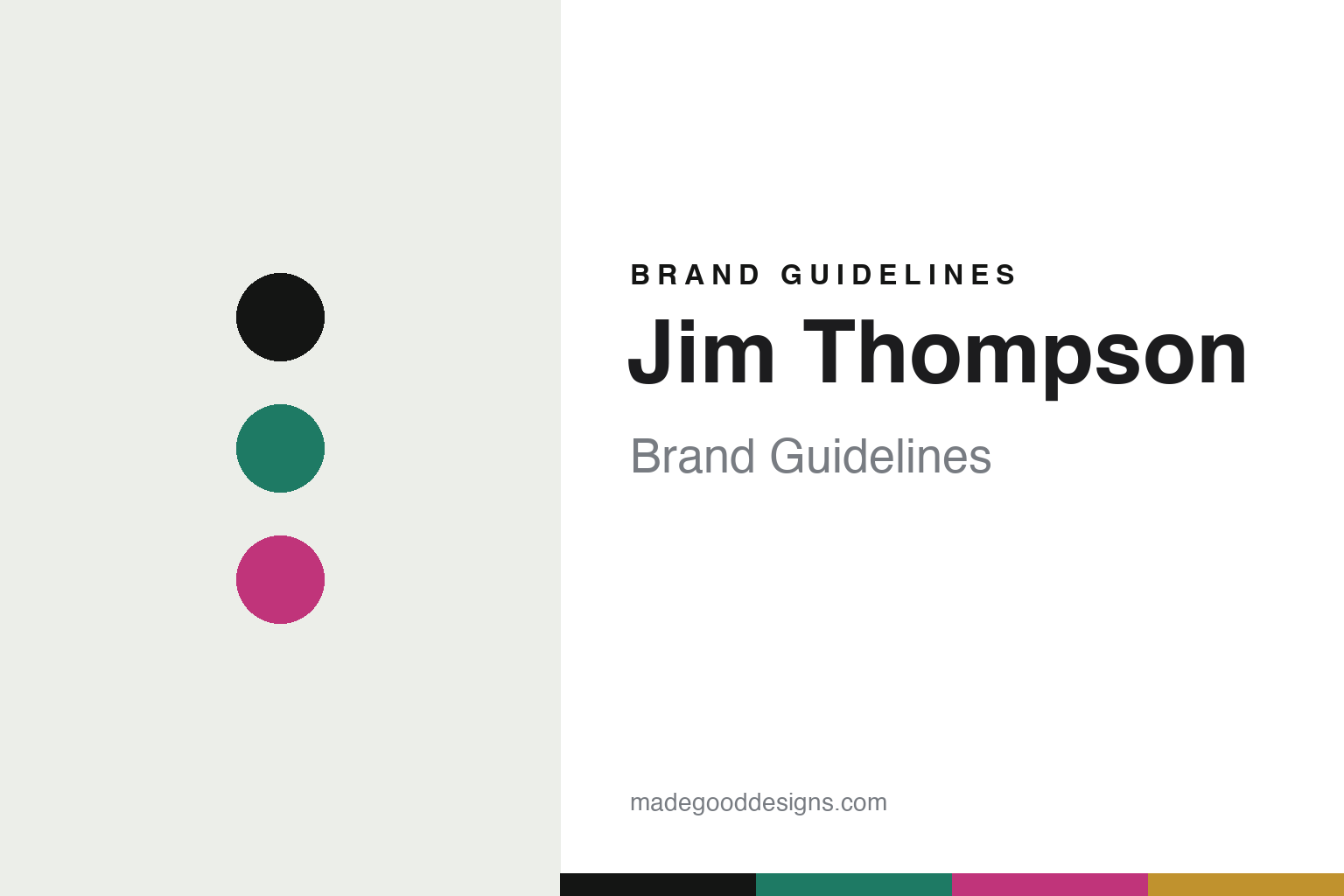
Jim Thompson Brand Guidelines
The Thai silk.
Aa
Two constants: a jade-and-magenta palette and a silk sans register. Abstract homage — not the Jim Thompson silks, Phoenix motif or packaging.
The Thai silk
Jim Thompson revived a craft and made it luxury.
Jim Thompson is a lesson in reviving a craft into a brand. James H. W. “Jim” Thompson — an American architect and former OSS officer — founded the Thai Silk Company in 1948 in Bangkok, and set about bringing Thai silk to the world.
Its identity is Thai silk. Thompson revived and commercialised a centuries-old craft — modernising colourfast dyeing and putting hand-woven Thai silk, in vivid saturated colour, on the global luxury map (its breakout came when Thai silk featured in the 1951 musical The King and I). Today the house is a lifestyle brand across silk, home furnishings and apparel, and the Jim Thompson House in Bangkok preserves his home and art collection as a museum. A craft, revived into luxury.
(Honest notes: the founder Jim Thompson revived and commercialised Thai silk — he didn’t “invent” it — founding the Thai Silk Company in 1948 (the 1951 King and I moment was his breakout, not the founding). He famously vanished in the Cameron Highlands, Malaysia, in 1967 and was never found (declared dead in 1974) — an unsolved mystery we report factually. The company operates today, but its current ownership isn’t confirmed in our sources; the Jim Thompson House museum is run by the James H. W. Thompson Foundation. Village-weaver details (Baan Krua) are reported. The Phoenix motif and silk designs are copyrighted — we reproduce none — and there’s no official brand hex, so these tones are an unofficial interpretation. This is design commentary and does not promote any product.)
Colour
Jim Thompson lives in a jade-and-magenta palette. Click a swatch to copy the hex.
Jim Thompson’s identity is vivid, luxurious and Thai — a jade, an ink, a magenta, a gold, and a chalk. The palette pairs a jade with a magenta — the register of vivid Thai silk. It signals saturated colour and craft rather than novelty. The honest caveat: with no published brand hex, these tones are an original, unofficial interpretation, not first-party values.
The lesson is a jade with a magenta signals a Thai-silk house. Jim Thompson’s world is a lustrous, colour-saturated silk. For designers, it is a reminder that reviving a traditional craft — and giving it vivid, modern colour — can be a whole identity. Because a jade can fail as small text, keep type dark and let the colour live in the accents, palette and band. The takeaways: revive a craft; own vivid colour; keep it hand-woven; and treat any single hex as unofficial.
Typography
The register is a silk sans — vivid, luxurious, Thai.
Jim Thompson’s identity carries a vivid, luxurious, Thai spirit — a colour-saturated silk. A clean geometric sans captures the mood: it is modern and confident, the register of a global lifestyle house built on craft. Set in a jade-and-magenta palette, the silk sans feels vivid and luxurious — exactly the personality Jim Thompson carries. It is contemporary rather than fussy, mirroring vivid silk. (Jim Thompson’s real silks, the Phoenix motif and wordmark are works we describe but do not reproduce, and the exact typeface is not ours to use.) Because it is not ours to use, the honest description is “a silk sans spirit,” shown here in a stand-in. The type behaves like the brand: vivid, luxurious and Thai.
Aa
A silk sans spirit — vivid and luxurious. (Specimen set in Jost, a clean geometric sans STAND-IN; NOT the Jim Thompson silks or packaging.)
Reviving a craft into a brand
Jim Thompson stands for Thai silk.
Jim Thompson is a lesson in making a revived craft the identity. A jade-and-magenta palette, a silk sans and a lustrous cloth make Thai silk the whole brand — vivid, luxurious, Thai. The silk is the differentiator. The differentiator is a centuries-old craft, revived and given vivid modern colour.
For designers and brand-builders, Jim Thompson offers a clear takeaway: revive a craft and give it the world. The lessons: revive a craft; own vivid colour; keep it hand-woven; and be honest about the story. It is also a reminder to stay accurate: an American founder started the Thai Silk Company in 1948, revived rather than invented the craft, vanished in 1967, and the palette here is an unofficial interpretation. Jim Thompson made a revived craft the brand — proof that craft can be the difference.
Explore & save
Keep Jim Thompson’s identity on hand — save it to a board in the Made Good inspiration library.
Jim Thompson identity set
Pin the jade-and-magenta palette and the silk-sans register to your own board.


