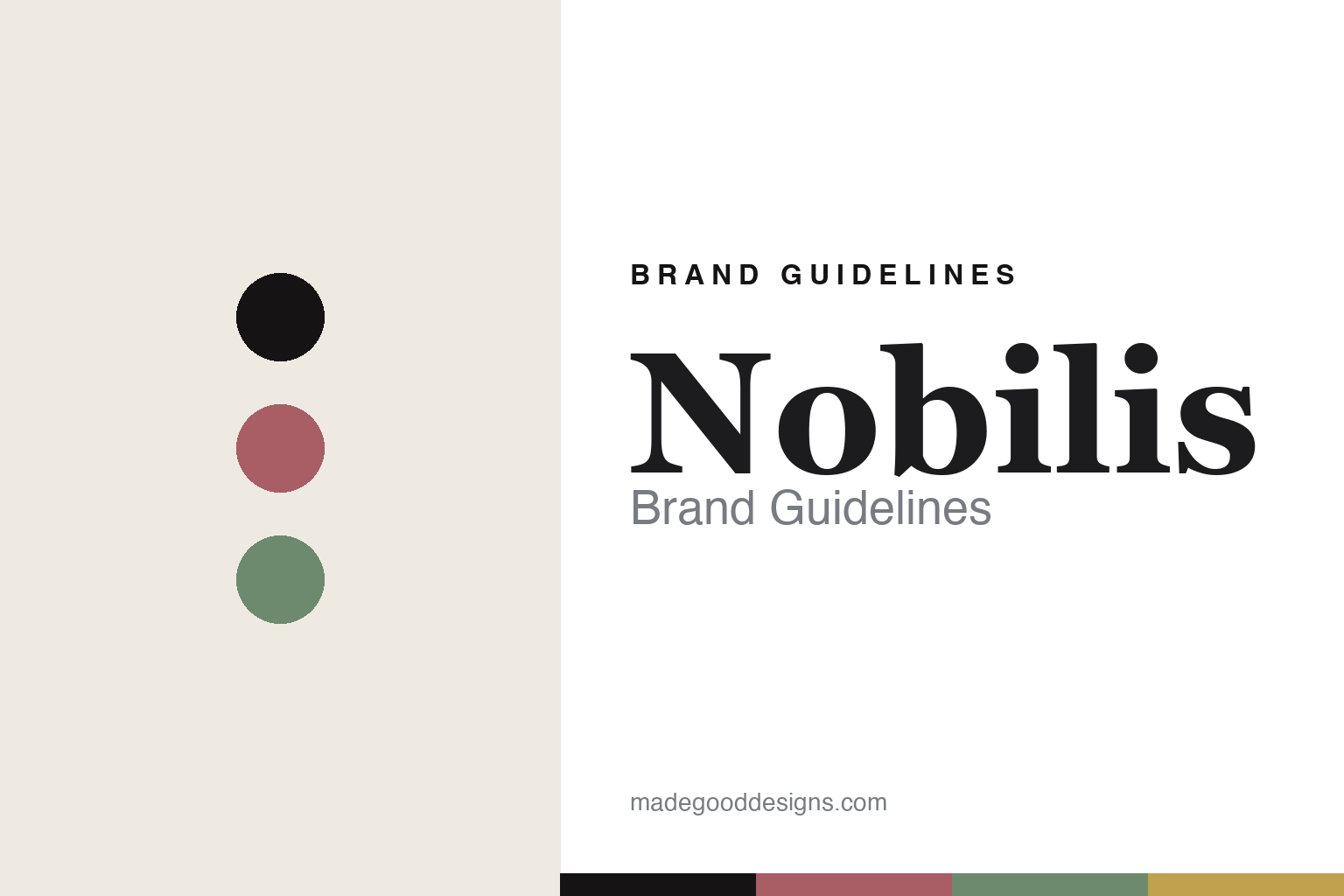
Nobilis Brand Guidelines
The French éditeur.
Aa
Two constants: a rose-and-green palette and an éditeur serif register. Abstract homage — not the Nobilis fabrics, prints or packaging.
The French éditeur
Nobilis has edited French decoration since 1928.
Nobilis is a lesson in the éditeur’s eye. Founded in 1928 in Paris by Adolphe Halard — who opened a wallpaper store by the École des Beaux-Arts — it grew into a French éditeur: a house that curates, commissions and publishes decoration.
Its identity is French fabrics and wallpapers. Nobilis edits furnishing fabrics, wallpapers, rugs, furniture and accessories, from an early signature of delicate, pastel floral prints to a “global decoration” offer spanning classic and contemporary — the decorative French style, colour and pattern. A Left Bank éditeur, still choosing what the room should wear.
(Honest notes: Nobilis was founded in 1928 in Paris by Adolphe Halard as a family firm; whether it is still Halard-family-owned today isn’t confirmed in our sources, so we don’t assert living-descendant control, and we treat its self-reported milestone dates as company-stated. It doesn’t state where its products are made, so we don’t claim “made in France” — we call it a Paris-based French éditeur. Its collaborations with Christian Liaigre, Jean-Michel Wilmotte and Éric Schmitt are documented. Note that the Wikipedia “Nobilis” is an unrelated video-game publisher — not this house. There’s no official brand hex, and we reproduce no actual print — these tones are an unofficial interpretation. This is design commentary and does not promote any product.)
Colour
Nobilis lives in a rose-and-green palette. Click a swatch to copy the hex.
Nobilis’ identity is delicate, decorative and French — a dusty rose, an ink, a soft green, a gold, and a cream. The palette pairs a rose with a green — the register of French floral decoration. It signals refinement and pattern rather than novelty. The honest caveat: with no published brand hex, these tones are an original, unofficial interpretation, not first-party values.
The lesson is a rose with a green signals a French éditeur. Nobilis’ world is a decorated, floral interior. For designers, it is a reminder that an éditeur’s job — curating and publishing a coherent decorative world — can be a whole identity. Because a mid rose can fail as small text, keep type dark and let the colour live in the accents, palette and band. The takeaways: edit a coherent world; keep the floral heritage; commission designers; and treat any single hex as unofficial.
Typography
The register is an éditeur serif — delicate, decorative, French.
Nobilis’ identity carries a delicate, decorative, French spirit — a floral, pastel interior. A high-contrast display serif captures the mood: it is elegant and refined, the register of Parisian decoration. Set in a rose-and-green palette, the éditeur serif feels delicate and decorative — exactly the personality Nobilis carries. It is refined rather than loud, mirroring floral prints. (Nobilis’ real fabrics, prints and wordmark are works we describe but do not reproduce, and the exact typeface is not ours to use.) Because it is not ours to use, the honest description is “an éditeur serif spirit,” shown here in a stand-in. The type behaves like the brand: delicate, decorative and French.
Aa
An éditeur serif spirit — delicate and decorative. (Specimen set in Playfair Display, a high-contrast display serif STAND-IN; NOT the Nobilis packaging.)
The éditeur’s eye
Nobilis stands for edited French decoration.
Nobilis is a lesson in making curation the identity. A rose-and-green palette, an éditeur serif and a floral interior make edited French decoration the whole brand — delicate, decorative, French. The eye is the differentiator. The differentiator is nearly a century of choosing what a French room should wear.
For designers and brand-builders, Nobilis offers a clear takeaway: be an éditeur, not just a maker. The lessons: edit a coherent world; keep the heritage; commission designers; and be honest about the story. It is also a reminder to stay accurate: it was founded in 1928 by Adolphe Halard, its current ownership and making location aren’t confirmed, and it collaborated with Liaigre — the palette here is an unofficial interpretation. Nobilis made the éditeur’s eye the brand — proof that curation can be the difference.
Explore & save
Keep Nobilis’s identity on hand — save it to a board in the Made Good inspiration library.
Nobilis identity set
Pin the rose-and-green palette and the éditeur-serif register to your own board.