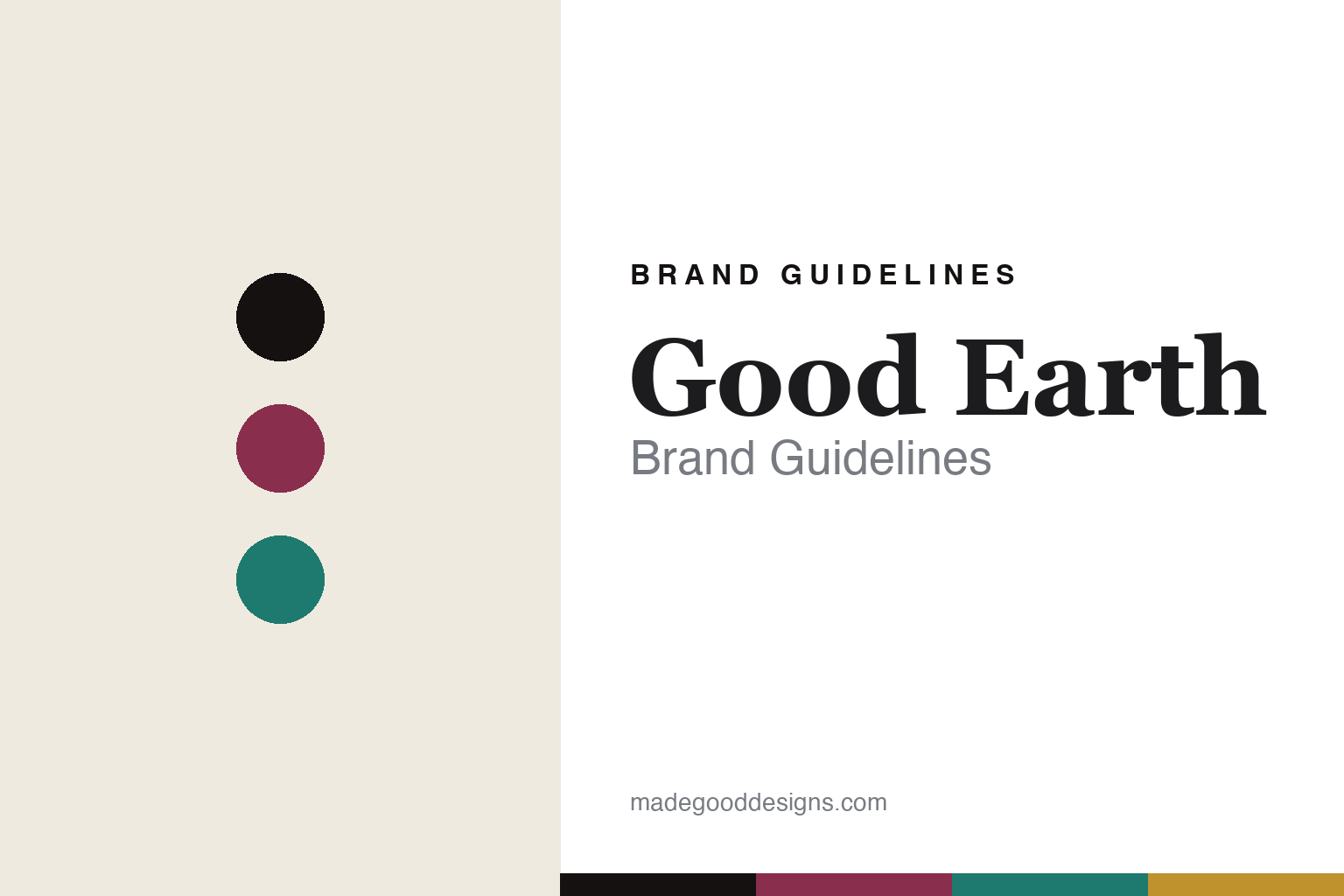
Good Earth Brand Guidelines
The Indian luxury craft.
Aa
Two constants: a berry-and-jewel-teal palette and a craft serif register. Abstract homage — not the Good Earth prints, textiles or packaging.
The Indian luxury craft
Good Earth reinterprets Indian craft as luxury.
Good Earth is a lesson in craft heritage as luxury. A luxury Indian design house — the entity Goodearth Design Studio — it presents itself as “stylish, sustainable luxury,” with stores across India and in Dubai.
Its identity is Indian craft, reinterpreted for luxury. Good Earth makes luxury home textiles, tableware and ceramics, and apparel, drawing on India’s craft traditions and historic motifs — block prints, embroidery, the influences of jamdani and brocade — reinterpreted for contemporary luxury living. Heritage technique, made a modern luxury.
(Honest notes: Good Earth’s entity name (Goodearth Design Studio), its “sustainable luxury” positioning and its store footprint (across India, plus Dubai) are verified from its site. Its founding — reported as 1996 by Anita Lal, with her son Simran Lal cited as CEO — we treat as reported and hedge the city and exact title. The specific craft techniques (block print, embroidery, jamdani, brocade) are a fair characterisation of its output rather than a sourced list. Nicobar is a separate, associated sister label. There’s no official brand hex, and we reproduce no actual print — these tones are an unofficial interpretation. This is design commentary and does not promote any product.)
Colour
Good Earth lives in a berry-and-jewel-teal palette. Click a swatch to copy the hex.
Good Earth’s identity is rich, crafted and Indian — a berry, an ink, a jewel teal, a gold, and a cream. The palette pairs a berry with a jewel teal — the register of Indian luxury craft. It signals heritage and richness rather than novelty. The honest caveat: with no published brand hex, these tones are an original, unofficial interpretation, not first-party values.
The lesson is a berry with a jewel teal signals an Indian luxury-craft house. Good Earth’s world is a rich, crafted interior. For designers, it is a reminder that reinterpreting a country’s craft heritage — for contemporary luxury — can be the whole identity. Because a deep berry can fail as small text, keep type dark and let the colour live in the accents, palette and band. The takeaways: draw on craft heritage; reinterpret for today; treat luxury as sustainable; and treat any single hex as unofficial.
Typography
The register is a craft serif — rich, heritage, Indian.
Good Earth’s identity carries a rich, heritage, Indian spirit — a crafted luxury interior. A high-contrast old-style serif captures the mood: it is elegant and ornate, the register of luxury craft. Set in a berry-and-jewel-teal palette, the craft serif feels rich and heritage — exactly the personality Good Earth carries. It is ornate rather than plain, mirroring block print and brocade. (Good Earth’s real prints, textiles and wordmark are works we describe but do not reproduce, and the exact typeface is not ours to use.) Because it is not ours to use, the honest description is “a craft serif spirit,” shown here in a stand-in. The type behaves like the brand: rich, heritage and Indian.
Aa
A craft serif spirit — rich and ornate. (Specimen set in Cormorant Garamond, a high-contrast serif STAND-IN; NOT the Good Earth packaging.)
Craft heritage as luxury
Good Earth stands for Indian luxury craft.
Good Earth is a lesson in making craft heritage the identity. A berry-and-jewel-teal palette, a craft serif and a rich interior make Indian luxury craft the whole brand — rich, heritage, Indian. The heritage is the differentiator. The differentiator is India’s craft traditions, reinterpreted for contemporary luxury.
For designers and brand-builders, Good Earth offers a clear takeaway: reinterpret a craft heritage. The lessons: draw on craft heritage; reinterpret for today; treat luxury as sustainable; and be honest about the story. It is also a reminder to stay accurate: it’s a luxury Indian design house (reportedly founded 1996 by Anita Lal), rooted in Indian craft, with Nicobar as a separate sister label — the palette here is an unofficial interpretation. Good Earth made craft heritage the brand — proof that heritage can be the difference.
Explore & save
Keep Good Earth’s identity on hand — save it to a board in the Made Good inspiration library.
Good Earth identity set
Pin the berry-and-jewel-teal palette and the craft-serif register to your own board.