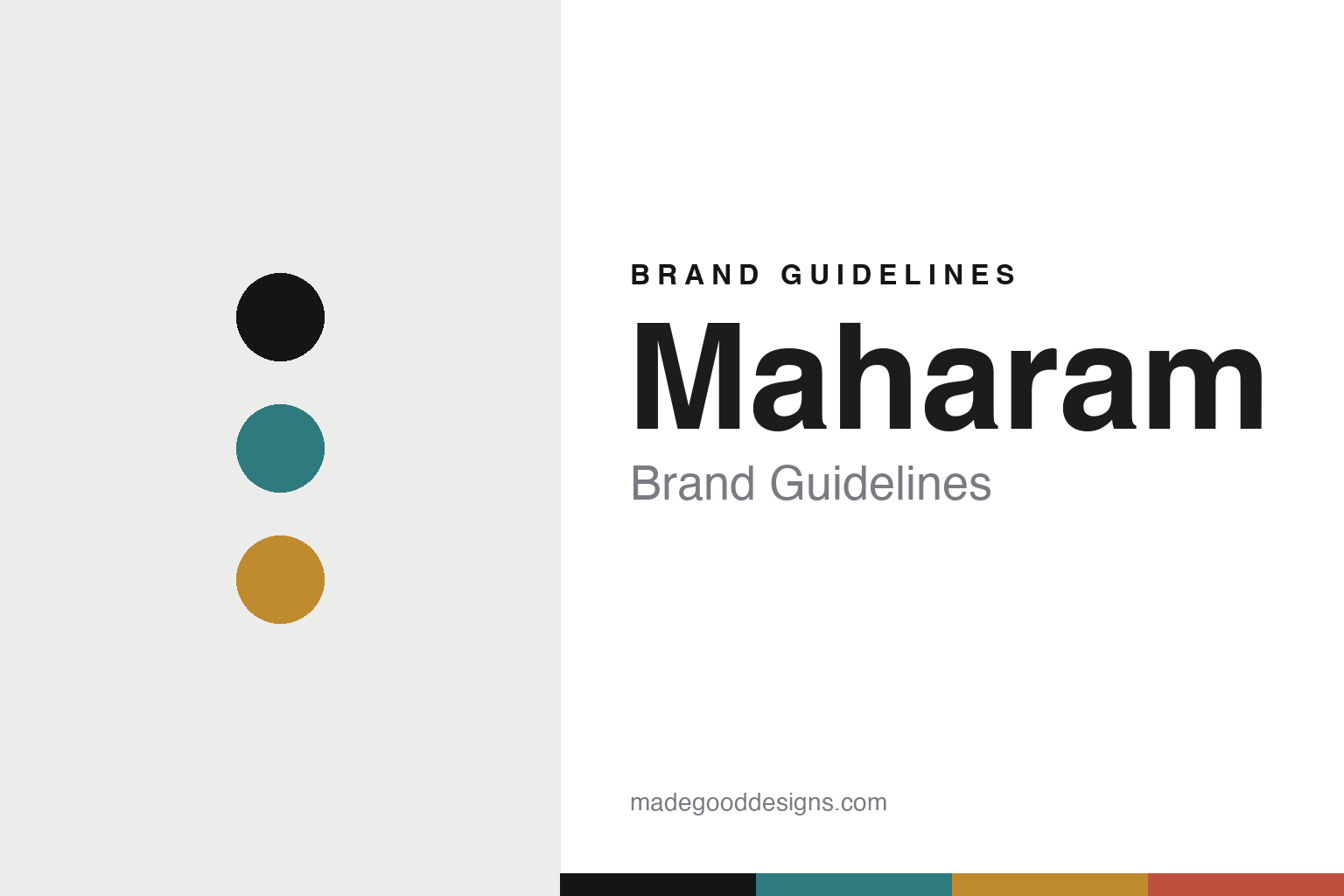
Maharam Brand Guidelines
The design textile.
Aa
Two constants: a teal-and-mustard palette and a modernist sans register. Abstract homage — not the Maharam textiles or packaging.
The design textile
Maharam made the contract textile a design object.
Maharam is a lesson in an archive as a design language. An American textile house founded in New York in the early twentieth century (reportedly 1902) as a family business, it grew into one of the most design-led names in contract textiles.
Its identity is the design textile. Maharam makes high-design upholstery and interior textiles for commercial and residential spaces, and it is known for two things: reissuing the great mid-century designer textiles — Alexander Girard, Charles and Ray Eames, George Nelson — through its “Textiles of the Twentieth Century” archive, and commissioning contemporary designers (Hella Jongerius, the Bouroullec brothers, Paul Smith). Modernism, kept in production.
(Honest notes: the 1902 founding and the founder’s name are widely reported but we couldn’t verify them live, so we hedge (“reportedly 1902”) and don’t state the founder as fact. Importantly, Maharam is now part of MillerKnoll — a Herman Miller brand (the acquisition is reported as 2013) — so it isn’t independent. The mid-century reissues (Girard especially) and contemporary collaborations are well established but reported rather than verified here. Kvadrat is a separate Danish house — not part of Maharam — so we don’t conflate them. There’s no official brand hex, and we reproduce no actual textile design — these tones are an unofficial interpretation. This is design commentary and does not promote any product.)
Colour
Maharam lives in a teal-and-mustard palette. Click a swatch to copy the hex.
Maharam’s identity is modernist, design-led and American — a teal, an ink, a mustard, a Girard red, and a chalk. The palette pairs a teal with a mustard — the register of mid-century modern textiles. It signals design history rather than novelty. The honest caveat: with no published brand hex, these tones are an original, unofficial interpretation, not first-party values.
The lesson is a teal with a mustard signals a design-textile house. Maharam’s world is a modernist, considered cloth. For designers, it is a reminder that stewarding design history — reissuing the greats — plus commissioning the present can be a whole identity. Because a mid teal can fail as small text, keep type dark and let the colour live in the accents, palette and band. The takeaways: steward the archive; commission the present; make it design-led; and treat any single hex as unofficial.
Typography
The register is a modernist sans — design-led, considered, American.
Maharam’s identity carries a design-led, considered, American spirit — a modernist textile. A clean modern grotesque captures the mood: it is exact and contemporary, the register of a design house. Set in a teal-and-mustard palette, the modernist sans feels design-led and considered — exactly the personality Maharam carries. It is engineered rather than decorative, mirroring mid-century design. (Maharam’s real textiles and wordmark are works we describe but do not reproduce, and the exact typeface is not ours to use.) Because it is not ours to use, the honest description is “a modernist sans spirit,” shown here in a stand-in. The type behaves like the brand: design-led, considered and American.
Aa
A modernist sans spirit — design-led and considered. (Specimen set in Space Grotesk, a clean modern grotesque STAND-IN; NOT the Maharam packaging.)
An archive as a design language
Maharam stands for the design textile.
Maharam is a lesson in making design history the identity. A teal-and-mustard palette, a modernist sans and a considered textile make the design textile the whole brand — design-led, considered, American. The archive is the differentiator. The differentiator is reissuing the modernist greats and commissioning the present.
For designers and brand-builders, Maharam offers a clear takeaway: steward a design history. The lessons: steward the archive; commission the present; stay design-led; and be honest about the story. It is also a reminder to stay accurate: it’s an American house (reportedly founded 1902), now a MillerKnoll brand rather than independent, known for its Girard and Eames reissues — the palette here is an unofficial interpretation. Maharam made design history the brand — proof that an archive can be the difference.
Explore & save
Keep Maharam’s identity on hand — save it to a board in the Made Good inspiration library.
Maharam identity set
Pin the teal-and-mustard palette and the modernist-sans register to your own board.