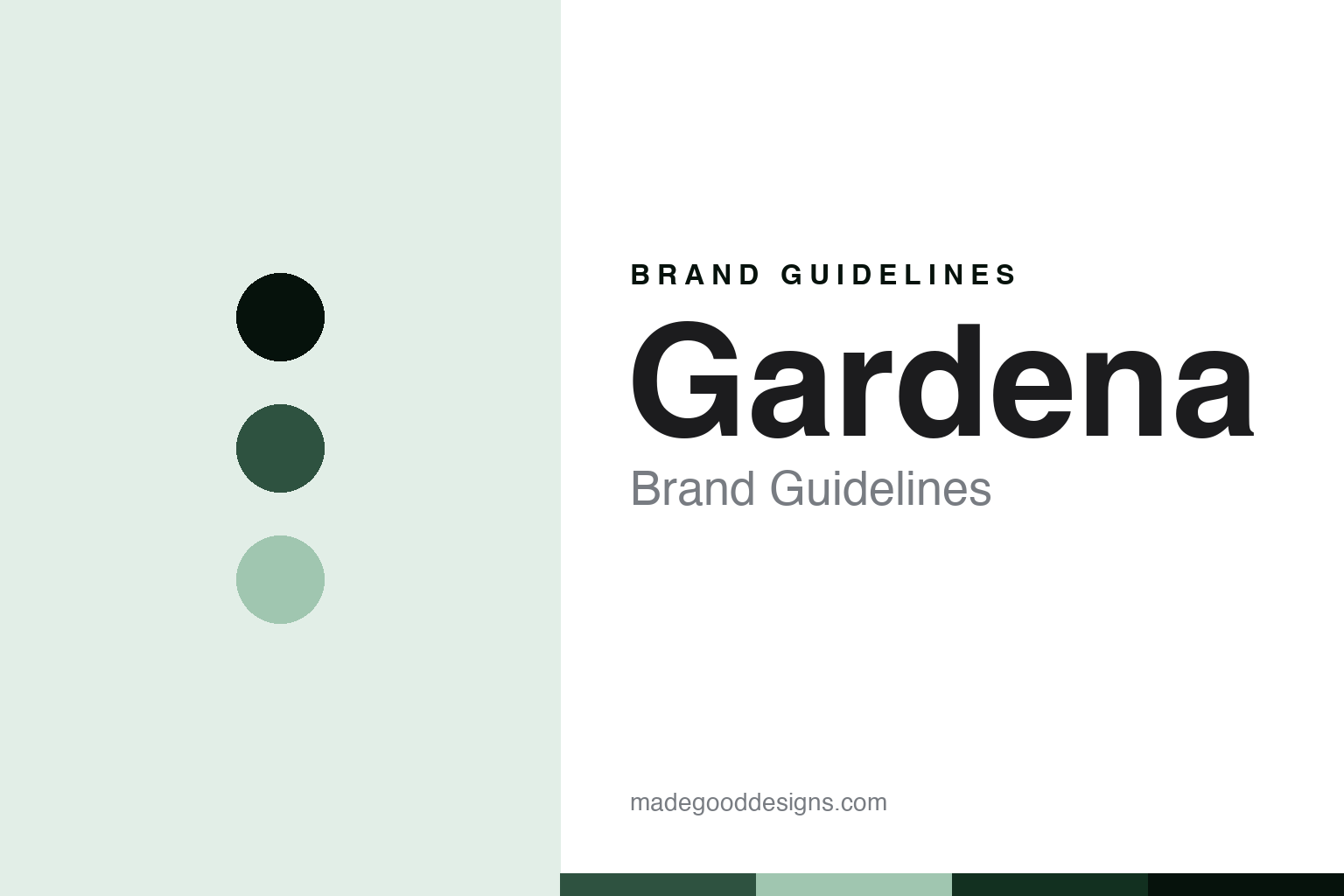
Gardena Brand Guidelines
The watering system.
Aa
Two constants: a garden-green palette and a system-sans register. Abstract homage — not a Gardena product or mark.
The watering system
Gardena is the German garden-watering brand of 1961, known for its click-connector system, now owned by Sweden’s Husqvarna Group.
Gardena is the round’s system-builder — the German brand that made garden watering a click-together kit. Gardena makes garden watering and irrigation systems, along with modular hand tools and powered garden equipment. Its answer to how a maker becomes a name is a system, not a single tool: standardise the hose connector so every piece clicks together, and build a whole watering range around it. A system, that clicks.
Its identity is the watering system. Gardena’s click-connector system, its irrigation range and its German heritage are the work it is known for. A system, from Germany. The watering system.
(Honest notes, so the story stays precise. Gardena — at gardena.com — makes garden watering and irrigation systems: the Original GARDENA System quick-connect click connectors from 1968, hoses, sprinklers, the Micro-Drip-System, smart automatic watering and pumps, plus the combisystem modular hand tools from 1976, secateurs and robotic mowers. It was founded in 1961 in Germany, by Werner Kress and Eberhard Kastner, adopting the Gardena name in 1966, and is headquartered in Ulm. On where it is made — a theme of this round — Gardena has German heritage and real production in Ulm, but as a large multinational it also makes elsewhere, such as the Czech Republic, so we say made in Germany and globally rather than all-German. On ownership — a recurring thread — Gardena has been owned by the Husqvarna Group of Sweden since 2007. Its name and marks, and its signature turquoise-and-grey colours, are IP, described but never reproduced, and there is no official brand hex; these tones are an unofficial interpretation. This is design commentary and does not promote any product.)
Colour
Gardena lives in a garden-green palette. Click a swatch to copy the hex.
Gardena’s identity is systematic, made and engineered — a garden green, an ink, a sage, a deep green, and a paper. The palette leans garden green and sage: a garden register drawn as colour rather than the brand’s own signature turquoise. It signals an engineered watering system. The honest caveat: Gardena’s real colours are its own, so these values are an original, unofficial interpretation, not first-party colours.
The lesson is a garden-green palette signals a systematic, engineered identity. Gardena’s world is a systematic, engineered object. For designers, it is a reminder that a garden green and a soft sage can carry a watering brand — the green of the garden it waters — without lifting its signature turquoise. Because these tones can fail as small text, keep type dark and let the colour live in the accents, palette and band. The takeaways: build a system, not a tool; standardise the connector; be honest about a global make; and treat any single hex as unofficial.
Typography
The register is a system sans — engineered, modular, made.
Gardena’s identity carries an engineered, modular, made spirit — a system brand, not a single-tool maker. A system sans captures the mood: technical, tidy and German, the register of a click-together watering kit. Set in a garden-green palette, the system sans feels engineered and modular — exactly the personality Gardena carries. It is a system rather than a logo, mirroring a connector that clicks. (Gardena’s real wordmark, and its turquoise colours, are things we describe but do not reproduce, and the exact typeface is not ours to use.) Because it is not ours to use, the honest description is “a system-sans spirit,” shown here in a stand-in. The type behaves like the system: engineered, modular and made.
Aa
A system-sans spirit — engineered and made. (Specimen set in Libre Franklin, a system-sans STAND-IN; NOT the Gardena logo or turquoise.)
The garden tool makers
Gardena stands for the watering system, made in Germany and beyond.
Gardena is a lesson in how a system can be an identity. A garden-green palette, a system sans and a click-connector make one thing — the watering system — the whole identity: systematic, made and engineered. The click-together system is the differentiator, and the German engineering is the meaning. The point is a German brand that turned garden watering into a modular kit, standardised on one connector, now within a Swedish group.
Put to work, the identity is a system, told straight, as design. A maker in this spirit would standardise a connector and build a range around it — the GARDENA System, from Ulm. A reader in this spirit would hold both threads: Gardena has genuine German heritage and Ulm production, but as a multinational it makes elsewhere too, so it is German-and-global rather than all-German; and it is owned by the Husqvarna Group of Sweden. Gardena holds the round’s three-jobs thread on the watering side with Guillouard and Dramm, its heritage-versus-system thread as the round’s engineered system against the heritage-craft makers, and its where-made thread at the mixed end. The honest editorial moves are to credit the click-connector system, to state the German-and-global make, and to name the Husqvarna ownership. The lesson Gardena teaches is that a system can hold an identity: the click connector gives it substance, and the German engineering keeps it credible. The watering system is the personality, and the click connector is the proof.
For designers and brand-builders, Gardena holds a Germany pole in the garden tool makers: build a system — and be honest about a global make. The lessons: standardise the connector; build a range around it; say a make is German-and-global when it is; disclose a group owner; and never reproduce a logo. It is also a reminder to stay precise: Gardena is the German garden-watering brand of 1961, known for its click-connector system, now owned by Sweden’s Husqvarna Group — with the palette here an unofficial interpretation. Read that way, Gardena is less a hose than a grammar of connection: standardise one fitting and every piece clicks into a system, which is a harder thing to build than a single good tool and a more durable kind of loyalty once it is built. Gardena made the watering system the identity — proof that a tool, honestly told, can be the difference.
Explore & save
Keep Gardena’s identity on hand — save it to a board in the Made Good inspiration library.
Gardena identity set
Pin the garden-green palette and the system-sans register to your own board.