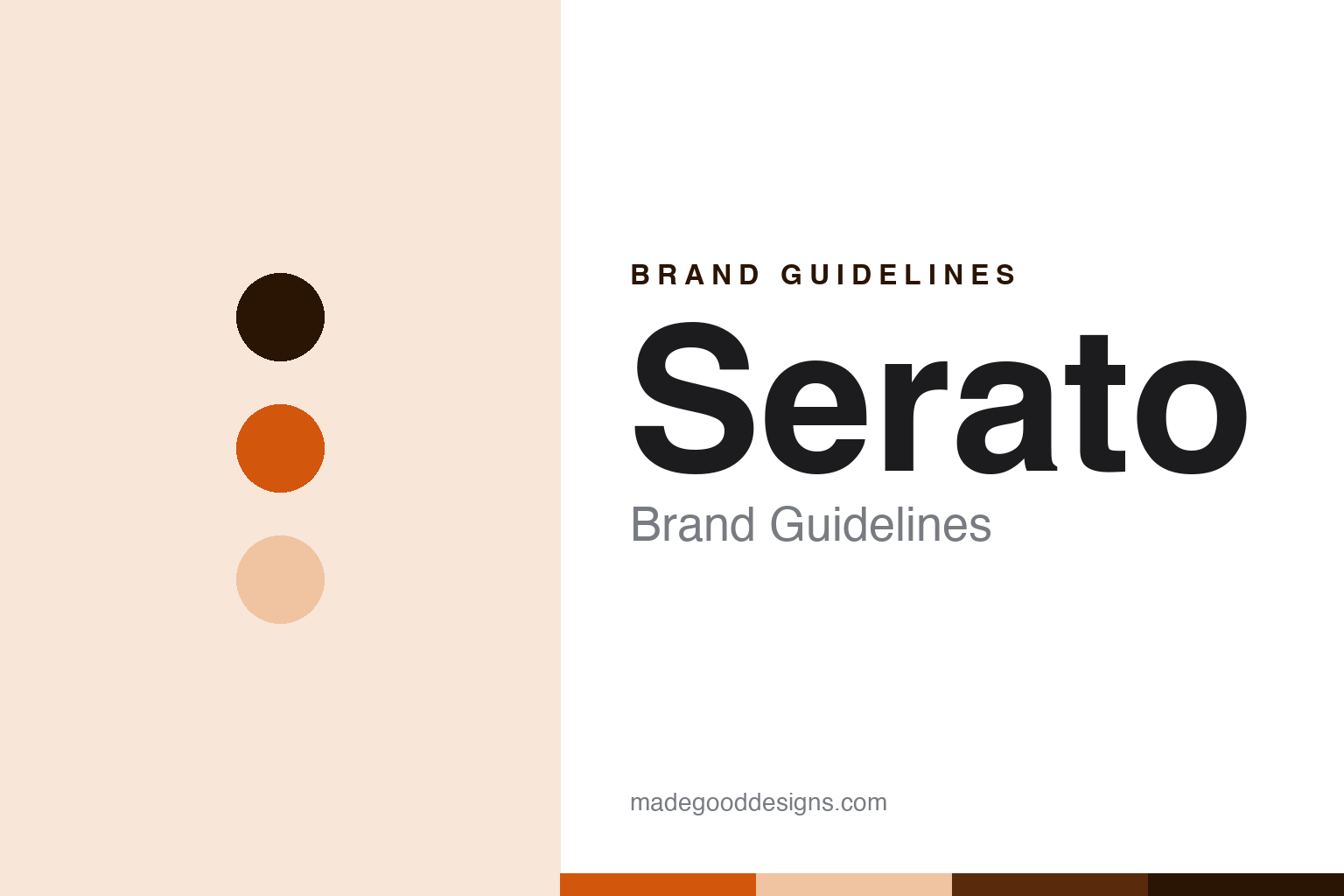
Serato Brand Guidelines
The neutral software they were blocked from buying.
Aa
Two constants: a Serato-orange palette and a software-sans register. Abstract homage — not a Serato product or mark; no waveform, UI or logo is reproduced.
The neutral software they were blocked from buying
Serato is a 1998 Auckland DJ-software maker whose Serato DJ Pro runs on rival hardware — so central that regulators blocked Pioneer DJ from buying it, and which instead went to Canada’s Tiny in 2025.
Serato sits at the round’s centre as its software node — the neutral DJ software that runs across competing hardware, so central to the industry that regulators blocked the market leader from buying it. Its answer to a round about who owns the DJ world is the pivot one: the independent software everyone’s hardware runs, now owned by an unexpected buyer.
Its identity is the neutral software they were blocked from buying. The 1998 Auckland founding, the blocked Pioneer DJ deal and the 2025 Tiny ownership are the story here. Runs on everything. The neutral software they were blocked from buying.
(Honest notes, so the founding, the blocked deal, the new owner and the neutrality are framed accurately. Serato sells DJ software as its heroes — Serato DJ Pro, Serato DJ Lite and Serato Studio; we report its language as the brand’s own. On founding: Serato Audio Research was founded in 1998 in Auckland, New Zealand, by Steve West and AJ Bertenshaw, with its first product a time-stretch plug-in. On the blocked deal, dated: Pioneer DJ’s parent AlphaTheta announced buying Serato in 2023, but New Zealand’s competition regulator declined clearance in 2024 because combining the leading software with the leading hardware raised competition concerns, so the deal was abandoned and AlphaTheta never took ownership. On the new owner: Serato was instead acquired in 2025 by Tiny, a Canadian holding company whose other holdings include AeroPress and Dribbble, which took a controlling stake while the founders kept a minority. On neutrality: Serato ran across rival hardware from Pioneer DJ, Rane, Denon DJ and others, which is exactly why the acquisition raised concerns. Its designs and the Serato name are IP we describe but do not reproduce; there is no official brand hex; these tones are an unofficial interpretation.)
Colour
Serato lives in a Serato orange. Click a swatch to copy the hex.
Serato’s identity is neutral, Tiny-owned and software-first — a Serato orange, an ink, a pale orange, a deep umber, and a paper. The palette leans Serato orange and deep umber: a bright, screen-first register that nods to a performance-software brand rather than a loud logo colour. It signals the neutral software they were blocked from buying — neutral, Tiny-owned and software-first. The honest caveat: with no official brand hex, and only a black-with-bright-accent identity documented, these values are a software, unofficial interpretation, not first-party colours.
The lesson is a Serato orange signals a neutral, software identity. Serato’s world is the laptop and the controller. For designers, it is a reminder that a bright orange and a pale orange can carry a neutral, software brand — a screen tone held as an accent, not a product shot. Because a bright hue fails as small text, keep type dark and let the colour live in the accents, palette and band. The takeaways: date the founding to 1998 and Auckland; record the blocked Pioneer DJ deal; name the 2025 Tiny ownership; and explain the neutrality that caused the block.
Typography
The register is a software sans — neutral, Tiny-owned, software-first.
Serato’s identity carries a neutral, Tiny-owned spirit — the software everyone shares. A software sans captures the mood: clean, modern and screen-friendly, the register of a performance app. Set in a Serato-orange palette, the software sans feels current and neutral — exactly the personality Serato carries. It behaves like a made, running thing rather than a loud logo, mirroring a cue-line and a waveform-line. (Serato’s real products and the name are things we describe but do not reproduce, and the exact typeface is not ours to use.) Because it is not ours to use, the honest description is “a software-sans brand,” shown here in a stand-in. The type behaves like the brand: neutral, Tiny-owned and software-first.
Aa
A software-sans brand — current and neutral. (Specimen set in Outfit, a software-sans STAND-IN; NOT the Serato logo or products.)
The DJ node
Serato stands for the neutral software they were blocked from buying.
Serato sits at the round’s centre as its software node. A Serato-orange palette, a software sans and a 1998 founding make one thing — the neutral software they were blocked from buying — the whole identity: neutral, Tiny-owned and software-first. The 1998 founding is the pitch, the blocked Pioneer DJ deal is the drama, and the 2025 Tiny ownership is the twist. The point is the independent software everyone’s hardware runs, in a round about who owns the DJ world.
Put to work, the identity is the brand told straight, the block recorded and the new owner named. A brand in this spirit would date the founding to 1998 and Auckland, record the blocked Pioneer DJ deal, name the 2025 Tiny ownership, and explain the neutrality that caused the block. A reader in this spirit would keep the facts right: Serato sells Serato DJ Pro and Serato Studio; it was founded in 1998 in Auckland by Steve West and AJ Bertenshaw; Pioneer DJ was blocked from buying it in 2024; and it went to Canada’s Tiny in 2025. Serato sits after Numark and before Native Instruments. The honest editorial moves are to date the founding, to record the block, to name the new owner, and to explain the neutrality.
For designers and brand-builders, Serato carries the DJ node: record a blocked deal — and name the buyer who did land it. The lessons: a brand can be the neutral platform a whole industry depends on, here Serato and its DJ software; a founding is dated to 1998 in Auckland, New Zealand, by Steve West and AJ Bertenshaw; a blocked deal is recorded, that Pioneer DJ’s parent AlphaTheta announced buying Serato in 2023 but New Zealand’s regulator declined clearance in 2024, because combining the leading software with the leading hardware raised competition concerns, so the deal was abandoned; a new owner is named, that Serato was instead acquired in 2025 by the Canadian holding company Tiny, whose other holdings include AeroPress and Dribbble, taking a controlling stake while the founders kept a minority; and the neutrality is explained, that Serato ran across rival hardware from Pioneer DJ, Rane, Denon DJ and others, which is why the acquisition raised concerns. It is also a reminder to stay precise: Serato is the neutral, now Tiny-owned software of the DJ aisle — with the palette here an unofficial interpretation. The hook is that pivot: Serato is the neutral software they were blocked from buying, a 1998 Auckland DJ-software maker whose Serato DJ Pro runs on rival hardware, so central that regulators blocked Pioneer DJ from buying it, and which instead went to Canada’s Tiny in 2025. Read that way, Serato is less a single app than the neutral software they were blocked from buying: neutral, Tiny-owned, software-first. The lesson for a brand is that recording a blocked deal and naming the buyer who did land it reinforce the honesty, and dating the founding keeps it earned. Serato made the-neutral-software-they-were-blocked-from-buying the identity — proof that an honestly-told pivot can anchor a node.
Explore & save
Keep Serato’s identity on hand — save it to a board in the Made Good inspiration library.
Serato identity set
Pin the Serato-orange palette and the software-sans register to your own board.