Franco Serblin Brand Guidelines
The Sonus faber founder’s second company, made in Vicenza.
Aa
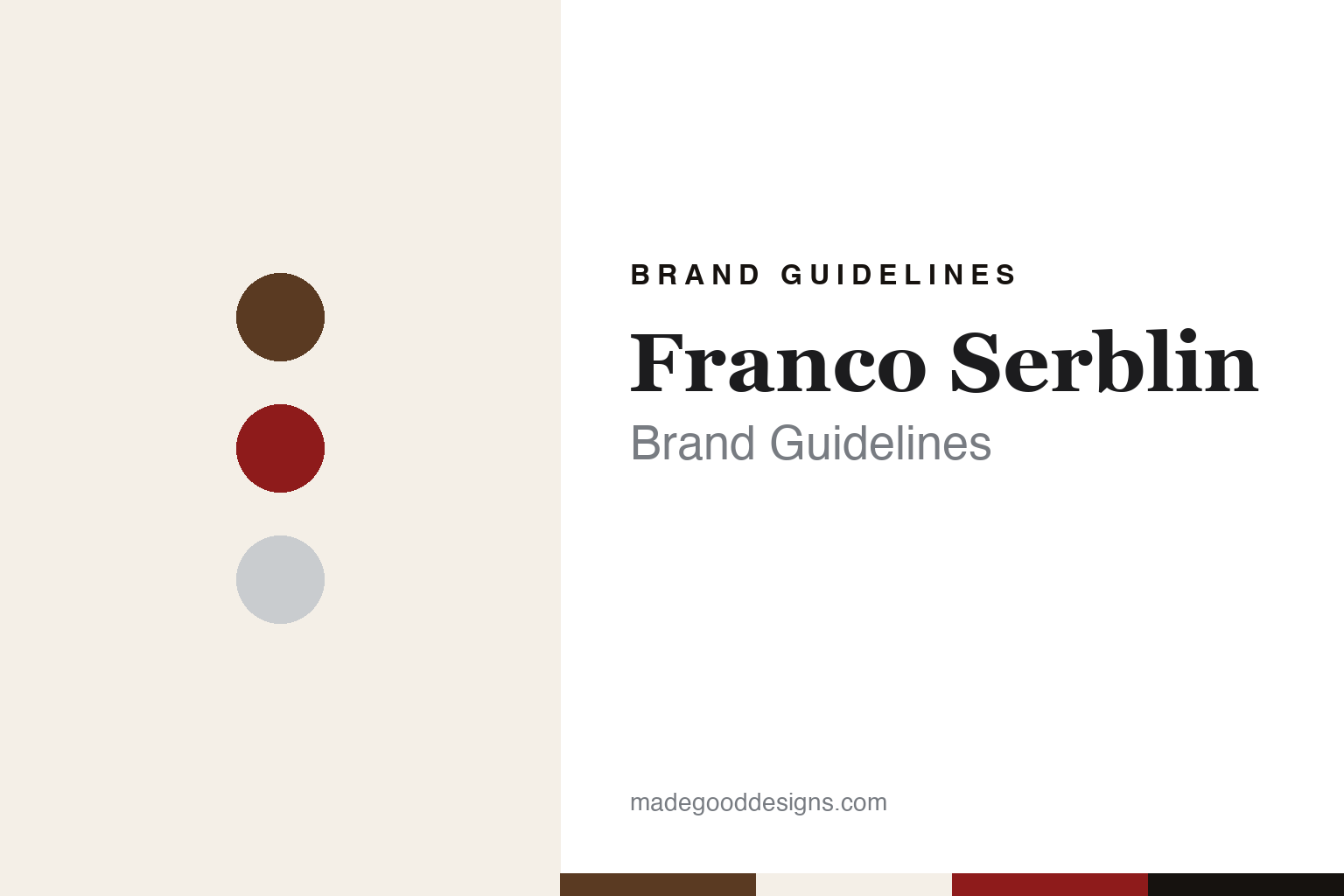
Two constants: a walnut, chrome and string-red palette and an instrument serif register. Abstract homage — not a Franco Serblin product or mark; no loudspeaker, logo or nameplate is reproduced.
The founder’s name
A second company, after Sonus faber.
The Franco Serblin brand carries the name of the man who founded Sonus faber. English Wikipedia gives his birth name as Gianfranco Serblin, born about 1939 in Vicenza, the youngest of seven children in a family whose father had come from Istria by way of Trieste; Italian Wikipedia says that at 18 he opened a dental laboratory with his siblings. His first loudspeaker, the “Snail,” followed in 1980 in a run of ten, and on 14 March 1983 he founded Sonus faber, both encyclopedias say. Sonus faber grew into a substantial company with a modern factory at Arcugnano, outside Vicenza, and Serblin left it in 2006.
Several English-language sources — Wikipedia, Hi-Fi News and Stereophile — describe that departure as coming after “33 years” or “a third of a century” at the company. The dates do not support it: 1983 to 2006 is 23 years, so we give the dates rather than the figure.
What came next was deliberately smaller. Stereophile, in Martin Colloms’s review of July 2024, says that in 2006 Serblin started a new venture with his son-in-law, beginning with precious-metal loudspeaker cables sold as Yter, before turning to loudspeakers. Hi-Fi News reported in 2020 that he first unveiled his flagship, the Ktêma, in 2010, after nearly five years of development, to be sold by “the new company bearing his name”; both Wikipedias date the Ktêma to 2011. Serblin died in Vicenza on 31 March 2013, aged 73, according to Italian Wikipedia.
Colour
Ktêma, Accordo and the instrument idea.
The flagship’s name comes from Greek. The company’s website explains Ktêma through the phrase “Ktêma eis aei” — “a possession for ever” — set against “panta rei,” everything changes: the idea was a loudspeaker meant to last rather than be replaced. The Ktêma is a four-way floorstander about 111cm tall, which Hi-Fi News put at 55kg each in 2020, with a soft-dome tweeter by Ragnar Lian, two small midrange units and two woofers firing from the back of a cabinet Serblin called a “triple arch” structure.
The Accordo — “chord” in Italian — is its opposite: a compact two-way speaker in an arch-shaped solid-wood cabinet, sold in mirror-imaged pairs, whose stand holds the crossover. Accounts differ on the order of the two: Stereophile places the Accordo before the Ktêma and Wikipedia lists it after, while Favella has said both were produced in 2010. The company says a pair has been permanently installed at Mozart’s birthplace in Salzburg since 10 April 2018.
Since Serblin’s death the range has grown around the Accordo. The website now lists the Lignea, a small floorstander whose cabinet is made from a single piece of solid wood and which the site calls “one of the last projects conceived by Franco Serblin”; the floorstanding Accordo Essence, reviewed by Hi-Fi News in January 2021; the larger standmount Accordo Goldberg, named after Bach’s Goldberg Variations and reviewed by Hi-Fi News in March 2024 and Stereophile in July 2024; and the Accordo Unica, a three-way floorstander whose cabinet, the company says, is built from 32 solid-walnut parts.
The design language is the thread. Writing in Hi-Fi News in 2020, Ken Kessler listed Serblin’s signatures as real wood in solid staves, rounded sculptural surfaces, grilles of tensioned “strings,” leather-clad baffles and unusual stands, and credited him with changing how domestic loudspeakers look, starting with the Snail and with cabinets he made for Cizek. The website frames it the same way, quoting Serblin: “Lutes and violin, through the use of wood, strings, their forms and harmony of their constitution, have inspired my systems.”
Typography
Design and documentation.
Italian hi-fi has long been judged on looks as well as sound. In the 1960s the Milan maker Brionvega worked with designers such as Marco Zanuso and Richard Sapper; its Doney television won the Compasso d’Oro in 1962, and in 1970 the award went to the company itself, according to Italian Wikipedia.
The loudspeaker story usually begins with Sonus faber, founded by Franco Serblin in 1983 and based at Arcugnano, outside Vicenza. Serblin left in 2006; in 2007 the brand passed to the Fine Sounds group, renamed McIntosh Group in 2016, and in November 2024 Bose announced it was buying McIntosh Group, Sonus faber included.
Italian magazines such as Audio Review and Fedeltà del Suono review the country’s equipment, and makers launch products at shows in Milan and at HIGH END, held for many years in Munich and, from 2026, in Vienna.
The makers in this guide are spread out. Franco Serblin’s studio gives its home as Vicenza; Rosso Fiorentino is at Bagno a Ripoli, outside Florence; Albedo’s maker is at Montelabbate in the Marche; Zingali is at Aprilia, south of Rome; and Indiana Line, a Turin name since 1977, has been owned since 2020 by the Polish distributor Audio Klan, Italian trade press reports. Riviera Audio Laboratories is named for the Ligurian coast its founders call home but is registered at Pozzuoli, near Naples. Diesis Audio is in Umbria, at Castel Ritaldi near Spoleto, according to its website and business-registry summaries.
This guide sets out what can be checked about each brand — who founded it, who owns it, and what it says about where its products are made — and marks clearly what rests only on the company’s own word.
Aa
An instrument serif — wood, strings and curves. (Specimen set in Lora, a serif STAND-IN; NOT the Franco Serblin logo.)
Who makes it now
A son-in-law and a workshop in Vicenza.
The loudspeakers are made by Laboratorium, the company of Serblin’s son-in-law, Massimiliano Favella. Hi-Fi News described Favella in 2020 as the owner of Laboratorium, maker of Franco Serblin loudspeakers, Yter cables and Flexum acoustic panels, and reported that he began at Sonus faber in 1995, spent his last two years there working with Serblin in research and development, left in 2001 and set up Laboratorium “a couple of years later.” “In 2010 Laboratorium produced Franco’s final loudspeakers, the Ktêma and Accordo,” Favella told the magazine. After Serblin’s death, the magazine reported, Favella took over; in 2024 he told it he was trying “to secure the future of this small but precious company.” In 2021 it said he had taken his time readying for production each of the four models “that he inherited.”
The brand’s website gives its home as Vicenza and says the products are “produced under licence” by Laboratorium. Stereophile lists the company as Franco Serblin/Laboratorium on Viale Riviera Berica in Vicenza, and Hi-Fi News names the maker as Franco Serblin Studio, Vicenza; a business-directory entry for Laboratorium S.r.l. at that address dates the limited company to 2010. The sources we checked mention no outside owner. The website lists distributors in several dozen countries, including Absolute Sounds in the UK and Axiss Audio in the US.
For a design guide, Franco Serblin shows how a designer’s name can carry a second company, with the look — wood, curves and strings — doing the work a logo might. Compare Sonus faber, the company he founded and left, and Rosso Fiorentino, another Italian loudspeaker maker that ties its name to Renaissance art. For this guide we use walnut, chrome and a deep string red with a serif, an unofficial interpretation; no product or logo is reproduced.
Explore & save
Keep Franco Serblin’s identity on hand — save it to a board in the Made Good inspiration library.
Franco Serblin identity set
Pin the Franco Serblin walnut, chrome and string-red palette and the instrument serif register to your own board.