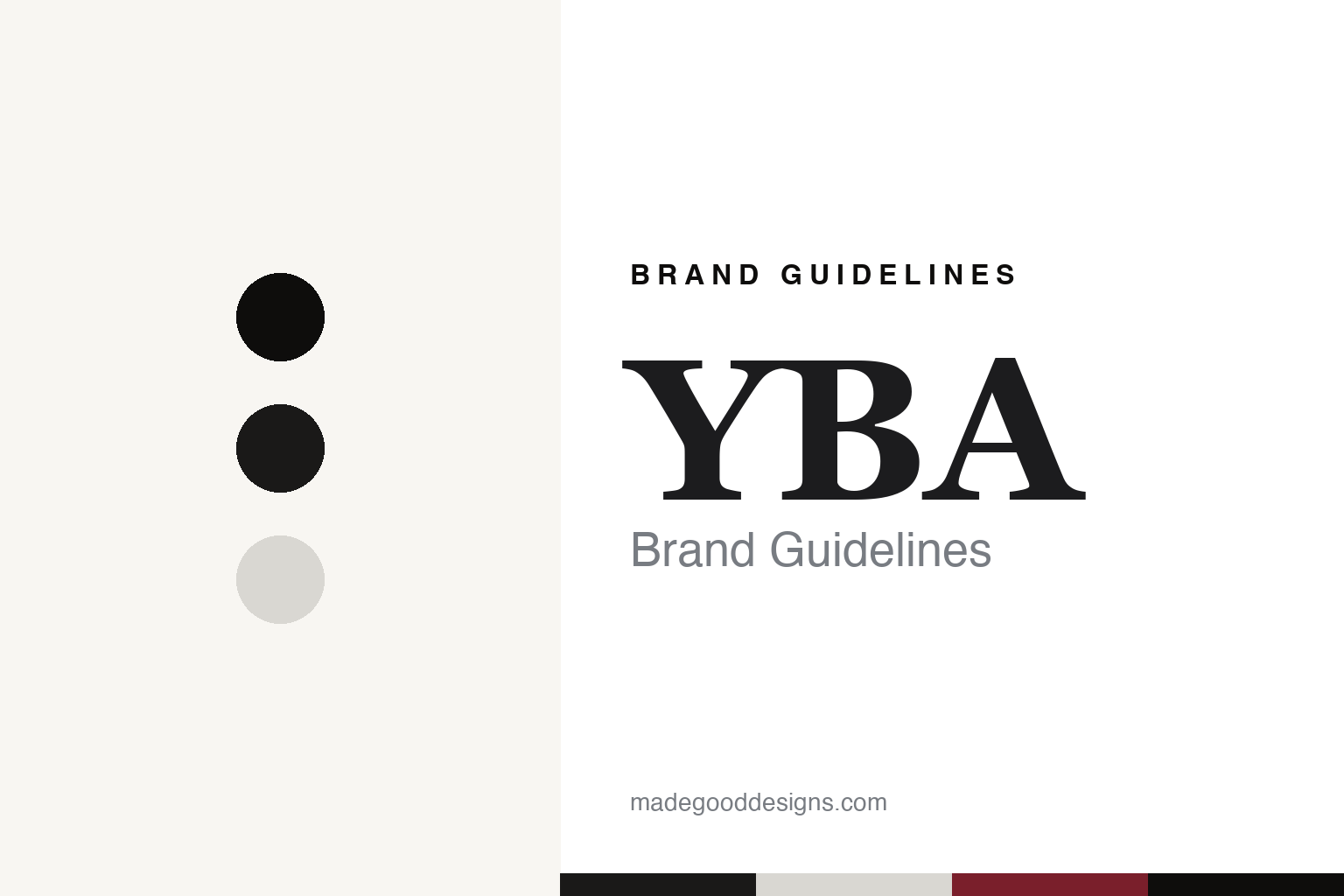
YBA Brand Guidelines
The amplifiers that carry their designer’s initials.
Aa
Two constants: a YBA black, silver and oxblood palette and an initialled serif register. Abstract homage — not a YBA product or mark; no device, logo or nameplate is reproduced.
Y.B.A.
An oboist, a laser lab and a set of initials.
YBA takes its name from its founder’s initials: Yves-Bernard André. The company’s website dates the brand to 1981 and calls him “an electronics professor”; in a 2004 interview with the French site Audiophile.fr, he described his own background in more detail. A player of the oboe — “particularly difficult to reproduce,” he said — he began in 1971 working for other French makers on loudspeakers (Perspective, Vecteur, France Acoustique), turntables (Goldmund and Vecteur) and electronics (Perspective, Goldmund, Nuance and Famco). From 1976, he said, he also carried out research in optics and lasers in a laboratory at the École Polytechnique.
In 1981, “after some ten years of collaboration with these manufacturers,” the first preamplifier and amplifier under the YBA name appeared, and their success, he said, “motivated the creation of the company.” Asked why the brand bore his name, he compared a designer to a craftsman or a winemaker who puts his whole person into the product, and named the French designers Jacques Mahul, Jean-Marie Raynaud and Pierre-Etienne Léon as examples. A French dealer’s history, published in 2016, adds that at the end of the 1970s he had designed an amplifier and preamplifier for an American maker that never paid him; we give that as the dealer’s account.
The model he singled out was the Intégré integrated amplifier, created in 1986 and still sold in 2004 as the Classic Intégré. He described it as the first integrated amplifier to rival far costlier separates — a claim, not a measurement. ON Mag wrote in 2011 that YBA, run with his wife Ariane, had been in the 1980s and 1990s “among the jewels of French hi-fi.”
Colour
Classic, Passion and a new logo.
The catalogue was organised into named lines. In the 2004 interview André listed the Signature line, the dual-power-supply CD 1 player and the Passion 1000 mono power amplifiers among the brand’s landmarks, and said they had made YBA “the only French brand” to appear without interruption in the annual “Recommended Components” list of the American magazine Stereophile, as well as winning prizes in Japan. We have not checked every year of that list, so we give it as his claim.
The year 2004 was a reset. The Classic range, in a “Delta” version since 2001, moved to a “Sigma” version; a cheaper Initial range was added for smaller budgets; and the Passion range grew with the Passion 600 and 400. André compared the lines to wine: the company had built its reputation on “white wines,” the Classic range, and now wanted “an exceptional red,” Passion. The same year brought, he said, “new products, new logo, new team … new communication” — a rare documented moment in the brand’s visual history, although he did not describe the logo itself.
The business was under pressure all the same. According to ON Mag, which reported in May 2011, YBA struggled with international competition at the turn of the century and was taken over in 2003 by Jérôme Schonfeld, a minority shareholder who became managing director and, the magazine said, put it back on its feet.
Typography
French hi-fi and its makers.
France has a long record in audio. Elipson, founded in 1938, is described by French Wikipedia as the country’s oldest high-end loudspeaker brand, and Cabasse, founded by Georges Cabasse in 1950, moved to Brest around 1960, the company says. Later came Focal, founded by Jacques Mahul in 1979 in the Saint-Étienne area which Belgium’s Barco agreed to buy, with Britain’s Naim, in 2026; the valve-amplifier maker Jadis, founded in 1983 and based near Carcassonne; Davis Acoustics, founded in 1986 and now in Troyes; and Devialet, founded in Paris in 2007.
Reviewing an Advance Paris CD player in 2025, Stereophile wrote: “Think French hi-fi and you think Focal, Triangle, Cabasse, Jadis, Devialet.” At home the trade gathers at the Paris Audio Video Show, held in October 2025 at the Palais des Congrès, and in magazines such as ON Mag.
The makers in this guide are spread across the country, according to their websites and the French company register: Cabasse at Plouzané, outside Brest; Triangle at Villeneuve-Saint-Germain, beside Soissons, in the Aisne; Elipson’s owner, AV Industry, at Champigny-sur-Marne, in the Val-de-Marne; Micromega, owned since 2021 by La Boite Concept, which assembles at Soorts-Hossegor, in the Landes; Atoll at Brécey, in Normandy; and Advance Paris in central Paris, with a design office at Brie-Comte-Robert.
YBA, named after its founder, Yves-Bernard André, is harder to place: China’s Shanling took a significant stake in it in 2009, What Hi-Fi? reported, and ON Mag wrote in 2025 that its products are designed in France but made under Shanling’s oversight.
This guide sets out what can be checked about each brand — who founded it, who owns it, and what it says about where its products are made — and marks clearly what rests only on the company’s own word.
Aa
An initialled serif — for a brand named after its designer. (Specimen set in Cormorant Garamond, a serif STAND-IN; NOT the YBA logo.)
YBA
A French name with a Chinese shareholder.
The decisive change involved China. What Hi-Fi? reported in May 2012 that YBA had “struck a deal with Chinese firm Shenzhen Shanling Digital Technology Development Company in 2009,” and that “the Chinese company took a significant shareholding stake in YBA.” YBA’s own website gives the same year and the same wording, adding that André “retained a shareholding in the company and continues to design products.” ON Mag, in 2011, dated the sale to a Chinese company to 2010, so sources differ by a year. A French dealer says YBA had already worked with Shanling for some twenty years on its cheaper lines.
For a while the brand all but disappeared from France: ON Mag wrote in 2011 that its workshops had “apparently been closed and relocated,” and quoted André as saying he and his children had taken shares again and that part of production would “certainly” return to France. In 2012 Shanling said the top Signature range “will continue to be built in France,” with the Passion, Heritage and Design lines below it; What Hi-Fi? named Jacki Pugh, formerly of Creek Audio, as chief executive, appointed at the end of 2011, the company says. YBA says it relaunched internationally in May 2012 and added a Genesis range in late 2013. By 2025 ON Mag described a hybrid: products “designed in France,” with manufacturing “under the aegis of Shanling.” The website’s motto is “Designed in France, made with Passion,” and it says André personally listens to products and gives them final approval. Its latest lines include the Design components of 2025–2026, a transportable SACD player and, in September 2026, a portable DAC, the VIBE P1. A domain note: yba.fr is now an unrelated beauty blog; the brand’s site is ybahifi.com.
For a design guide, YBA shows how a personal name can hold a brand together through a change of ownership and of country of manufacture. Compare Goldmund, where André once worked, and Atoll, another French amplifier maker. For this guide we use black, brushed silver and an oxblood red with a serif, an unofficial interpretation; no product or logo is reproduced.
Explore & save
Keep YBA’s identity on hand — save it to a board in the Made Good inspiration library.
YBA identity set
Pin the YBA black, silver and oxblood palette and the initialled serif register to your own board.