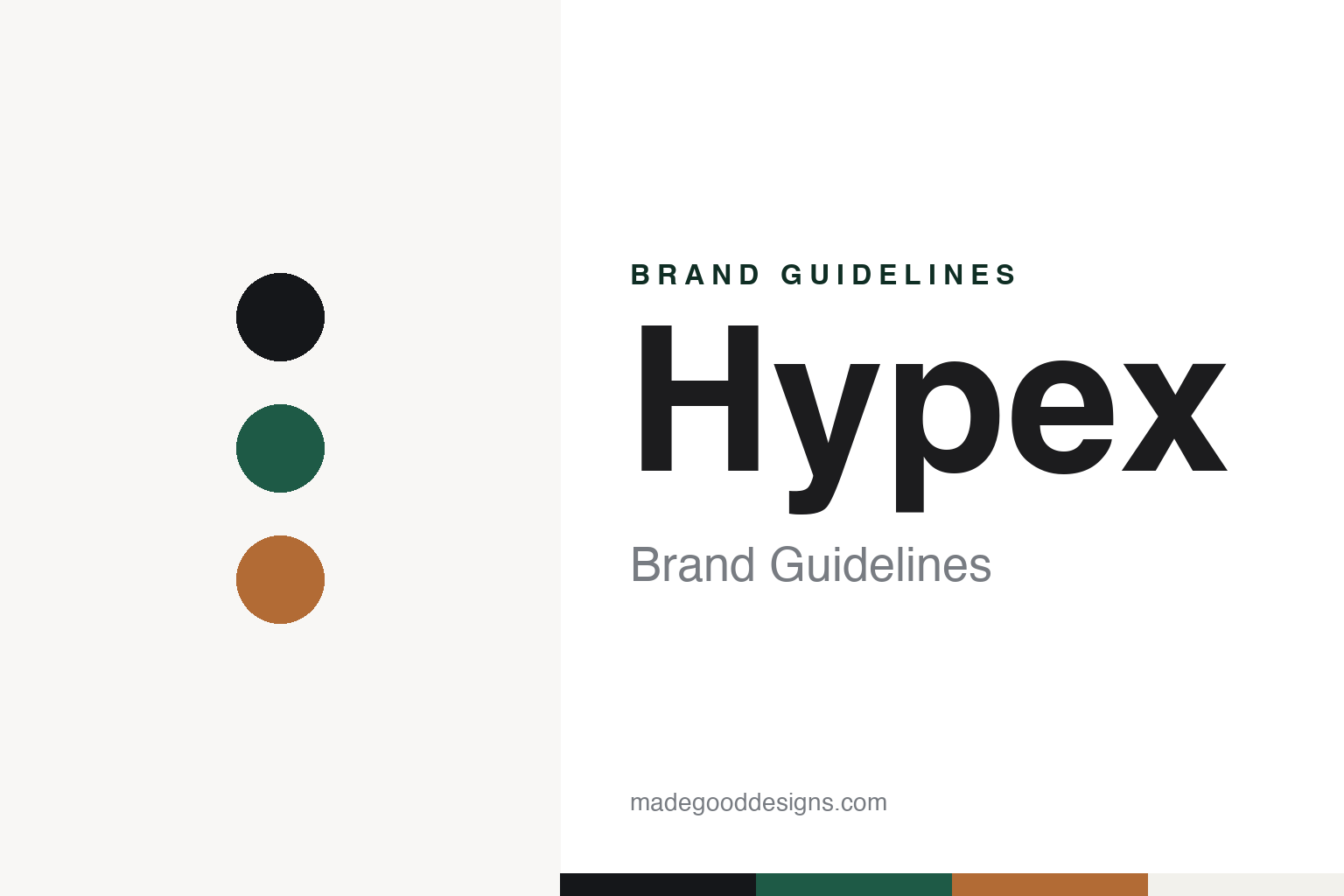
Hypex Brand Guidelines
The Groningen module maker behind UcD and Ncore.
Aa
Two constants: a Hypex black, board green and copper palette and a technical sans register. Abstract homage — not a Hypex product or mark; no module, logo or nameplate is reproduced.
Groningen, 1996
An upstairs apartment and hand-built amplifiers.
Hypex Electronics was founded in 1996 in Groningen, in the north of the Netherlands, by Jan-Peter van Amerongen. The company’s own history, published for its thirtieth anniversary in 2026, says he started in a small upstairs apartment, built the first amplifiers by hand and sold them through a local audio retailer. In a 2024 interview with audioXpress, the chief executive, Jan-Willem Winters, described the early Hypex as “a small company that designed and sold conventional plate amplifiers, Class-H amplifiers, that sort of thing.”
The company’s timeline says its modules appeared in a German audio catalogue in 1997 and 1998, bringing its first export orders, and that in 1999 it moved to its first dedicated premises, 250 square metres on the Ulgersmaweg in Groningen. A fire in a neighbouring unit damaged that building in 2003, the company says, before operations resumed.
In 2004, according to the same timeline, Hypex completed a new building at Kattegat 8, in the Eemspoort business area on the edge of the city, and moved in. It is still the address of Hypex Electronics B.V. A floor was added for research and development in 2013, and from 2021 the company also rented space across the road for a listening room and workshops.
Colour
UcD, Bruno Putzeys and Ncore.
The turn came with class D, the switching amplifier technology. According to Winters, van Amerongen “arrived with the first Class-D amplifier as developed by Bruno Putzeys at Philips,” and the first designs were made by van Amerongen “with remote help from Bruno.” Putzeys, a Belgian engineer at the Philips Applied Technologies lab in Leuven, told SoundStage! Ultra in 2014 that his best-known circuit, UcD or Universal class D, “was done in 2001,” and that Philips licensed it to Yamaha and Loewe but did not use it in its own products. Hypex says it introduced UcD in 2003, licensed from Philips; Winters names the UcD180 and UcD400 as the first modules.
Putzeys then joined Hypex. The company’s timeline says he began working for it in 2004 from his home above a bakery in Belgium, the start of its Belgian research arm, and that it rented the former bakery the following year; SoundStage! Ultra and English Wikipedia give 2005 as the year he left Philips, dividing his time between Hypex and Grimm Audio. At Hypex he developed Ncore, which he described as building “on from UcD”; Hypex launched it in 2011 with the NC400 module. English Wikipedia says he left Hypex in 2014 to co-found Kii Audio and, the same year, Purifi. Hypex moved its research from Belgium to Eindhoven in 2015, it says, and later followed Ncore with NCOREx in 2021 and Nilai in 2023, the latter sold only to home builders.
Manufacturing moved several times. Winters told audioXpress that local assembly in Groningen soon proved insufficient, so production went first to a company in Slovakia, then to Hansong Technology in China, and then to Malaysia. Sources differ on when the Malaysian operation began: Hypex’s timeline gives a 50/50 venture in 2011, its production page says large-scale manufacturing started in 2013, and Winters dated the joint venture to 2014. Hypex says it took full ownership in 2015. The factory, Seetek EMS Sdn Bhd, is described on the Hypex website as its “own Malaysian-based manufacturing affiliate,” with about 80 staff. English Wikipedia places the first plant at Simpang Empat in Penang and a 2017 move to Parit Buntar, and Hypex says the factory moved again in 2025, to its third Malaysian site.
Typography
Design and documentation.
The Low Countries have a long record in consumer audio. Philips, founded in Eindhoven in 1891 by Gerard Philips and his father Frederik to make light bulbs, introduced the Compact Cassette in August 1963 — developed, English Wikipedia says, by a team led by Lou Ottens in Hasselt, Belgium — and co-developed the compact disc with Sony; the first CDs went on sale in Japan in October 1982.
Philips is also part of the story of Dutch class-D amplification. The Belgian engineer Bruno Putzeys spent ten years at Philips’s Applied Technologies lab in Leuven, where he invented the “UcD” circuit, which Philips patented. Hypex, a Dutch company formed in 1996, began producing it in the early 2000s after Philips declined to use it, and in 2005 Putzeys left Philips to divide his time between Hypex and Grimm Audio, according to English Wikipedia.
The makers in this guide are spread across the Netherlands: Kharma in Breda; Grimm Audio in Veldhoven, beside Eindhoven; Siltech and Crystal Cable at the same address in Elst, in Gelderland; Hypex and Mola Mola at the same address in Groningen; and Dutch & Dutch in Capelle aan den IJssel, next to Rotterdam, according to their own websites.
A Dutch address does not always mean Dutch manufacture. Hypex has its own production facility in Malaysia, English Wikipedia says, and Dutch & Dutch buys its drivers and amplifiers from outside suppliers, The Absolute Sound reported in 2024.
This guide sets out what can be checked about each brand — who founded it, who owns it, and what it says about where its products are made — and marks clearly what rests only on the company’s own word.
Aa
A technical sans for an engineering company. (Specimen set in IBM Plex Sans, a sans STAND-IN; NOT the Hypex logo.)
Hypex
An OEM supplier with a Malaysian factory.
Today Hypex describes itself as a supplier, designer and manufacturer of class-D power amplifiers, power supplies, DSP solutions and plate amplifiers for hi-fi, high-end and professional audio. Most of its business is with other manufacturers — its website calls it “your OEM audio industry partner” — and its modules sit inside other brands’ loudspeakers and amplifiers; English Wikipedia names NAD, including the Masters Series M10, and TEAC’s AX-505 among the products that use its technology. Since 2016 it has also sold to hobbyists, first through DIYclassD.com and, since 2025, under the Hypex Direct name.
The company says its products are “manufactured in our own factory in Malaysia,” with stock held in Hong Kong and at its Groningen headquarters, and calls them “Dutch-designed and Malaysian-produced.” Groningen keeps research, planning, sales, support and a small warehouse, audioXpress reported in 2024, and Hypex also has a research office in Eindhoven. One 2025 review described Hypex as “owned by Seetek”; Hypex’s own account is the reverse, with Seetek as its factory.
Jan-Peter van Amerongen died in 2021. Winters, who joined Hypex straight after a graduation project and later led its research team, told audioXpress that when van Amerongen fell ill, “Jan-Peter asked me to take over his duties.” The company says it now has a team of about 30 and marked its thirtieth year in 2026. In 2012 van Amerongen and Putzeys also set up a consumer brand, Mola Mola, which gives Hypex’s Groningen address on its website.
For a design guide, Hypex shows how a maker of parts can become known by name even though most of its work sits inside other brands’ products. Compare Philips, whose lab produced UcD, and Mola Mola. For this guide we use black, circuit-board green and copper with a technical sans, an unofficial interpretation; no product or logo is reproduced.
Explore & save
Keep Hypex’s identity on hand — save it to a board in the Made Good inspiration library.
Hypex identity set
Pin the Hypex black, board green and copper palette and the technical sans register to your own board.