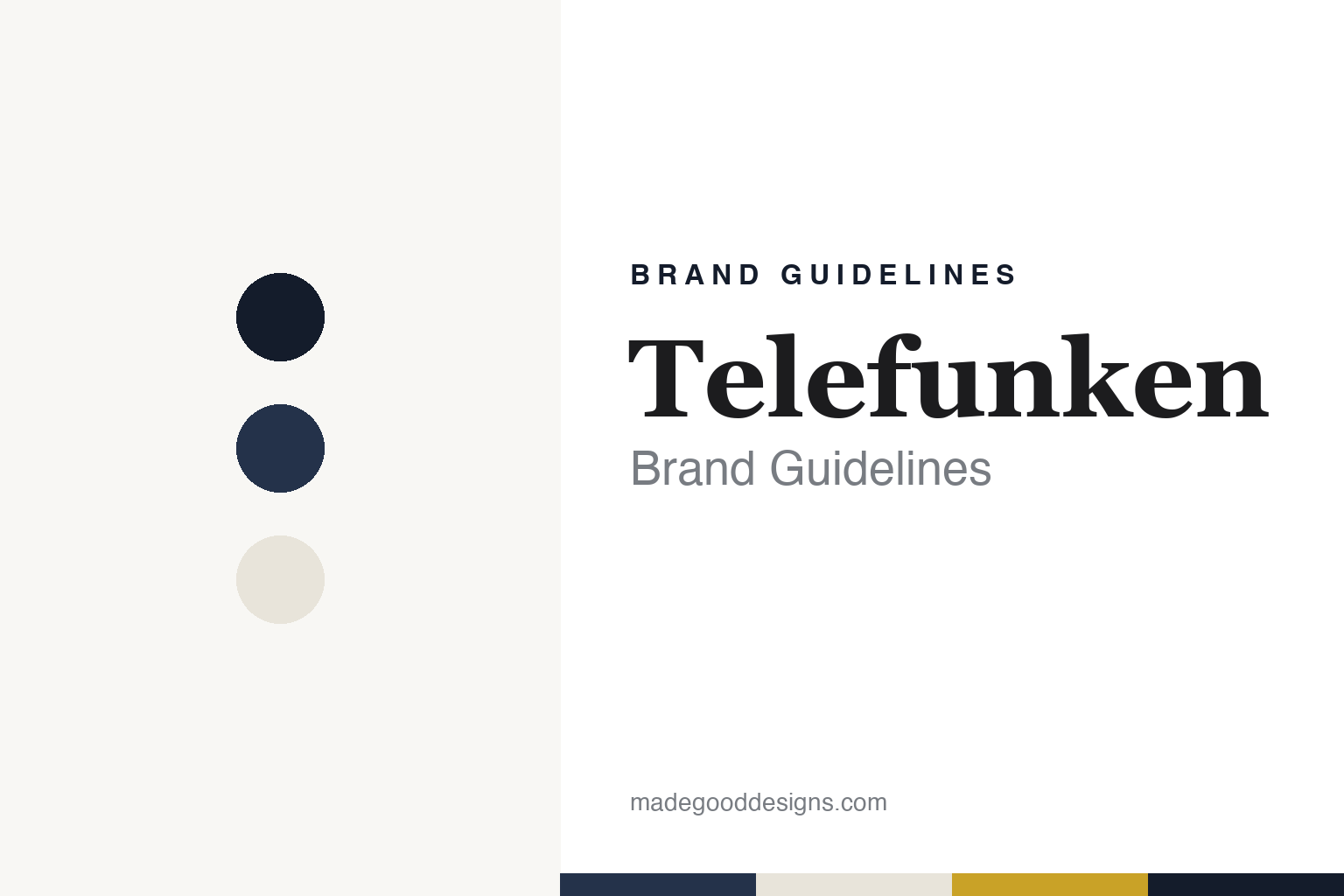
Telefunken Brand Guidelines
The 1903 wireless pioneer whose name outlived its factories.
Aa
Two constants: a navy, ivory and gold palette and an engineering serif register. Abstract homage — not a Telefunken product or mark; no radio, microphone, logo or emblem is reproduced.
System Telefunken
Two rivals, an emperor and a telegram address.
Telefunken was born from a patent fight. Around 1900 two German electrical giants were developing wireless telegraphy separately: at AEG, Adolf Slaby and Georg Graf von Arco worked for the Imperial Navy, while at Siemens & Halske a team around the physicist Karl Ferdinand Braun worked for the army. German Wikipedia says Kaiser Wilhelm II pressed the rivals to settle their patent disputes, and on 27 May 1903 they founded a joint company in Berlin, the Gesellschaft für drahtlose Telegraphie m.b.H., System Telefunken, each holding half of its 300,000 marks of capital.
The name was a practical one. “Telefunken” was the company’s telegram address — roughly “tele-sparks,” after the spark transmitters of the day — and it was registered as a trademark on 11 November 1903, German Wikipedia says. English Wikipedia dates the company’s logo to 1919 but names no designer, and we found no documented colours or typeface for it, so the palette in this guide is our own.
For most of the twentieth century the company sat inside a larger group. In 1941 AEG bought Siemens’ half, making Telefunken a wholly owned AEG subsidiary, and on 1 January 1967 the two merged as AEG-Telefunken, German Wikipedia says. The name came to stand for valves, radios, record players, televisions and professional broadcast equipment. English Wikipedia says Telefunken was the first company in the world to sell electronic televisions with cathode-ray tubes, in Germany in 1934.
Colour
PAL, microphones and a group in crisis.
Telefunken’s best-documented technical legacy is PAL, the colour-television system used across much of Europe and beyond for decades. German Wikipedia says it was developed at the company’s research institute in Ulm, founded in 1956, under the engineer Walter Bruch, and patented in 1962; its advantage over the American NTSC system was that it corrected colour errors automatically.
The name also appears on some of the most famous studio microphones, but the story needs care. The Neumann U 47, first shown in 1947, was made by Georg Neumann GmbH; English Wikipedia says units made before 1950 were distributed by Telefunken and carry its logo, and that the microphone depended on the Telefunken VF 14 valve, made exclusively for Neumann from 1946 to 1957. The vintage “Telefunken” microphones collectors prize, including the ELA M 251, were sold under the Telefunken name; who built each model is a question for specialist sources.
The group itself did not last. English Wikipedia says AEG-Telefunken collapsed in 1982. German Wikipedia says the consumer-electronics arm, Telefunken Fernseh und Rundfunk GmbH, went to the French group Thomson-Brandt in 1983–84, which then used the brand on its own products; in 1985 Daimler-Benz took majority control of AEG, which dropped “Telefunken” from its company name, and AEG was struck from the commercial register in 1996. From then on, “Telefunken” was increasingly a trademark rather than a manufacturer.
Typography
Design and documentation.
In the decades after the Second World War, Europe’s radio, television and hi-fi makers were household names. By the 1970s several were losing money. Norwegian Wikipedia says Tandberg faced strong competition from Japanese and other Asian producers and made losses from 1976; German Wikipedia ties Dual’s decline to Japanese competition, and English Wikipedia describes Far East competition in Lenco’s.
Some names were absorbed by larger groups. The French Thomson group took over SABA in 1980, after GTE left consumer electronics, then Dual in 1982 and Telefunken’s television and radio business in 1983–84. Philips took a 31.6 per cent stake in Grundig, with management control, in 1984.
Others failed. Lenco went bankrupt at the end of the 1970s, Tandberg in December 1978 and Dual in 1981; Grundig filed for insolvency in April 2003. Studer, a maker of studio equipment, took another path: Willi Studer sold it in 1990, and it passed to Harman in 1994.
Many of the names lived on as brands rather than factories. Grundig belongs to Turkey’s Arçelik; the Telefunken brand, licensed through Telefunken Licenses GmbH in Frankfurt, was bought by Gordon Brothers in 2023; SABA is a licensing brand of Talisman Brands; the Dual name in Europe belongs to Dual GmbH of Fuchstal, in Bavaria; Lenco to the Dutch Commaxx group; Studer to Canada’s Evertz; and the Tandberg video-conferencing company to Cisco.
This guide sets out what can be checked about each brand — who founded it, who owns it, and what it says about where its products are made — and marks clearly what rests only on the company’s own word.
Aa
An engineering serif for a 1903 wireless company. (Specimen set in IBM Plex Serif, a serif STAND-IN; NOT the Telefunken logo.)
Telefunken
One name, two very different businesses.
Today the Telefunken name belongs to two separate businesses, and it helps to keep them apart.
The first is the licensor. The trademark is managed by Telefunken Licenses GmbH, whose legal notice gives an address on Bockenheimer Landstraße in Frankfurt am Main. German Wikipedia says it has managed the rights since 2007; English Wikipedia says since 2004, so we note both. It does not make products itself. It licenses the name to other manufacturers — more than 50 partners in over 120 countries, German Wikipedia says. The best-known is the Turkish electronics maker Vestel, which has made Telefunken-branded televisions under licence since 2008 and, according to German trade press, has added large household appliances in Germany, Austria and Switzerland. German Wikipedia names further licensees, including the hearing-aid company Hörex Hörakustik from late 2019 and Eton Soundsysteme, a subsidiary of the German automotive supplier paragon, which announced Telefunken headphones and earbuds at IFA 2024. In August 2023 the US investment firm Gordon Brothers announced that it had acquired “the global consumer electronics brand Telefunken” from Hemjo Klein, described as the founder and former chairman of Telefunken’s holding company; Gordon Brothers had earlier revived Polaroid.
The second is Telefunken Elektroakustik, a professional-audio maker in South Windsor, Connecticut. The company says its founder, Toni Fishman, acquired the rights to the name and diamond logo for North America in 2000 and set up the business in 2001, starting by reverse-engineering a faulty switch on his own vintage ELA M 251 before building whole microphones. In 2009, after being designated the “Elektroakustik” arm of Telefunken Holding AG, it took its current name and gained rights to sell professional audio equipment under the brand in 27 countries, trade press reported at the time. It says its microphones are built in Connecticut, and in 2021 it marked its 1,000th reissued ELA M 251E. Fishman died in July 2024, Mix reported. Whether a given Telefunken product is a Frankfurt-licensed television or a Connecticut microphone, neither is made by the company founded in 1903.
For a design guide, Telefunken shows how a trademark can outlive its maker and be split between very different products. Compare Grundig, another German radio name with a new owner, and Philips. For this guide we use navy, ivory and gold with a serif, an unofficial interpretation; no product or logo is reproduced.
Explore & save
Keep Telefunken’s identity on hand — save it to a board in the Made Good inspiration library.
Telefunken identity set
Pin the Telefunken navy, ivory and gold palette and the engineering serif register to your own board.