Doepfer Brand Guidelines
The Gräfelfing maker whose A-100 became the Eurorack standard.
Aa
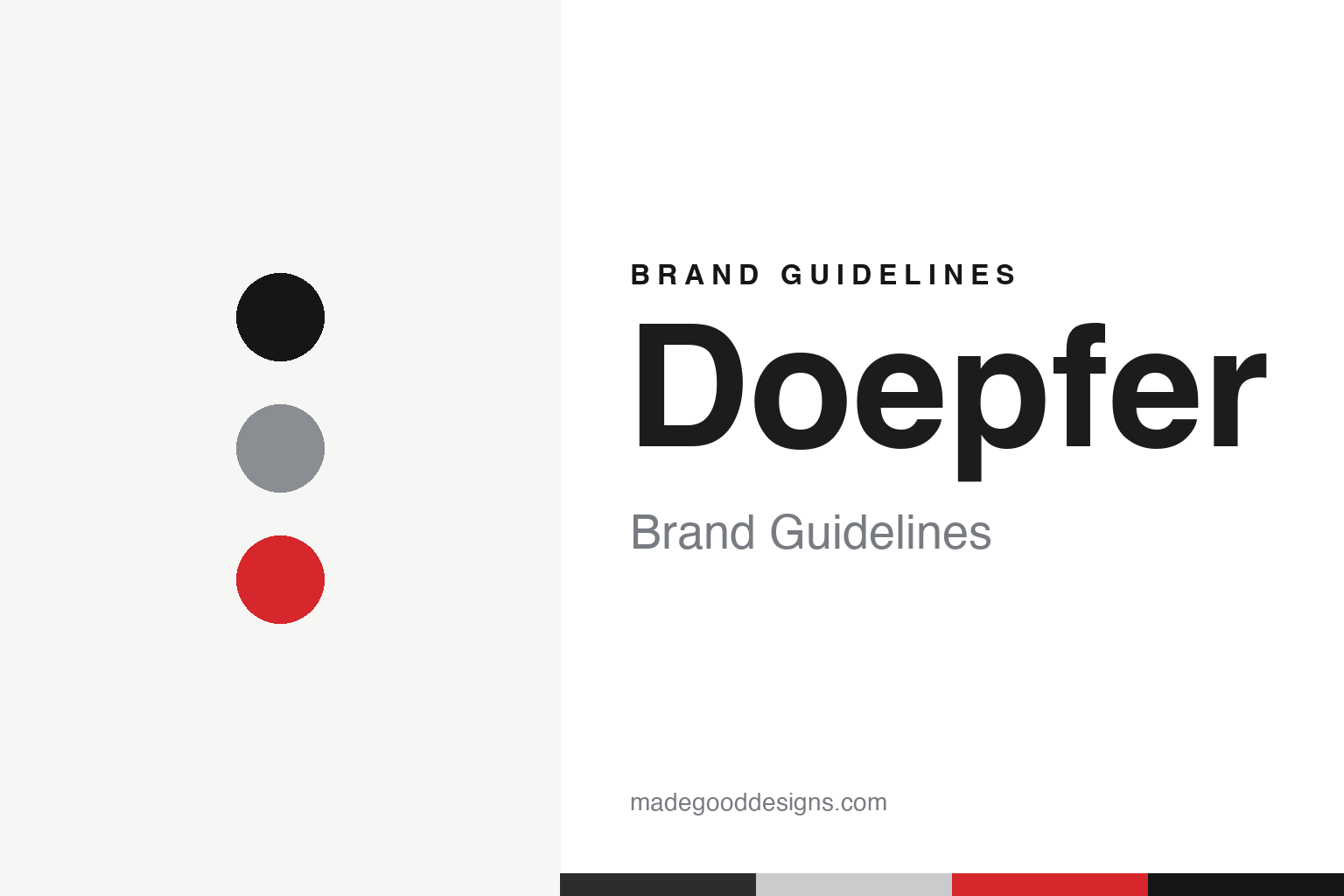
Two constants: a Doepfer aluminium, grey and LED red palette and a Technical sans register. Abstract homage — not a Doepfer product or mark; no module, logo or panel is reproduced.
From the Formant
A physics student, a DIY synthesizer and a Moog he could not afford.
Doepfer Musikelektronik GmbH is based in Gräfelfing, in the district of Munich in Upper Bavaria, and was founded by Dieter Döpfer, according to English and German Wikipedia; the company and the music press spell the name Doepfer. Neither article gives an exact founding year, and we have not found one in the other sources we checked.
“Everything began during my physics studies at the end of the ’70s,” Doepfer told Sound On Sound in April 2017. He played guitar in a band, repaired amplifiers and built his own effects, and wanted his guitar to sound like a Moog synthesizer he could not afford. Instead he built the Formant, a do-it-yourself modular synthesizer that the electronics magazine Elektor published in instalments in the mid-1970s, and then designed modules the Formant lacked: a voltage-controlled phaser, a frequency divider, an envelope follower. The company’s own timeline, drawn from a 1997 portrait in the German magazine Keys, dates the phaser to 1979. In a 2015 interview on the Ableton blog he called his “big break” the restoration, with a friend, of a Moog modular system that he says was the one used to record “Popcorn.”
A polyphonic modular system followed in 1980. Doepfer then became European distributor for Curtis Electromusic, whose CEM chips made synthesizer design easier, and his Voice Modular System of 1982 was, he told Sound On Sound, “the first time I was able to make a living from synth design.” When digital synthesizers cut demand for analogue ones, he turned to MIDI keyboards and controllers. English Wikipedia says the MMK2 keyboard of 1989 was used by Kraftwerk on stage for “Pocket Calculator,” and Sound On Sound wrote in 1998 that the MAQ16/3 step sequencer, which the company dates to 1992, was “developed with the help of Kraftwerk’s Florian Schneider.”
Colour
The A-100 and the format that others adopted.
The modular system came back through a small synthesizer. When prices for second-hand Roland TB-303s rose, Doepfer designed the MS-404, a MIDI-controlled analogue synthesizer the company dates to 1995. Its success, he told Sound On Sound, gave him “an opportunity to raise the modular synth from the dead,” and “the first modules were nothing more than circuits taken from the MS404 and converted into individual modules.”
That system was the A-100, and sources give two dates for it. The company’s FAQ says “We started in 1995 with the A-100,” Ableton’s 2015 interview also gives 1995, and English Wikipedia says the format was specified that year, citing a mailing-list review from December 1995. The company timeline and German Wikipedia put the first series of modules in 1996, followed by new series in 1997 and 1998.
The format’s dimensions came from existing laboratory and measurement-equipment standards, German Wikipedia says, and Doepfer published details of its power supply and internal wiring, so other makers could build compatible modules. A module is 3U, or 128.5 mm, tall and its width is counted in HP units of 5.08 mm, English Wikipedia says. Reviewing a system for Sound On Sound in July 1998, Chris Carter found a 6U aluminium rack case and modules with “3.5mm jack sockets and grey knobs, with small but legible lettering throughout and lots of bright red LEDs.” The base system of 23 modules cost £999 in the UK.
The format came to be called Eurorack. In the mid-2000s Cwejman, Make Noise and Tiptop Audio adopted it, English Wikipedia says; citing Sound On Sound, it counts about 80 manufacturers in 2013 and, citing the ModularGrid database, gives more than 600 manufacturers and 15,000 modules as of 2022. “I assumed it might last five or 10 years but never expected that, after 20 years, sales would still be growing,” Doepfer said in 2017.
The one thing he said he would change was the unboxed pin headers on the power bus, chosen to keep prices low, which let users plug a module in the wrong way round. The company FAQ says it moved to boxed headers in 2019, once they had become the market standard, and admits that at the start “the A-100 was a very small project” and no one could foresee a system with several hundred makers — our translation of the German.
Typography
Design and documentation.
Eurorack is a modular synthesizer format that English Wikipedia says was originally specified in 1995 by Doepfer Musikelektronik, Dieter Döpfer’s company at Gräfelfing in Upper Bavaria; Doepfer’s own timeline dates the first A-100 modules to 1996, and the company now says it receives ready-built modules from outside manufacturers, doing only final testing in-house. Other makers began building to Doepfer’s published specification in the mid-2000s, and by 2022, Wikipedia says, citing ModularGrid, more than 600 manufacturers offered over 15,000 modules.
The seven makers in this guide span that history. Tiptop Audio, which Wikipedia lists among the format’s mid-2000s adopters, says it has “joined forces” with Buchla to resume production of the Buchla 200 series, and its founder, Gur Milstein, told Sound On Sound in 2024 that he had built a factory in Thailand that makes all its products. 4ms Company says Dan Green founded it as a pedal business near Chicago in 1996, began designing Eurorack modules in Austin in 2009 and moved to Portland, Oregon, in 2012.
Intellijel is Canadian — “made with love by robots in Canada,” its website says — and Sound On Sound credits it with its own widely adopted 1U format. Noise Engineering, owned by the husband-and-wife team Stephen McCaul and Kris Kaiser, says its products are “designed and built in Southern California.” XAOC Devices described its team in 2021 as based in the suburbs of Warsaw; its manuals say “Made in the European Union.”
Mutable Instruments, Émilie Gillet’s company, worked from a Paris workshop and had its modules made in Normandy, its website said, until it shut down in December 2022. In the sources we checked, we found no record of any of the others being sold to an outside owner.
This guide sets out what can be checked about each brand — who founded it, who owns it, and what it says about where its products are made — and marks clearly what rests only on the company’s own word.
Aa
A technical sans — the register of small, legible panel lettering. (Specimen set in IBM Plex Sans Condensed, a sans STAND-IN; NOT the Doepfer logo.)
Doepfer
Built by contract makers, tested in Gräfelfing.
Doepfer remains the company Dieter Döpfer founded; we found no sale or change of ownership in the sources we checked. In 2017 Sound On Sound counted about 125 Doepfer modules on sale, with a new one designed every two to three months, and Doepfer said he had persuaded the successor company of Curtis Electromusic to bring back the CEM3340 oscillator chip. Besides A-100 modules and cases, the company’s product list today includes the Dark Time sequencer, the Dark Link and MCV4 interfaces, MIDI master keyboards and electronics kits for builders, while earlier instruments such as the Dark Energy synthesizer, the Schaltwerk and the Regelwerk are listed as no longer available. It sells through authorised dealers.
On where its modules are made, the company is specific. “We do no longer manufacture in-house but receive ready built and pre-tested modules from our manufacturers,” its A-100 FAQ says. “Only the final test and adjustment is still carried out in-house.” It does not say where those manufacturers are, so we do not describe the modules as made in any particular country.
In 2015 Doepfer told Ableton that the growth of other makers had helped his company, because their more unusual modules still needed “the standard modules that we make,” and predicted that once the hype subsided “only those manufacturers that offer high-quality products and good service will remain.”
For a design guide, Doepfer shows how a technical standard can become a brand’s main achievement. Compare Make Noise, one of the first makers to adopt the format, and Buchla, the West Coast modular pioneer. For this guide we use aluminium grey, knob grey and an LED red with a sans, an unofficial interpretation; no product or logo is reproduced.
Explore & save
Keep Doepfer’s identity on hand — save it to a board in the Made Good inspiration library.
Doepfer identity set
Pin the Doepfer aluminium, grey and LED red palette and the Technical sans register to your own board.