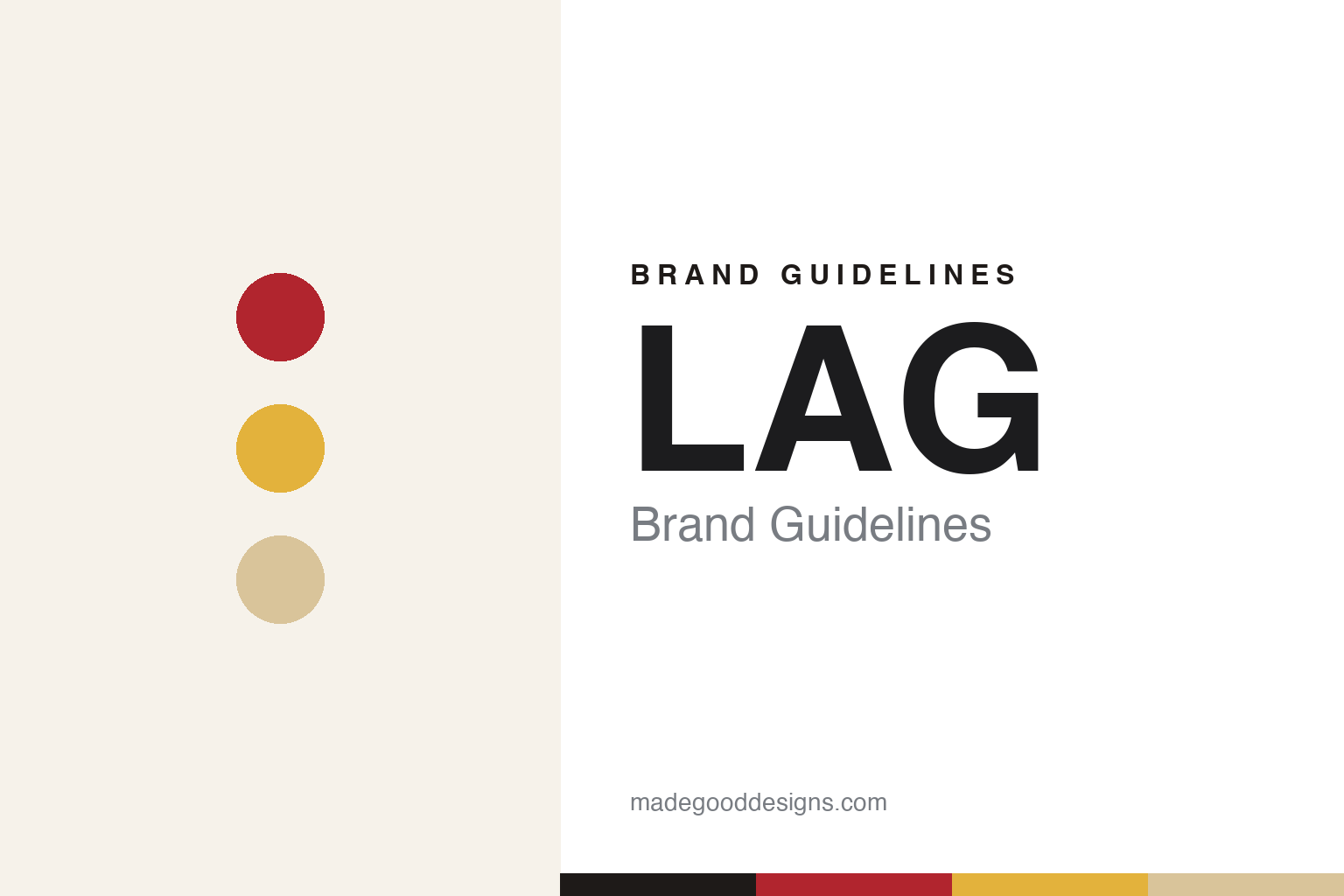
LAG Brand Guidelines
The Toulouse guitar maker that added a circumflex.
Aa
Two constants: an Occitan red and gold palette and a grotesque sans register. Abstract homage — not a Lâg product or mark; no instrument, logo or Occitan-cross inlay is reproduced.
Rue Laganne
A Toulouse workshop, a mother’s name and a street.
The guitars sold as Lâg — usually written LAG in English — did not begin in Bédarieux, the Hérault town most associated with them. They began in Toulouse. French Wikipedia says that in 1978 Michel Chavarria, a guitarist, singer and composer in the Toulouse progressive-rock group Madrigal, set up a lutherie workshop on the rue Laganne, in his grandfather’s former furniture-upholstery workshop, to repair, adjust and build guitars, and began making small numbers of his own designs from 1981. The company itself gives 1981 as “Lâg creation in Toulouse,” and Midi Libre told the same rue Laganne story in 2015.
The name has two sources, according to French Wikipedia: Lag was the maiden name of Chavarria’s mother and also a short form of the street’s name. The accent came later. Midi Libre reported in 2015 that a friend advised him to trade on what the world admired in France — gastronomy, luxury and, as the friend put it, the word “château” on Bordeaux wine — and that Chavarria then added a circumflex to his logo, turning Lag into Lâg, with a haute-couture spirit to match.
Early players included the French singer Renaud and AC/DC’s bassist Cliff Williams, French Wikipedia says. In 1983 the firm moved to larger premises as exports grew, and in 1992 Chavarria built a new factory at Bédarieux, in the hills of the Hérault north of Béziers, where production was partly mechanised; Midi Libre placed that workshop between Bédarieux and Hérépian. Buyers of made-to-measure models, French Wikipedia says, included Jean-Jacques Goldman, Michael Jones, Motörhead’s Phil Campbell, Keziah Jones and Neil Diamond.
Colour
Algam, Asia and the Occitan cross.
In 2002 Lâg was bought by Algam, the French musical-instrument distributor based at Thouaré-sur-Loire, east of Nantes, according to Midi Libre and Guitariste.com, both writing in 2016, and French Wikipedia; Lâg’s own timeline gives 2003, so we note both. Guitariste.com describes Algam as the company that grew out of Camac, a young distributor of the late 1970s, known to the French public through its La Boîte Noire du Musicien shops; its president, Gérard Garnier, is called the group’s founder in Lâg’s timeline.
Under Algam the brand became a volume business. Midi Libre reported in 2015 that Lâg was producing about 100,000 guitars a year, that production had multiplied fiftyfold between 2003 and 2014, and that the group owned factories in China and South Korea. Chavarria told the paper that the Bédarieux team of about a dozen designed the luxury electric models and some acoustics, which were “then adapted into mid and entry level in Asia,” making a Lâg available from €150. The company now says it “opened its own factory in Tianjin, China,” which its timeline dates to 2011, with a team of 110 led by Steve Kim, and that guitars are checked in the factory “and again in France.” The Tramontane acoustic range, launched in 2009 according to the timeline, runs from the 70 to the 318 series on the company’s site.
The brand also collected trade awards. At the NAMM Show in January 2012 Lâg was named acoustic guitar brand of the year for 2011 by American retailers, according to the magazine of Algam’s own shop network, which added that KORG USA then distributed the guitars in the United States and Canada. At the Frankfurt Musikmesse in April 2013 it showed the Roxane Racing electrics, styled after racing cars and built at the Bédarieux custom shop, and in 2013 it launched the Occitania classical guitars bearing the Occitan cross — the regional emblem that Midi Libre described in 2016 as sitting beside the Lâg logo on guitars “imagined and created in Bédarieux.”
Typography
Europe’s guitar makers.
The seven European and Japanese guitar brands in this guide have been owned and run in different ways: some are one-maker workshops, some sit inside larger music groups, and one has stopped trading.
In Germany, Framus was founded by Fred Wilfer in Erlangen in 1946 and went bankrupt in the later 1970s — sources differ on the year; his son Hans-Peter Wilfer revived the name in 1995 as part of Warwick, in Markneukirchen, English Wikipedia says. In Sweden, Hagstrom began in 1925 as Albin Hagström’s accordion business and made guitars at Älvdalen from 1958; the brand returned in the mid-2000s, and its website today is published by Musik Meyer of Marburg, Germany, its European distributor. In Finland, Ruokangas, founded by the luthier Juha Ruokangas in 1995, has worked from Harviala manor in Janakkala since 2011 and is solely owned by him, English Wikipedia says.
In France, LAG was founded in Toulouse in 1981 by Michel Chavarria and has belonged since 2002 to Algam of Thouaré-sur-Loire, near Nantes, French Wikipedia says.
In Japan, Tokai Gakki was founded in 1947 and is based in Hamamatsu, according to its website; English Wikipedia says the Grace Company bought it in 2021. Aria grew from Shiro Arai’s Nagoya trading company of 1956, Arai & Co. Fernandes, founded in 1969, stopped trading in July 2024, and a Tokyo court opened bankruptcy proceedings in July 2025, Tokyo Shoko Research reported.
Where the guitars are made varies too — French Wikipedia says LAG’s entry-level and mid-range guitars come from China and South Korea — and the makers do not always say.
This guide sets out what can be checked about each brand — who founded it, who owns it, and what it says about where its products are made — and marks clearly what rests only on the company’s own word.
Aa
A confident grotesque sans for a brand built on one accent mark. (Specimen set in Archivo, a sans STAND-IN; NOT the Lâg logo.)
Lâg
French history, made in Tianjin.
The Bédarieux era ended in 2016. Midi Libre reported that January that Algam had told the factory’s eight employees on 24 December that production would move to Thouaré-sur-Loire, and that Chavarria had written on Facebook that “part of my universe and my life is collapsing.” French Wikipedia, citing Ouest-France, says the move took place in June 2016, into a factory tripled to 10,000 square metres, with a stated aim of raising acoustic output from 250 to about 1,250 guitars a year. Guitariste.com reported in October 2016 that Chavarria had left after the relocation, and that Garnier would keep “100% French” manufacturing through a new high-end acoustic brand, Lâg & Dupont, made with the luthier Maurice Dupont at Thouaré. We could not confirm whether that French production continues today; the company’s English-language factory page describes Tianjin and speaks of Bédarieux in the past tense.
So the plainest answer to where a Lâg is made today is China, by the company’s own account, with a second round of quality control in France. The “French DNA” the company describes is real as history — Toulouse, Bédarieux, the circumflex — and as ownership, since Algam is a French group based at Thouaré. The current range spans Green Guitars, the Smart Guitars with built-in electronics, Tramontane, Escapade travel guitars and Tiki Uku ukuleles.
For a design guide, Lâg shows how much identity a single accent mark and a regional emblem can carry after production has moved. Compare Furch, which makes its acoustics in the Czech Republic, and Lowden, the Northern Irish acoustic maker. For this guide we use Occitan red and gold with spruce and a dark ink with a sans, an unofficial interpretation; no product or logo is reproduced.
Explore & save
Keep LAG’s identity on hand — save it to a board in the Made Good inspiration library.
Lâg identity set
Pin the Lâg Occitan red and gold palette and the grotesque sans register to your own board.