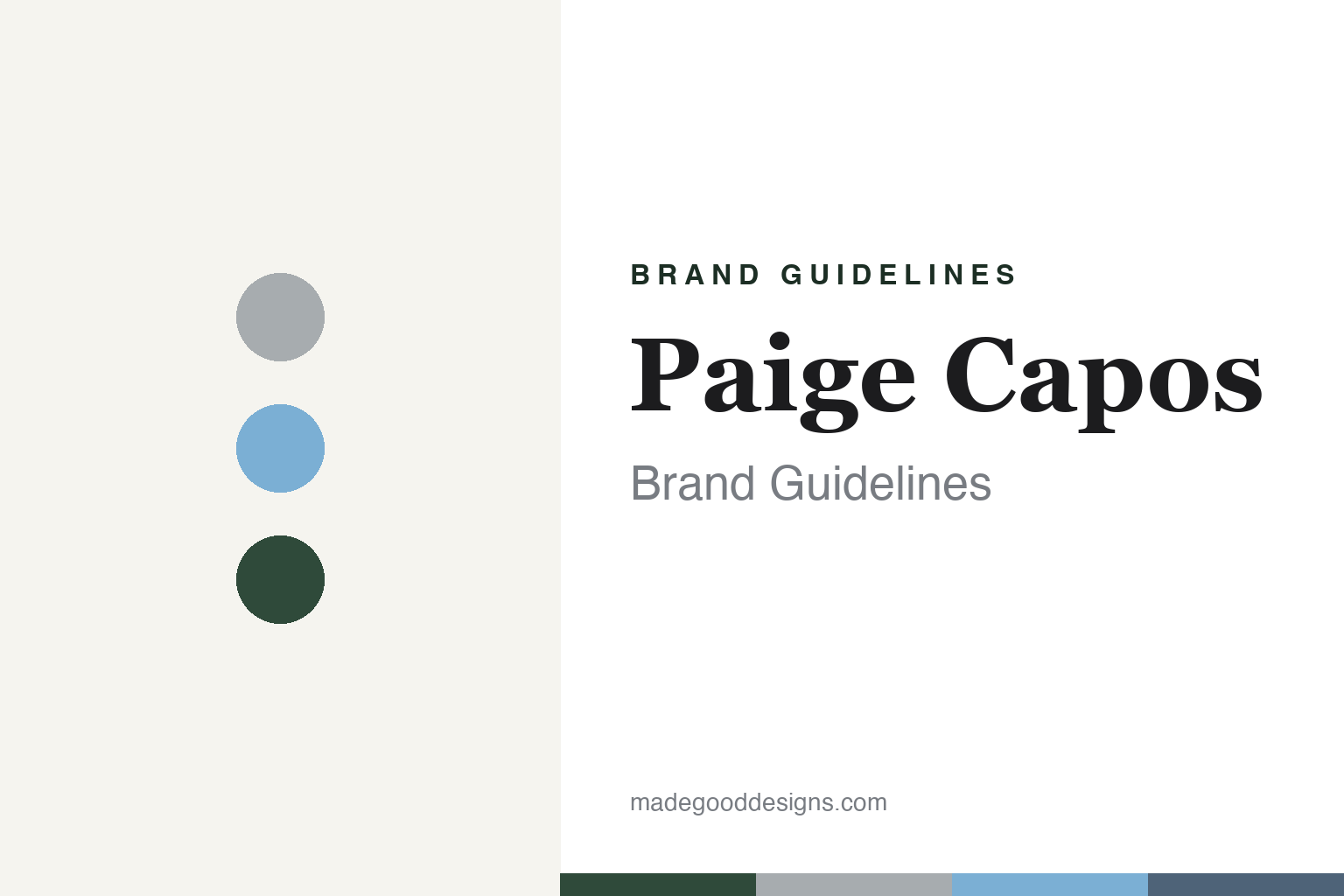
Paige Capos Brand Guidelines
The family capo maker from a Michigan tool-and-die shop.
Aa
Two constants: a stainless, green and Carolina blue palette and a workshop slab register. Abstract homage — not a Paige product or mark; no capo, logo or packaging is reproduced.
Tool and die
A father, a son and a bluegrass band.
Paige Musical Products is a family capo maker that began in a tool-and-die shop in Litchfield, Michigan. The company says Bryan Paige, a journeyman tool maker, and his father, Ralph Paige, opened the shop while playing bluegrass — Bryan on mandolin in his father’s band, R&L Express — and that the first Paige capo was made there. In 2021 Bryan Paige told Bluegrass Today that the shop built parts and fixtures for the automotive industry, and that his father played bluegrass guitar “like Lester Flatt did, with a thumbpick.”
The idea came from the market. In the late 1980s, Paige told the magazine, they noticed players offering up to $75 for old McKinney capos — a design that wraps round the neck and presses the strings from below — and began making stainless-steel capos for friends based on it, then built tooling to make them in quantity. At $29.95 in 1988, he said, these were too dear for pickers who could buy a Shubb for $14.95, so the company switched to cheaper, lighter models based on Tom McKinney’s original design, and built up a network of music retailers around the world.
The company dates its first capo to 1988. Its 2009 website said Bryan Paige built it that year for his own use, in a small workshop on his farm in southern Michigan, and that the Paige Capo was introduced to the market in 1989; its 1999 website spoke of “entering our 9th year of manufacturing.” The family secured a patent and took out ads in music magazines, the company says, but for years the tool-and-die business still supported Bryan’s growing family.
Colour
From the Original to the PaigePro.
The Paige capo is the kind that stays on the guitar. It encloses the neck, presses the strings from below and is tightened by a thumbscrew. Paige’s 2009 website described the aim as a capo that was ultra-thin, quick to move, could be stored on the instrument and, above all, did not pull the strings out of tune. The same site said the whole Paige line had been added to Fender’s wholesale catalogue, that the capo had won an Acoustic Guitar Players’ Choice award in 2004, and that an electric-guitar model was unveiled at the 2008 NAMM show in Nashville — claims we give as the company’s.
The range now has four series: the Original; the Clik, whose button bypasses the tension of the wheel so the capo can be moved quickly or parked behind the nut, as Bluegrass Today described it; the Spring; and the PaigePro. The magazine reported in November 2021 that the PaigePro, designed by Bryan Paige, replaced the usual sleeved bar with six individually sprung inserts, one under each string, adjusted by a left-handed double-lead thread — a system Paige calls ETI, for “enhanced tone innovation.” One patent had been granted, for the inserts, and another was pending, for the thumbscrew wheel; the capo was to list at $230, with a first serialised batch of 150. Its stainless parts are made by metal-injection moulding, and the company says the PaigePro won a grand-prize award for parts assembly with APG-MIM at the 2024 PowderMet conference, and that a banjo-capo assembly made with Nichols Portland won an award of distinction in 2025.
Models cover acoustic, electric, 12-string and classical guitar, banjo, mandolin and ukulele, and the company makes custom-radius capos for necks that depart from a 16-inch radius. In June 2026 it added colours, among them Carolina Blue and Crimson, to the Original series, sold on Amazon.
Typography
Capos, tuners and the accessory trade.
The seven makers in this guide each hold one corner of the guitar-accessory trade — straps, capos, tuners or picks — and most are still tied to a founder or a founding family.
Levy’s, which makes straps, was founded in 1973 by Dennis Levy, its 2009 website said, describing factories in Winnipeg and in Antigonish, Nova Scotia. In January 2019 Gator Co., the Tampa case maker, said it had acquired Levy’s the year before, and Levy’s now gives a Tampa address.
Three make capos. Shubb was formed in California in 1974 by Rick Shubb and Dave Coontz; Rick Shubb’s own history says a dedicated shop in Qingdao, China, was making about 80% of its capos by 2016, the year its founding partnership ended. Kyser says the machinist Milton Kyser had incorporated it in Texas by 1980, and that it makes its capos in Kaufman, Texas, under his great-niece Meredith McClung-Attebery. Paige, begun by Bryan Paige and his father Ralph in Michigan, says it now operates only from Erwin, Tennessee.
Two make tuners. Peterson Electro-Musical Products, founded by the inventor Richard H. Peterson, has been based in Alsip, outside Chicago, since 1964, its history says. Snark says it launched in 2010; in 2013 its warranty address was Evets Corporation’s, in Camarillo, California; English Wikipedia names Evets as the owner of Danelectro. Gravity Picks, the youngest, says it began in early 2011 and makes its acrylic picks in California.
This guide sets out what can be checked about each brand — who founded it, who owns it, and what it says about where its products are made — and marks clearly what rests only on the company’s own word.
Aa
A sturdy slab serif — a nod to the tool-and-die shop. (Specimen set in Bitter, a slab-serif STAND-IN; NOT the Paige logo.)
Paige
From southern Michigan to the Appalachians.
Paige has stayed in the family. As orders grew it became a standalone company and moved to Jonesville, Michigan, in the early 2000s, the company says, and by 2021 Bryan Paige and his wife, Lisa, were running it, Bluegrass Today reported. The magazine described Paige capos as made by the family in Michigan for 33 years, and in December 2021 Bryan Paige told The Hollywood Times, “Our products are made here in Michigan and we are proud to be a Family-owned business.”
In August 2024, the company says, the family moved both its manufacturing shop and its home from Michigan to the Appalachian mountains, drawn by years of bluegrass festivals and by the nearness of Nashville. Its own pages describe the new base in two ways: its “About” page says it now operates exclusively out of Erwin, in Unicoi County, Tennessee, while a post from August 2025 speaks of “the mountains of western North Carolina.” We give both. The company says that all Paige capos are manufactured in the United States and that every one is now made in its Appalachian facility; its website calls the business “Family-Owned & American-Made.”
For a design guide, Paige shows how a small family workshop can build a brand on plain function — its website asks for “a product that does what it should without any fuss.” Compare Shubb, the lever capo Paige priced itself against in 1988, and G7th, another capo specialist. For this guide we use stainless grey, Appalachian green and a Carolina blue with a slab serif, an unofficial interpretation; no product or logo is reproduced.
Explore & save
Keep Paige Capos’s identity on hand — save it to a board in the Made Good inspiration library.
Paige identity set
Pin the Paige stainless, green and Carolina blue palette and the workshop slab register to your own board.