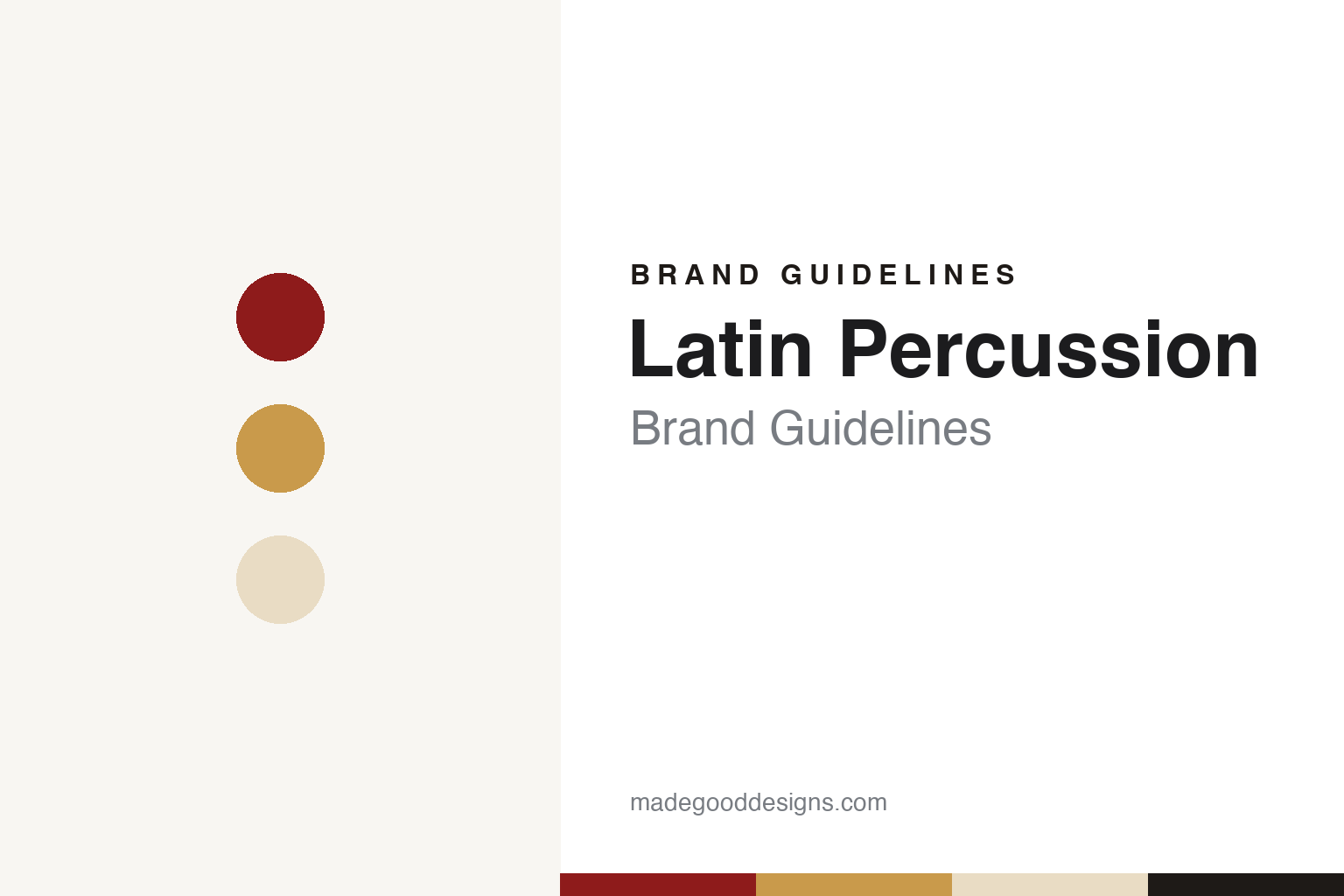
Latin Percussion Brand Guidelines
The engineer’s bongos that became a percussion standard.
Aa
Two constants: a conga red, oak and rawhide palette and a heavy sans register. Abstract homage — not an LP product or mark; no instrument, logo or badge is reproduced.
The embargo bongos
An engineer, a jazz club and a shortage of drums.
Latin Percussion — styled LP — was founded in 1964 by Martin Cohen, an engineer from the Bronx; English Wikipedia gives New York City as its birthplace. In a 2011 profile, The New York Times’ Lens blog said Cohen first heard Latin rhythms as a teenager when he sneaked into Birdland, where the vibraphonist Cal Tjader was playing, and later graduated from City College as a mechanical engineer. LP’s own history, as published on its website in 2011, dates that Birdland visit to 1956 and says he became a regular at Monday jam sessions led by the flautist Herbie Mann, with percussionists including Candido and José Mangual Sr.
The founding story turns on the US trade embargo against Cuba, which made good bongos hard to find. According to the Times, Cohen made his own set, machining the metal rim in the shop of the defence company where he worked. “I was promptly fired,” he said. LP’s 2011 history says he worked from photographs of Johnny Pacheco’s bongos, and that his first wooden shell, cut from wet wood on a Friday, had shrunk by a quarter of an inch by Monday. He delivered bongos and cowbells to musicians in paper bags and treated the clubs as his testing ground, the Times reported; by then he was living in New Jersey.
The company says Cohen worked his last day for an employer in August 1964 and started Latin Percussion full time, with a workshop in his basement and gas welding done in an unheated garage. Early work included cowbells made under contract for Rogers Drums and claves for the bandleader Charlie Palmieri, it says. Its first endorser, by its account, was the Afro-Cuban and jazz drummer Willie Bobo, and the conga player Carlos “Patato” Valdés advised on design in the early years; LP’s Patato model congas still carry his name.
Colour
From a jawbone that would not break to the Classic conga.
LP’s reputation rests on instruments that replaced fragile traditional ones. The drummer Specs Powell, of The Ed Sullivan Show, asked Cohen for a bongo stand, and Cohen designed a mount that did not need holes drilled in the shell, LP’s 2011 history says. Powell introduced him to Bobby Rosengarden, the Tonight Show drummer, who wanted a modern version of the jawbone, an animal’s jaw whose loose teeth rattle when struck. The result was the Vibra-Slap, which English Wikipedia dates to 1967 and LP calls its first patent. Rosengarden also asked for a sturdier cabasa; Cohen rolled a textured material taken from an elevator wall into a cylinder and wrapped it in bead chain, and LP calls the resulting Afuche/Cabasa its most successful patent.
English Wikipedia also credits LP with the jam block and granite blocks. The company says Cohen was one of the first makers of fibreglass congas, which dance bands liked for their volume; its LP60 conga, made for the 60th anniversary in 2024, was presented as a tribute to its first congas of 1967. Its first wooden conga, the Classic, followed in 1983 “after years of development,” the company says, with shells of Siam oak, a wood its Matador and Aspire lines also use.
In the late 1970s Cohen managed the Latin Percussion Jazz Ensemble, featuring Tito Puente, which the company says opened the European market; its website cites the group’s recording Live at Montreux 1980. In 2001 Cohen received a Special Recognition Award from the International Latin Music Hall of Fame, English Wikipedia says. The Times noted that he was also a prolific photographer of the Latin and jazz scene, with an archive running to hundreds of thousands of pictures.
Typography
Hand percussion and its makers.
The seven brands in this group make the instruments that sit around the drum kit: hand drums, cajóns, frame drums, tambourines, concert percussion and drumheads.
Two are hand-drum makers. LP, or Latin Percussion, was founded in New York in 1964 by Martin Cohen; Drum Workshop bought it from Fender’s Kaman Music business in 2014–15, and Roland bought Drum Workshop in 2022. Tycoon Percussion says it was founded in Bangkok in 1983 by Stephen Yu, a musician from Hong Kong, and that it is family-owned and makes its instruments in its own Thai factory.
Two work mainly in wood. Schlagwerk says it began in 1982, when two carpentry apprentices, Gerhard Priel and Bengt Schumacher, copied a Brazilian slit drum, and that it makes its cajóns at Gingen an der Fils, Germany, though its cajón cymbals are hammered in Turkey. Cooperman says Patrick Cooperman began making drumsticks and fifes in Mount Vernon, New York, in the 1950s, and that it has worked from a former sawmill in Bellows Falls, Vermont, since 2006.
Three make tambourines, concert percussion and drumheads. Rhythm Tech grew from the crescent tambourine of the session drummer Richard Taninbaum, which it says it introduced in 1980; its website calls it a division of JAM USA. Black Swamp Percussion was founded by Eric Sooy in Bowling Green, Ohio, dates itself to 1995 and now works from Zeeland, Michigan, calling its instruments “USA made.” Aquarian, founded in 1980 by Roy Burns and Ron Marquez, has made drumheads since 1987 and is based in Anaheim, California.
This guide sets out what can be checked about each brand — who founded it, who owns it, and what it says about where its products are made — and marks clearly what rests only on the company’s own word.
LP
A heavy, compact sans for a two-letter brand. (Specimen set in Archivo Black, a sans STAND-IN; NOT the LP logo.)
LP
Four corporate parents in two decades.
LP changed hands several times after its founder sold it. In October 2002 it was bought by KMC Music — Kaman Music Corporation, the musical-instrument arm of the Connecticut aerospace group Kaman — according to LP’s website at the time; the Times reported in 2011 that Cohen had stayed on as a consultant. In October 2007 Fender Musical Instruments announced an agreement to buy Kaman Music, whose brands then included Ovation, Gibraltar, Toca and LP, Premier Guitar reported; English Wikipedia gives 2008 for the purchase. In January 2015 Modern Drummer reported that Drum Workshop of California had finalised a deal with Fender to buy LP, Toca, Gibraltar, KAT and the Gretsch Drums licence from Fender’s KMC subsidiary, and that LP’s offices would stay in New Jersey. In September 2022 the Japanese electronic-instrument maker Roland acquired all of Drum Workshop’s outstanding shares, MusicRadar reported, with DW, LP included, to continue as a standalone unit; English Wikipedia puts the price at $65 million.
Where LP instruments are made is less clearly documented today. In 2011 LP’s website said more than 250 people worked at its manufacturing facility in Thailand, and called LP “the world’s largest producer of hand percussion instruments,” a claim we give as the company’s. The current lpmusic.com product pages we checked do not state a country of origin. The site now describes LP as appearing on “more recordings and live performances than any other brand,” also its own claim, and uses the slogans “We Are Rhythm” and “LP… The Original.”
For a design guide, LP shows how a two-letter mark can come to stand for a whole family of instruments, and how a brand built on musicians’ trust can outlast several owners. Compare DW Drums, its parent since 2015, Meinl, the Bavarian maker that competes with it in hand percussion, and Schlagwerk, the German cajón maker. For this guide we use a conga red, Siam-oak gold and charcoal with a heavy sans, an unofficial interpretation; no product or logo is reproduced.
Explore & save
Keep Latin Percussion’s identity on hand — save it to a board in the Made Good inspiration library.
LP identity set
Pin the LP conga red, oak and rawhide palette and the heavy sans register to your own board.

