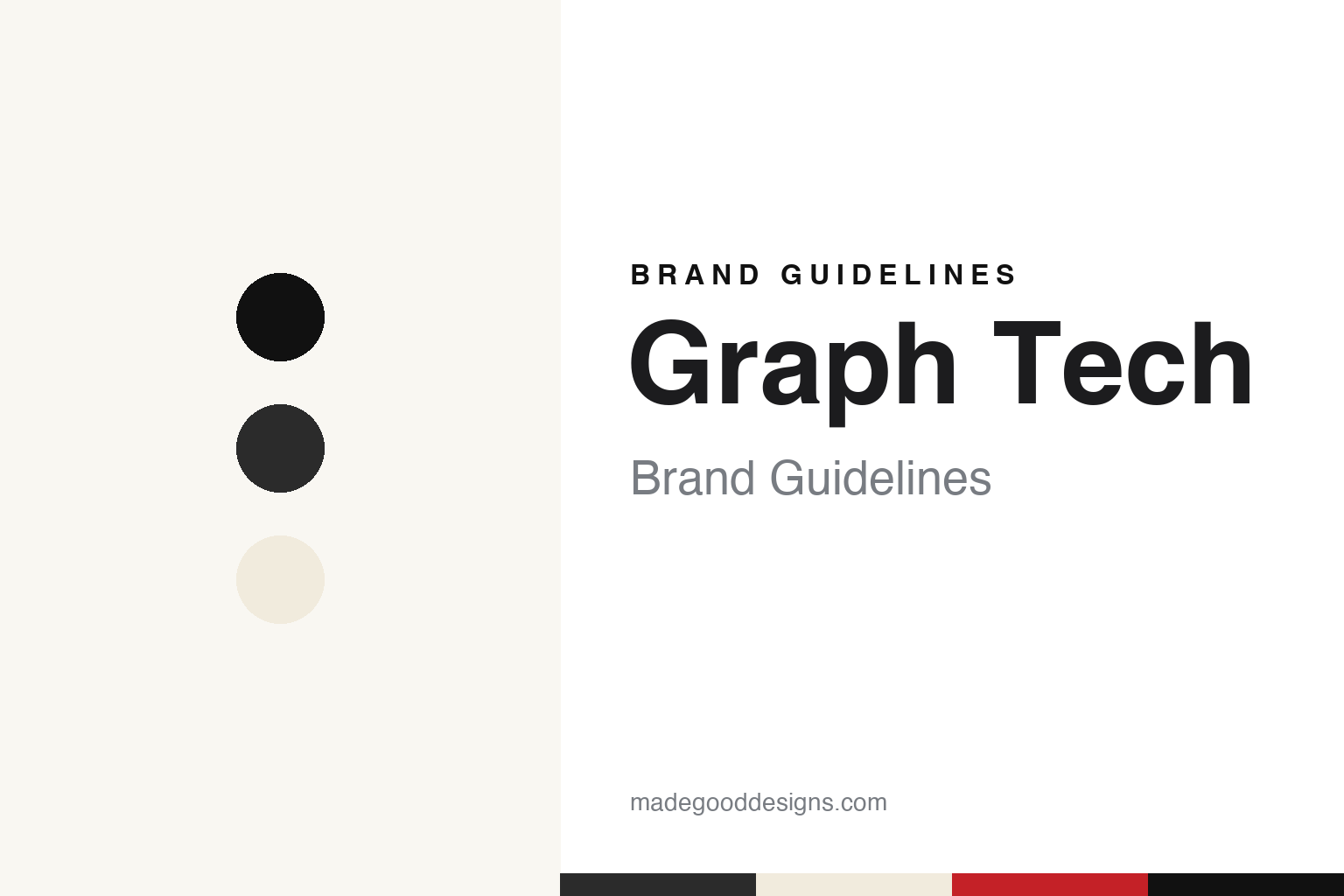
Graph Tech Brand Guidelines
The Vancouver maker of slippery nuts, man-made ivory and balanced-gear tuners.
Aa
Two constants: a graphite, ivory and red palette and a workshop sans register. Abstract homage — not a Graph Tech product or mark; no part, logo or packaging is reproduced.
A gig in Vancouver
One tremolo dive, one binding nut and a kitchen table.
Graph Tech Guitar Labs began with a problem every tremolo player knows. The company’s own story, unchanged in its essentials since at least 2005, says that in the early 1980s Dave Dunwoodie, playing a gig in his hometown of Vancouver, hit the vibrato arm on his first Fender Stratocaster — “he was a Gibson man,” the company adds — and the guitar went out of tune as the strings caught in the nut slots. “I went to do my first ‘wang’ and went totally out of tune,” he is quoted as saying. “I couldn’t use the guitar for stage work at all.”
Players at the time rubbed pencil lead into nut slots to help the strings slide. Dunwoodie began experimenting with composite materials instead, and the result, the company says, was the world’s first self-lubricating guitar nut, a formula it describes as “500% more slippery than graphite.” The NAMM Oral History programme, which interviewed Dunwoodie in January 2014 and lists him as the company’s founder, gives the same outline: he noticed guitarists’ reliance on pencil lead and set out to eliminate string binding.
The company dates its start to 1983. Its website in 2004 opened with “Founded in 1983, Graph Tech Guitar Labs of Vancouver, Canada is a leading edge manufacturing company specializing in advanced polymer guitar parts,” and today’s site lists “the world’s first self-lubricating nut in 1983” among its firsts and says the business “was started on a kitchen table.”
It stayed small for a long time. In March 2005 the company described itself as housing “the entire operation” in one facility in Vancouver with thirteen employees, with Dunwoodie involved “from product design and manufacturing to marketing and shipping.” It sold through distributors including All Parts, St. Louis Music, Stewart MacDonald and Moridaira in Japan, and its 2004 website listed 17 models of the Trem Nut, the self-lubricating nut, 15 of the String Saver saddle and 12 of TUSQ nuts and saddles.
Colour
Man-made ivory, slippery saddles and balanced gears.
Graph Tech’s range is built on materials. TUSQ, which it markets as “man-made ivory,” is a nut, saddle and bridge-pin material that the company calls “a proprietary material which is precision engineered under high pressure and heat.” It says TUSQ can raise a guitar’s harmonic content “by up to 200% in some frequencies” and contrasts it with bone, whose grain it says causes dead spots; those are the company’s claims. In 2005 it named Taylor, Gibson, Larrivée, Tacoma, RainSong and Ovation among guitar makers using TUSQ, and said the Trem Nut was used by Carvin, Parker, Brian Moore, Steinberger and the Fender Custom Shop. Later lines include TUSQ XL and Black TUSQ XL, and English Wikipedia’s article on the Epiphone Sheraton records a change to a Graph Tech NuBone XL nut.
The String Saver saddle, a lubricated polymer saddle, is meant to cut string breakage at the bridge; the company’s 2004 website cited US patent 4,960,027 for it. Graph Tech built a piezo pickup system around it, GHOST, which in 2005 combined String Saver saddle pickups with an Acousti-Phonic preamp and a Hexpander preamp with a 13-pin output for Roland guitar synthesizers. Its later ResoMax bridges use what it calls a patented magnetic lock to the posts.
The biggest later line is the tuner. In a release dated January 2013 from Delta, British Columbia, Graph Tech launched Ratio machine heads, calling them “possibly its greatest product innovation in 30 years.” The idea, the release says, went back 25 years, to a tremolo that would retune a guitar to open tunings: Dunwoodie found that thin-core strings need more turns to change pitch than thick-core ones. Ratio sets give each string its own gear ratio — on one six-string set, 39:1 for the low E and 12:1 for the high E — so that, the company says, “a half turn equals one semitone change on all strings.” It calls Ratio “the first and only machine head” to take string gauge into account, a claim we give as its own, and supplies the tuners with InvisoMatch mounting plates it says are patented. A more recent product, the Un-Lock Nut for Floyd Rose-style bridges, debuted at the 2024 NAMM Show, NAMM records.
Typography
Tuners, bridges and nuts.
The seven brands here make the hardware that keeps a guitar in tune: tuning machines, bridges and nuts. Three are tuner names with long histories. Grover’s machine heads come from a Cleveland company that took the name in 1952, when the Grossman family’s firm bought A. D. Grover & Son; English Wikipedia says it designs and imports its tuners. Kluson, founded as John Kluson’s Chicago machine shop in 1925, folded in 1981; WD Music Products of Florida revived the brand in 1994, and English Wikipedia says its tuners are now made in Korea. Schaller, founded by Helmut Schaller in 1945 and based at Postbauer-Heng near Nuremberg, has been owned by Lars Bünning since 2009 and says its hardware is “Made in Germany.”
Two American makers stress their factories. Sperzel says it has made tuning keys since 1977, from parts made in its own Cleveland factory. Hipshot says Dave Borisoff founded it in California in 1982 with a B-string bender worked from the hip; now based in Interlaken, New York, it makes tuners, bridges and detuners.
Floyd Rose is a bridge and a company. Floyd D. Rose began work on his locking tremolo in 1976 and patented it in 1979; English Wikipedia says Schaller made the Original in Germany from 1983 to 2024. The company says it is a division of AP International Music Supply and that its 1000 Series is made in Korea.
Graph Tech began with the nut. Founded in Vancouver in 1983 by Dave Dunwoodie around a self-lubricating nut, it makes TUSQ nuts and saddles and, since 2013, Ratio tuners, and says it ships from its own factory in Vancouver.
This guide sets out what can be checked about each brand — who founded it, who owns it, and what it says about where its products are made — and marks clearly what rests only on the company’s own word.
Aa
A plain workshop sans — part-number labels, not ornament. (Specimen set in Archivo, a sans STAND-IN; NOT the Graph Tech logo.)
Graph Tech
A founder-led parts maker in Metro Vancouver.
Graph Tech has stayed with its founder. The website named Dunwoodie as president in 2005 and does so today, and the 2013 Ratio release calls him “founder and president.” The company trades as Graph Tech Guitar Labs Ltd. and gives its address in Delta, British Columbia, in Metro Vancouver. Its shipping page says it is “located in Vancouver, Canada” and that courier orders ship “directly from our factory in Vancouver.” The product pages we checked do not say where its Ratio tuners or ResoMax bridges are made, so we leave that open.
Its claims of scale are its own. The website calls Graph Tech “the world’s largest manufacturer of guitar nuts, saddles, and bridge pins,” says its parts are factory-installed on more than 180 guitar brands and sold in more than 42 countries, names Fender, Gibson, Godin, Ibanez, Kala, Martin, Taylor, Warwick and Yamaha among the brands it supplies, and counts “65+ patents and trademarks.” Its motto is “products that really do what they say they will do,” backed by a 45-day “Love it or Return it” guarantee on direct orders; it also says none of its artist endorsers are paid.
For a design guide, Graph Tech shows how a components maker can build brands out of materials — TUSQ, String Saver, Ratio — that sit, mostly unseen, inside other companies’ guitars. Compare Gotoh, the Japanese tuning-machine maker, and Floyd Rose, which answered the same tremolo tuning problem with a locking nut rather than a slippery one. For this guide we use graphite black, an ivory white and a signal red with a sans, an unofficial interpretation; no product or logo is reproduced.
Explore & save
Keep Graph Tech’s identity on hand — save it to a board in the Made Good inspiration library.
Graph Tech identity set
Pin the Graph Tech graphite, ivory and red palette and the workshop sans register to your own board.