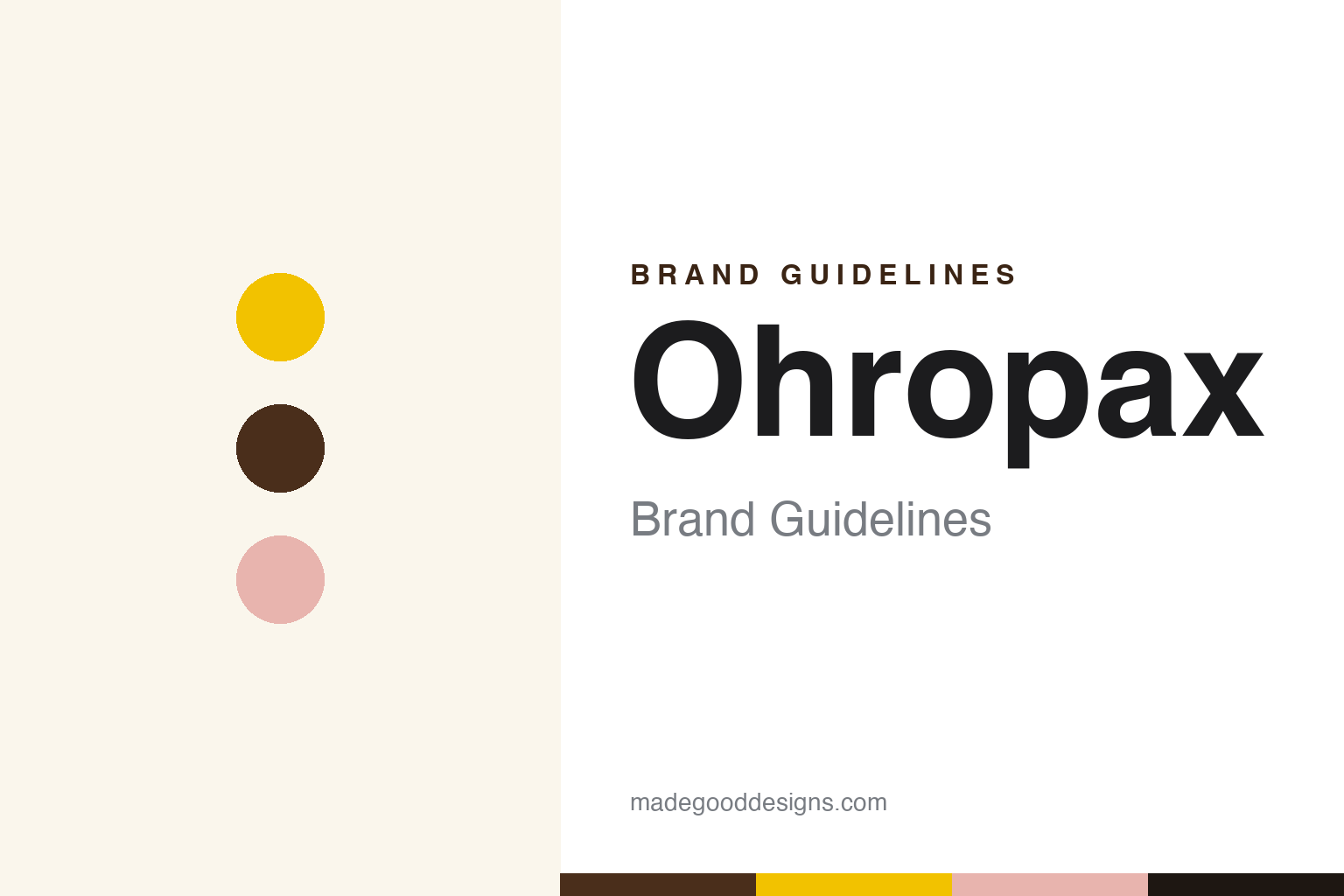
Ohropax Brand Guidelines
The Berlin wax earplug that has come in a yellow tin since 1908.
Aa
Two constants: an Ohropax yellow, brown and wax pink palette and a heavy grotesque sans register. Abstract homage — not an Ohropax product or mark; no tin, logo or packaging is reproduced.
Max Negwer’s factory
A Berlin pharmacist and a line from Homer.
Ohropax began in Berlin. The company says its founder, Maximilian Negwer, was a pharmacist and druggist born in Silesia in 1872, who moved to Berlin in 1900 and opened a drugstore in Kreuzberg in 1901, selling a stain remover and herbal sweets of his own. On 17 October 1907, it says, he founded the “Fabrik pharmazeutischer und kosmetischer Spezialitäten Max Negwer” — a factory for pharmaceutical and cosmetic specialities — in Berlin-Schöneberg. German Wikipedia gives the same name and the same year.
The idea came from Homer. Odysseus stopped his crew’s ears with beeswax so they could sail past the Sirens, and Die Welt, in a 2014 report from the Catholic news agency KNA, says it was this story that gave Negwer the idea. Plain beeswax softened and broke up, so, the company says, he soaked cotton wool in a mix of neutral waxes and petroleum jelly and rolled it into balls that held together and could be moulded to the ear. The company also names Jenny Preiss as part of the circle of friends in which the idea came up; German Wikipedia says she registered a utility model for a noise protector in 1912 that Ohropax used, and that Negwer paid her a licence fee while it ran.
The name joins the German Ohr, ear, and the Latin pax, peace. The first packs went on sale in the autumn of 1908: a tin of six pairs of wax balls for one Goldmark, sold in medical-supply shops and department stores, German Wikipedia says. The company calls it the “first usable quiet product for everyone” and says the trademark was registered in 1911. Sales were slow at first. “From 1912 it seems to have got going to some extent,” Michael Negwer, the founder’s grandson, told KNA.
Colour
War, a divided country, and a move to the Taunus.
The First World War made the brand known. German Wikipedia says a general recommended Ohropax to the war ministry in August 1914 and that the army introduced it in 1916; the company dates its place in army kit to 1917. The firm’s archive in Wehrheim holds an army order from 1917 for 10,000 tins, Die Welt reported in 2014, and a special edition was sold as a gift for soldiers at the front. Period packs promised protection “against the sound of cannon fire”; Michael Negwer told KNA the plugs would not stand up to artillery noise and helped at best against the constant activity and lack of sleep in the trenches.
The company moved from Berlin to Potsdam in 1924 and stayed there until 1958, it says. From 1930 it advertised heavily, with an oversized model ear in pharmacy windows, and from 1936 it exported to more than 40 countries, among them Austria, Switzerland, the Netherlands, Britain and Italy. After Maximilian Negwer’s death, the company says, his wife Erna ran the business, and production stopped near the end of the Second World War.
Germany’s division split the brand in two. The company says Wolfgang Negwer, a son of the founder, set up a second site in Frankfurt am Main in 1950 and moved it to Bad Homburg a year later, while in East Germany production passed in 1958 to a state-owned pharmaceutical works in Königsee, in Thuringia. For more than three decades, it says, two separate Ohropax productions existed, one in each Germany, until reunification.
In 1991 Michael Negwer took over the management and moved the business to Wehrheim in the Taunus, north of Frankfurt. Until 1990 every ball was shaped by hand, Die Welt reported in 2006; in Wehrheim machines took over.
Typography
Seven brands, seven origins.
The seven brands in this group all sell earplugs, but they come from very different places and decades. The oldest is German and more than a century old; the newest names arrived in the 2010s, selling online and, in one case, through crowdfunding. What they share is a product people put in their ears to turn the world down, sold to concert-goers, musicians, sleepers and travellers.
Three are new names built around filtered plugs for music and nightlife. Loop is a Belgian company founded in 2016 by the childhood friends Maarten Bodewes and Dimitri O., according to Wikipedia and the company, and CNBC reported in 2023 that it was headquartered in Antwerp. Eargasm says it is based in Southern California and was founded in 2015 by Ryan Parry. Earasers belongs to Persona Medical of Florida, whose president, Don Campbell, designed the soft silicone plug, the company says.
Two date from the 1990s. Alpine Hearing Protection says it was founded in the Netherlands in 1994 as a pioneer of reusable filtered earplugs for the general public. In 2025 the Belgian investor Gimv announced it was taking a majority stake. ACS says it was established in 1994 to make custom-fit hearing protection, and describes itself as a privately owned UK company that also makes in-ear monitors.
The last two are the outliers. Flare Audio began as a three-person pro-audio maker in a garden garage on England’s south coast, it says, before crowdfunding its Isolate ear protector; Companies House lists Flare Audio Limited, of Lancing in West Sussex, as incorporated in 2007. Ohropax was founded in Berlin in 1907 by the pharmacist Maximilian Negwer, is still run by his family, and makes its wax plugs in Wehrheim, near Frankfurt.
This guide sets out what can be checked about each brand — who founded it, who owns it, and what it says about where its products are made — and marks clearly what rests only on the company’s own word.
Aa
A heavy grotesque sans — for a brand known by its yellow tin. (Specimen set in Archivo, a sans STAND-IN; NOT the Ohropax logo.)
Ohropax
A yellow tin, pink wax and a family firm.
Ohropax is still a family business. German Wikipedia names Michael Negwer, the founder’s grandson, as head of Ohropax GmbH, with about 40 staff; the company’s legal notice lists him and Wolfgang Flohr as managing directors, and the company calls itself a medium-sized family firm. In 2006 Die Welt visited the Wehrheim factory and found nearly 30 staff and two production lines turning out about 25 million wax balls a year from wax melted at 80 °C, mixed with cotton, pressed through tubes and cut; in 2014 Negwer gave KNA a figure of 30 million, and German Wikipedia, citing the company, now gives more than 35 million. The company says it builds most of its production machinery itself. German Wikipedia says the firm makes only its wax products itself; the foam, silicone and filter plugs it has added since the 1990s are sold under its name.
The look has been steady. Die Welt described the product in 2006 as pink wax balls in a small yellow tin, and the company says a 1975 redesign of the twelve-piece tin stressed the contrast between dark brown and strong yellow, before a plastic box replaced the tin; until the 1980s, German Wikipedia says, each tin held a small wire tool for lifting the balls out. In 2024 the company redesigned all its packaging in what it calls a modern, colourful style. It says its plugs reduce noise by between 21 and 35 dB depending on the model, as SNR ratings, and that its Good Night silicone plug was rated best in a Stiftung Warentest earplug test in issue 09/2024.
The company’s slogan is “Erfinder der Ruhe” — inventor of quiet — and it quotes Franz Kafka, who, it says, wrote to a friend in 1922 that he could not manage “without Ohropax day and night.” In 2006 Die Welt put the brand’s fame alongside Tempo, Nivea and Tesa; the company says it is the market leader in sales to German consumers.
For a design guide, Ohropax shows how a single pack colour and a plain product can carry a name for more than a century. Compare Etymotic, the American lab behind the musicians’ earplug, and Westone, the Colorado earmould maker. For this guide we use tin yellow, dark brown and wax pink with a sans, an unofficial interpretation; no product or logo is reproduced.
Explore & save
Keep Ohropax’s identity on hand — save it to a board in the Made Good inspiration library.
Ohropax identity set
Pin the Ohropax yellow, brown and wax pink palette and the heavy grotesque sans register to your own board.