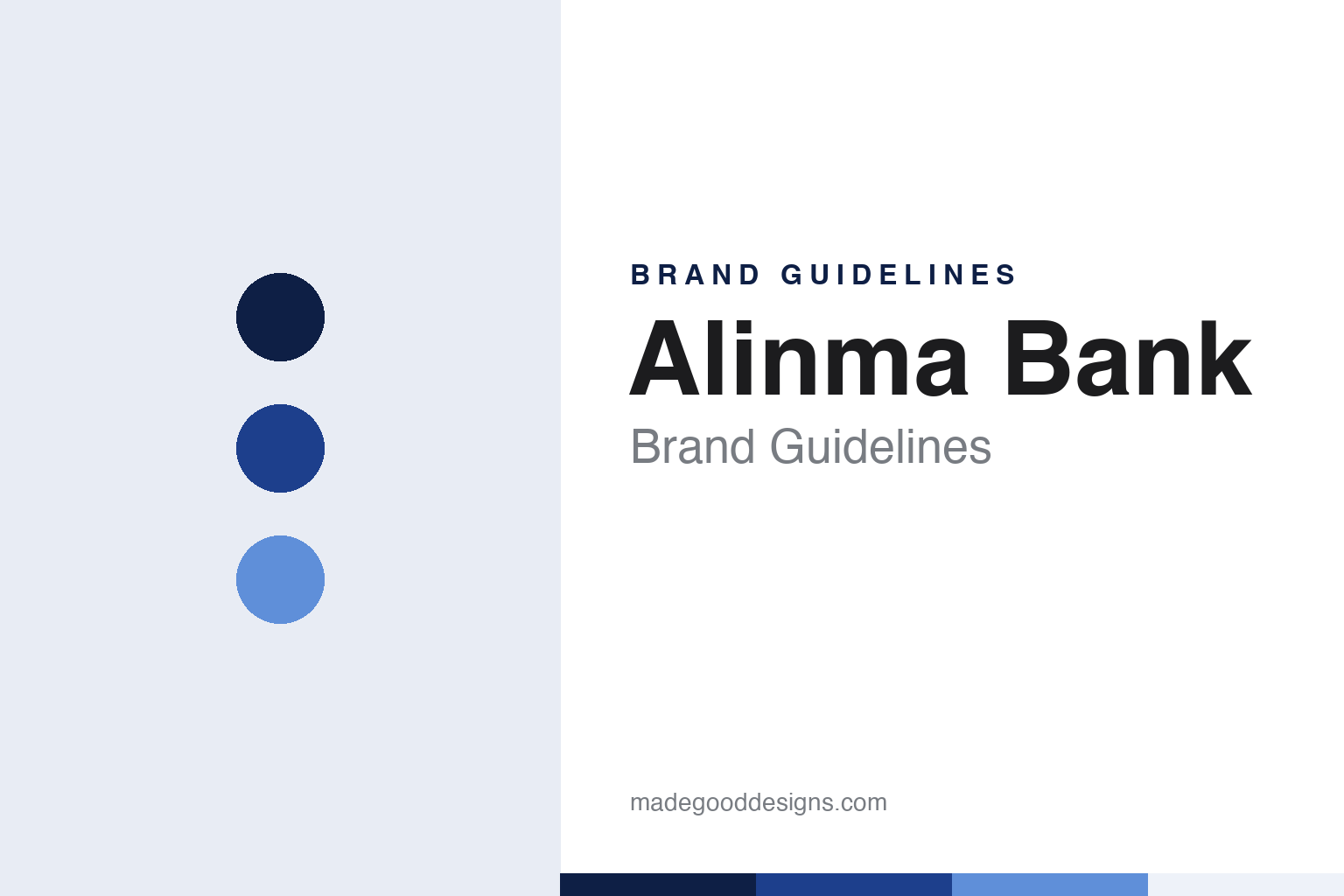
Alinma Bank Brand Guidelines
A 2006 Riyadh bank that grew into a lower-case “alinma.”
Aa
Two constants: an Alinma deep blue palette and a Kufic-inspired sans register. Abstract homage — not an Alinma Bank product or mark; no logo, icon or card design is reproduced.
A decree in 2006
A new bank, built from scratch.
Alinma Bank dates from 2006. English Wikipedia says it was formed as a Saudi joint stock company under a royal decree dated 28 March 2006 and a ministerial resolution dated 27 March 2007, and the bank’s own Annual Report 2025 opens its timeline with the same decree. Its Arabic name, Masraf Al Inma, translates as “growth” or “development,” according to English Wikipedia.
Wikipedia names its founding shareholders as three state bodies — the Public Investment Fund, the Public Pension Agency and the General Organization for Social Insurance — holding 30 per cent between them in equal parts, with the other 70 per cent offered to the public in April 2008. The annual report gives the listing date on the Saudi Exchange as 3 June 2008, and its financial statements date the bank’s commercial registration to 26 May 2008.
The bank built its network over the following years. Its timeline lists the opening of its first stand-alone branch in Riyadh in 2010, and in March 2011 Arab News reported a ceremony in the city marking the start of all of Alinma’s banking services, with 40 branches and 225 cash machines then in operation. The same report said The Banker had given the bank’s 2008 share offer its award for the Middle East that year.
Alinma describes itself as a provider of “Shariah-compliant banking and financial services in Saudi Arabia,” regulated by the Saudi Central Bank. Its head office, Wikipedia says, is in the Al-Anoud Tower on King Fahad Road in Riyadh; in 2023, its annual report says, it signed the construction agreement for a new headquarters, Burj alinma.
Colour
Products, channels and a youth app.
Alinma offers retail, corporate and investment banking under a Shariah committee whose role, publications and decisions it sets out on its website. Wikipedia lists its channels as branches and cash machines, internet and phone banking and the Alinma app; the bank’s financial statements give 127 branches in the Kingdom at the end of 2025, up from 115 a year earlier.
Its own timeline traces a run of digital and service steps: the Ersal remittance service in 2015, an e-learning academy in 2017, the mada Pay service and naming rights for a Riyadh Metro station in 2018, and its first digital branch in 2019, the year it joined the MSCI Emerging Markets index. A separate youth banking experience, iz, has its own app, and the bank reports a business version too.
Its social programme is called amad. The bank’s sustainability pages describe an amad podcast on saving, investing and financial literacy, an amad programme for entrepreneurs offering interest-free loans with a year of mentoring, and an amad hackathon for developers of financial technology.
Subsidiaries listed in the annual report include alinma capital, its investment arm. Alinma also issues sukuk, Islamic certificates; its timeline records a Tier 1 sukuk issue in 2021. The bank’s About page describes a “digital-first banking model” drawing on fintech, data and AI-powered tools, and links the bank to Saudi Vision 2030, the national development plan.
Typography
Design and documentation.
Islamic banks present themselves through a small set of recurring signals. Green, gold and deep blue appear often in their wordmarks and branch signs, and many write their names in two scripts side by side: Arabic, or Jawi in Malaysia, next to Latin letters. Geometric patterns, drawn from the long tradition of Islamic ornament, turn up on cards, reports and branch interiors, usually as a background rather than as a logo.
Their names tend to say what they are. Words such as “Islamic,” “Islam” and “Syariah” sit in the name itself, alongside the country or city, so that the banking model is part of the brand. Product names follow the same logic: accounts and financing are often labelled with the Arabic name of the contract behind them, such as murabaha, a cost-plus sale; ijara, a lease; mudharabah, a profit-sharing arrangement; or wakalah, an agency.
Their websites have a common structure. Alongside the usual pages on savings, cards and home and business financing, most carry a page on the bank’s Sharia supervisory board or council, the panel of scholars that reviews its products, and many add pages on sukuk, the Sharia-compliant certificates used in place of conventional bonds, on takaful, the cooperative form of insurance, and on zakat and charitable giving. Newer banking apps add prayer times and the qibla direction next to transfers and payments.
Annual and sustainability reports are where much of the identity is set out at length, with the Sharia board’s statement printed beside the auditors’ report. This guide follows what dated sources say about each bank — when it was founded, how it was merged, renamed or listed, and how it describes its own products — and treats the palette and type shown here as an unofficial interpretation rather than any bank’s own.
Aa
A Kufic-inspired sans — the register of the 2025 refresh. (Specimen set in Reem Kufi, a Kufic-style STAND-IN from Google Fonts; NOT the alinma typeface or logo.)
alinma
A refresh, not a rebrand.
The current identity dates from 2025. In a case study in its Annual Report 2025, the bank says it introduced a “revitalized brand identity” after research confirmed the strength of its core attributes, which it names as trust, innovation and customer-centricity — and that this “guided a strategic refresh rather than a full rebrand.” The report says the bank had grown since 2009 into one of the country’s most influential financial brands, and that technology and customer expectations had moved on.
It lists four elements. A new tagline, One Step Ahead, “to signal foresight, agility, and leadership in digital banking”; an updated vision and mission; a stand-alone “alinma” name and an enhanced icon “for stronger digital flexibility and recognition”; and “a bold, deep blue palette and custom Kufic-inspired typeface” meant, the bank says, to convey confidence, modernity and cultural authenticity. Kufic is an early, angular style of Arabic script. On its website the bank now writes its name in lower case, as “alinma,” and states its vision as being “the most forward-thinking financial services brand”; its stated mission is to offer fast, convenient and innovative financial services that anticipate customers’ needs. The report also lists an award for the refresh from Global Business Outlook, as the bank’s own claim.
The name has moved beyond banking screens. In 2025, the report says, the bank obtained naming rights to the King Abdullah Sports City Stadium in Jeddah, now alinma Stadium, and it activated a Visa partnership around the Visa Cash App Racing Bulls Formula One team at regional races. Both are sponsorships, as the bank describes them, and both carry the lower-case name.
For a design guide, Alinma Bank shows how a young bank can refresh rather than replace: one colour family, one custom script-inspired typeface and a shorter name. Compare Al Rajhi Bank, another Riyadh Islamic bank, and Bank Albilad, a Riyadh Islamic bank of the same generation. For this guide we use night blue, a Riyadh blue and a light sky blue with a sans, an unofficial interpretation; no product or logo is reproduced.
Explore & save
Keep Alinma Bank’s identity on hand — save it to a board in the Made Good inspiration library.
Alinma Bank identity set
Pin the Alinma deep blue palette and the Kufic-inspired sans register to your own board.