Emirates Islamic Brand Guidelines
The Dubai Islamic bank that began as Middle East Bank.
Aa
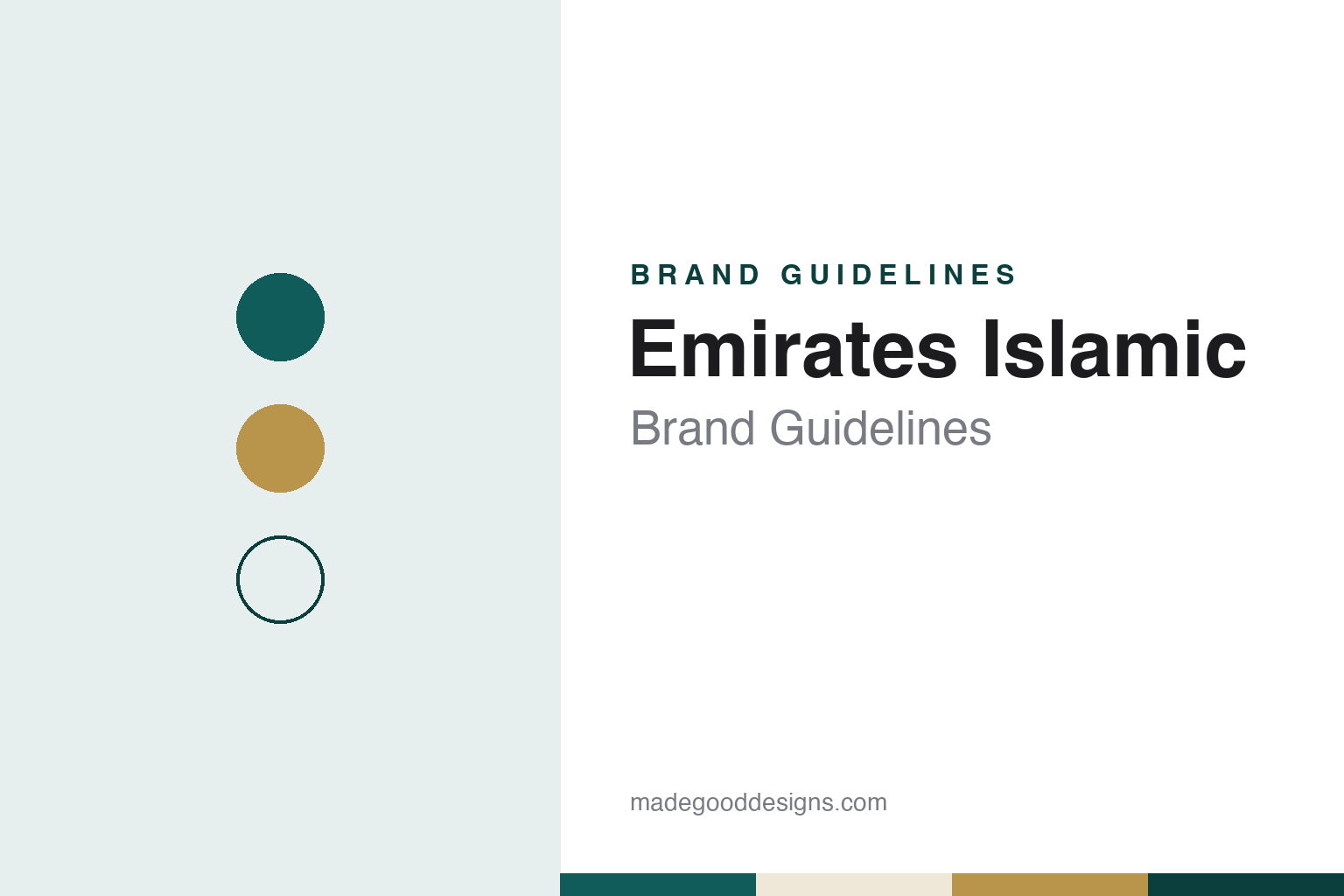
Two constants: a teal, sand and gold palette of our own and a rounded geometric sans register. Abstract homage — not an Emirates Islamic product or mark; no logo, card or signage is reproduced.
Middle East Bank
A 1975 bank, converted in 2004.
Emirates Islamic is the Islamic banking arm of the Emirates NBD group, with its head office in Dubai. Its history is older than its name. In its list of the Middle East’s top 100 listed companies for 2025, Forbes Middle East said the bank, formerly Middle East Bank, was incorporated in 1975 and converted to Islamic banking in 2004. The bank’s own press materials describe it as established in 2004 as Emirates Islamic Bank, and that is still its legal name: Emirates Islamic Bank PJSC.
The two dates describe one institution under two names. The 2004 conversion brought a new name with the word “Islamic” built into it, and the bank now describes its products as Sharia-compliant, grouped into personal, business and corporate banking.
Until 2025 its shares traded on the Dubai Financial Market, even though the bank was already part of the Emirates NBD group. That changed in the first half of 2025. Emirates NBD issued an offer document on 27 February 2025 for the shares it did not already hold, and then used a mandatory acquisition to take the rest, Khaleej Times reported on 9 June 2025. The notice period for that acquisition ended on 7 June, the paper said, with no objections received.
In a statement to the exchange, the bank said it would ask for trading in its shares to be suspended from 10 June 2025, and that all remaining shares would be re-registered in Emirates NBD’s name on or around 13 June, giving the parent 100 per cent ownership. Forbes Middle East, publishing its list the same month, ranked Emirates Islamic 41st among the region’s listed companies and recorded the bank’s announcement that it was delisting after Emirates NBD completed the mandatory acquisition of the remaining shares.
Colour
Personal, business and corporate.
Today Emirates Islamic describes a full range of Sharia-compliant products across personal, business and corporate banking. In a September 2026 release it gave its network as 39 branches and 231 cash and deposit machines across the UAE; Forbes Middle East counted 40 branches as of December 2024, in addition to the Dubai head office.
Much of its recent publicity is about digital channels. The bank says it was the first Islamic bank in the UAE to launch a mobile banking app and to offer Apple Pay, and the first Islamic bank anywhere to offer chat banking through WhatsApp; these are its own claims. Gulf News, reporting the bank’s nine-month results on 21 October 2026, described it as a “Dubai-based Islamic lender” whose growth came across its retail, corporate and small-business operations.
Among its named products is murabaha financing: the bank says it won a “Most Innovative Murabaha” award, alongside Islamic Retail Bank of the Year for the Middle East, at The Banker’s Islamic Banking Awards 2025. In September 2026 it said it had taken six titles at the Euromoney Islamic Finance Awards 2026, among them the Middle East and UAE Islamic bank categories and an award for a sukuk deal.
Sport has become part of the brand. On 20 May 2026 FC Barcelona announced Emirates Islamic as its Official Commercial Banking Partner in the UAE through June 2028. The deal is built around a co-branded Emirates Islamic Barça Cashback Card, with rewards on spending in categories such as sports, fuel, supermarkets and dining, and club benefits such as match tickets and merchandise, the club said. Barcelona said the card was designed for a young fan base.
Typography
Design and documentation.
Islamic banks present themselves through a small set of recurring signals. Green, gold and deep blue appear often in their wordmarks and branch signs, and many write their names in two scripts side by side: Arabic, or Jawi in Malaysia, next to Latin letters. Geometric patterns, drawn from the long tradition of Islamic ornament, turn up on cards, reports and branch interiors, usually as a background rather than as a logo.
Their names tend to say what they are. Words such as “Islamic,” “Islam” and “Syariah” sit in the name itself, alongside the country or city, so that the banking model is part of the brand. Product names follow the same logic: accounts and financing are often labelled with the Arabic name of the contract behind them, such as murabaha, a cost-plus sale; ijara, a lease; mudharabah, a profit-sharing arrangement; or wakalah, an agency.
Their websites have a common structure. Alongside the usual pages on savings, cards and home and business financing, most carry a page on the bank’s Sharia supervisory board or council, the panel of scholars that reviews its products, and many add pages on sukuk, the Sharia-compliant certificates used in place of conventional bonds, on takaful, the cooperative form of insurance, and on zakat and charitable giving. Newer banking apps add prayer times and the qibla direction next to transfers and payments.
Annual and sustainability reports are where much of the identity is set out at length, with the Sharia board’s statement printed beside the auditors’ report. This guide follows what dated sources say about each bank — when it was founded, how it was merged, renamed or listed, and how it describes its own products — and treats the palette and type shown here as an unofficial interpretation rather than any bank’s own.
Aa
A rounded geometric sans — our register, not the bank’s. (Specimen set in Readex Pro, a sans STAND-IN; NOT the Emirates Islamic logo.)
Emirates Islamic
An Islamic bank inside a larger group.
The identity question for Emirates Islamic is how to sit inside a group while keeping a name of its own. Its parent is covered in our Emirates NBD guide, yet the Islamic arm trades under its own name rather than its parent’s, and puts that name on its products, as the Barça card shows.
The name itself records the 2004 change. Middle East Bank was a regional, descriptive name; Emirates Islamic says where the bank is and what kind of bank it is, in two words. Dubai has other Islamic banks with place names of their own, among them Dubai Islamic Bank.
Since June 2025 the bank has had no public shareholders of its own. Its results are still reported — Gulf News covered its nine-month figures in October 2026 — but its share register belongs to Emirates NBD alone. Customers meet the bank through its name, its branches and its cards, such as the Barça card launched in 2026. In the same October 2026 report, the bank’s chairman told Gulf News that its priorities would help it contribute to the development of Islamic finance under the UAE Islamic Finance and Halal Industry Strategy 2025–2031.
For a design guide, Emirates Islamic shows how a subsidiary can keep a distinct name and register inside a larger banking group. Compare Emirates NBD, its parent, and Dubai Islamic Bank, another Islamic bank in Dubai. For this guide we use a deep teal, a dune sand and a muted gold with a sans, an unofficial interpretation; no product or logo is reproduced.
Explore & save
Keep Emirates Islamic’s identity on hand — save it to a board in the Made Good inspiration library.
Emirates Islamic identity set
Pin the teal, sand and gold palette and the rounded geometric sans register to your own board.